TL;DR
- Sexual trauma is more common than we often acknowledge, and it does not always look the way we expect. What matters is the impact it leaves behind, not how it compares to someone else’s experience.
- Trauma is not just something that is remembered. It is held in the body and nervous system, which is why reactions like anxiety, numbness, or triggers can feel immediate and physical.
- There is no single “right way” to respond to trauma. Reactions like freeze, shutdown, or going along with something are survival responses, not choices, and they do not make the experience any less valid.
- Healing is not linear. It often feels confusing because different parts of you may want different things, and avoidance can sometimes be a form of protection.
- Before processing trauma, a sense of safety needs to be built, both externally and within the body. This creates the foundation that makes deeper healing possible.
- Regulating the nervous system is a key part of recovery. Small, body-based practices and safe relationships can help create more stability over time.
- Trauma can be processed in different ways, but all effective approaches prioritise safety, pacing, and not overwhelming the system. Healing does not require reliving the trauma in full intensity.
- Resilience is not about going back to who you were before. It is about slowly building more capacity, more choice, and a more compassionate relationship with yourself as you move forward.
Introduction
Something has been shifting in recent years. Conversations that once stayed hidden are slowly finding their way into the open. Movements like #MeToo were not just moments on the internet. They made space for people to speak about experiences that had long been buried under fear, shame, societal conditioning, or the sense that no one would listen, especially in India. For many, it was the first time they could say, in their own words, that something had happened to them—and crucially, that it was not their fault.
As more voices came forward, a difficult truth became harder to ignore. Sexual trauma is not rare. It is far more common than most of us are taught to believe. It exists across age, gender, culture, and background. It also does not always look the way we expect it to. Many experiences fall outside the narrow, often violent, definitions we are used to hearing, such as experiences involving coercion, manipulation, or freeze response, and because of that, they often go unrecognised. At its core, sexual trauma involves a violation of sexual boundaries without freely given consent, along with the impact that follows. That impact is not always immediate or obvious. For some, it might be intense and for others, it might show up slowly, in ways that feel confusing, subtle, or difficult to name. Both are real. Both matter.
For a long time, people who go through sexual trauma have had to carry more than the experience itself. They have also had to navigate stigma, disbelief, and systems that do not always know how to respond. Social attitudes are blaming and questioning in nature. Medical and psychological frameworks historically pathologized survivors rather than understanding their reactions as normal responses to abnormal events. Cultural silence and institutional betrayal can make it even harder to speak. Many people are left trying to make sense of what they feel on their own, wondering why it affects them the way it does, or whether it even 'counts'.
At the same time, there is a growing understanding that healing is not simple or one-dimensional. Sexual trauma reconfigures the nervous system, impacting the mind, the body, relationships, and a person’s sense of safety in the world. It is not just a memory of the past, but a lived experience in the present body.
What Counts as Sexual Trauma
When people hear the term sexual trauma, they often think of extreme or visibly violent situations. Because of this, many experiences that do not match that image get dismissed or minimised. Sometimes this dismissal comes from others. Very often, it comes from within. It is common for someone to question their own experience. They may wonder if it was serious enough, or if they are overreacting. These doubts are not random. They are shaped by societal myths around sexual violence, rigid legal frameworks, and the way we learn to think about consent, harm, and whose experiences are considered valid.
Sexual trauma is not defined only by how intense an event appears from the outside. It is defined by how it is experienced and what impact it leaves behind. At its core, it includes any sexual experience where consent was not freely given, not informed, or not respected. This can involve pressure, coercion, manipulation, or situations where saying no did not feel possible. It also includes experiences where a person froze, shut down, fawned (appeased the aggressor to stay safe), or went along with something they did not want. These responses can be especially confusing later. It may not feel like a clear refusal, and that can lead to self-doubt. But these are not conscious choices made freely. They are automatic survival responses shaped by the nervous system in moments of perceived threat.
It is also important to recognise that sexual trauma is not limited to women. Men and boys experience sexual abuse and assault more often than is openly acknowledged, especially in childhood. Many of these experiences remain unspoken due to stigma, shame, and patriarchal expectations around masculinity and strength. Furthermore, physiological responses during an assault can be deeply confusing for men, leading to a profound crisis of identity. When men do try to make sense of what happened, they may struggle to name it, particularly if their reactions do not match common narratives. This can deepen the sense of isolation. If something feels violating, overwhelming, or continues to affect your sense of safety, your body, or your relationships, it deserves attention. Trauma is not a fixed category with clear edges. It is a lived experience, and it is valid even when it is difficult to define.
How Sexual Trauma Affects the Brain and the Body
Sexual trauma is something that is experienced in the body, often long after the experience itself has passed. When a person encounters a threat, the nervous system responds automatically, shifting into survival mode. Some of these responses are more familiar, like fight or flight. Others are less often talked about, but just as important. Freezing can feel like being unable to move, speak, or react. Fawn can look like going along with something in order to reduce harm or keep the situation from escalating. These are not deliberate decisions. They are protective responses that happen outside conscious control, driven by the survival-oriented parts of the brain before the thinking mind can even process what is happening.
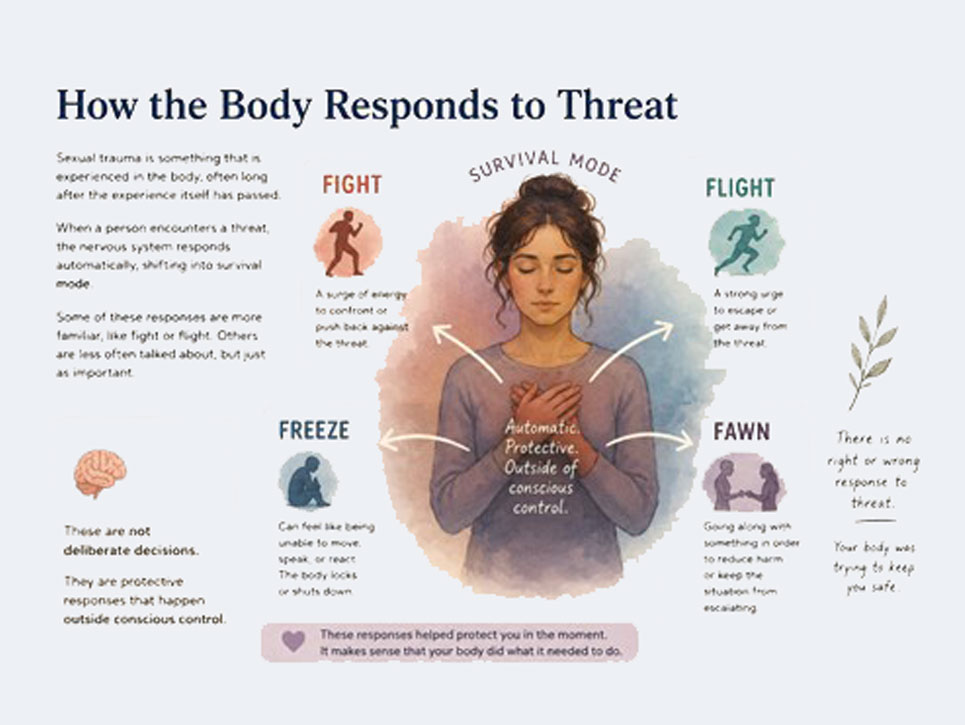
In many situations involving sexual trauma, freeze and shutdown are especially common. This can become a source of confusion later on. People may find themselves asking why they did not resist, leave, or do something different. What is often missing from that question is an understanding of how the body works under threat. Sometimes immobility or compliance is the body’s way of increasing the chances of getting through the situation safely. When the brain perceives that fighting or fleeing will cause more harm, it automatically deploys these containment strategies. Recognising this can begin to ease some of the self-blame that often follows.
Trauma also changes how memory is stored. Not all experiences are held as clear, detailed stories. Some are stored in a more implicit way, showing up as somatic flashbacks, isolated sensations, emotions, or body reactions without a clear narrative attached. During trauma, the stress hormone cortisol temporarily impairs the hippocampus (the brain's timekeeper), preventing the experience from being filed away as a 'past' event. This is why a person might suddenly feel fear, discomfort, or numbness without fully knowing why. Other memories may exist in a more explicit form, with a clearer sense of what happened.
This also helps explain why triggers can feel so immediate. A sound, a smell, a tone of voice, or even a subtle shift in someone’s behaviour can activate the nervous system before the thinking mind has time to catch up. The body responds as if the threat is present again, even when the person rationally knows they are safe. This narrows a person's 'window of tolerance,' meaning their nervous system gets easily pushed into hyper-arousal (panic, anxiety) or hypo-arousal (numbness, dissociation). These reactions are not malfunctions, but they can feel confusing or frustrating, especially when they seem out of proportion to the situation. These reactions are signs of a nervous system that learned, at some point, how to protect in the face of danger, and is still trying to do that job.
Common Aftereffects Survivors May Experience
The impact of sexual trauma does not end with the event itself. It often continues to shape different areas of a person’s life, sometimes in ways that feel confusing or difficult to trace back to what happened. These effects are not always immediate or obvious. They can unfold gradually, showing up in emotional, physical, sexual, and relational patterns over time.
Emotionally, many survivors live with a sense of unease that is hard to fully explain. This can include hypervigilance, anxiety, shame, numbness, or sudden shifts in mood. There may be a persistent feeling of being on edge, as if something is about to go wrong, even in situations that are objectively safe. Some people find themselves reliving parts of the experience through intrusive thoughts, flashbacks, or emotional distress triggered by seemingly unrelated events. Others feel a kind of emotional distance or dissociation, as though their feelings are muted or out of reach. Over time, these patterns can deepen into experiences such as post-traumatic stress, depression, or difficulty regulating intense emotions, leaving survivors feeling disconnected from their own sense of self.
The body often carries its own version of the story. Trauma can show up physically in ways that are not always immediately recognised. This might look like chronic tension, fatigue, headaches, digestive issues, unexplained chronic pain, or a general sense of discomfort in one’s own body. The nervous system may remain stuck in a chronic pattern of hyper-arousal (fight/flight) or hypo-arousal (freeze/shutdown), affecting sleep, energy, and overall health. These responses are not separate from the trauma. They are part of how the body continues to hold and process what it has been through.
Sexuality can also be deeply affected. Many survivors notice changes in desire, arousal, or their overall sense of comfort with intimacy. For some, this shows up as avoidance, fear, or difficulty experiencing pleasure. For others, it may look like engaging in sexual activity in ways that feel disconnected, automatic, or hyper-sexualized as a way to reclaim control or re-enact the trauma.. These responses are often linked to how the body has learned to associate intimacy with threat, discomfort, or a loss of control, making it difficult for the body to distinguish between safe vulnerability and actual danger
Relationships can feel different as well. Sexual trauma can shape how safe it feels to trust, to be close, or to depend on someone, often disrupting a person's attachment style. There may be a tendency to withdraw, to keep distance, or conversely, an intense fear of abandonment that leads to clinging to unsafe dynamics. In close relationships, especially romantic ones, this can create tension around intimacy, communication, and emotional needs. Partners may not always understand what is happening, and survivors may feel unseen or alone in their experience. At the same time, relationships can also become a space for healing. When there is safety, patience, and understanding, connection with others can help rebuild a sense of trust and stability. Healing does not happen in isolation. It often unfolds, at least in part, through safe and supportive connection.
Childhood vs Adult Sexual Trauma
Sexual trauma does not affect everyone in the same way, and one of the factors that shapes its impact is when it happens. Trauma, especially sexual trauma, experienced in childhood often leaves a different kind of imprint than in adulthood. This is not about comparing which is worse. It is about understanding how timing influences the way an experience is processed, remembered, and carried forward.
When sexual trauma happens in childhood, it occurs at a time when the brain, body, and sense of self are still forming. A child does not yet have the capacity to fully understand or make sense of what is happening. There is no stable framework to place the experience into. Because of this, the impact often becomes deeply woven into the child’s developmental baseline, shaping how they come to see themselves and the world around them. In psychology, we call these 'core schemas', deeply ingrained blueprints. Feelings of unsafety, helplessness, or even responsibility can take root early, not as conscious beliefs at first, but as underlying relational and somatic patterns.
This can also affect how relationships are experienced later in life. Early trauma can shape attachment dynamics, frequently leading to developmental trauma responses like chronic hypervigilance in relationships, making it harder to recognise what safety feels like or to trust one’s own boundaries. In many cases, due to the child's developing brain, the memory of what happened is not held as a clear story. Instead, it may exist in fragments, sensations, or emotional states that are difficult to fully explain.
When sexual trauma happens in adulthood, the experience often lands differently. By that point, a person usually has some sense of identity, boundaries, and expectations of trust. The trauma can disrupt that sense of stability, causing what psychologists call a 'shattering of assumptions' about fairness, safety, and predictability in the world. This creates a sharp rupture between the 'before' and 'after' selves. While there may be a clearer, more chronological memory of the event, along with a stronger awareness of what was violated, the secondary struggle often involves deep grief for the life and identity that existed prior to the trauma. Even then, the impact can be deep and far-reaching. But in some cases, there is an existing framework that can help with making sense of the experience, especially if the person has access to support, language, or safe relationships.
It is important to note that these are broad patterns, not fixed categories. Many people carry experiences from different stages of life, and responses can vary widely from person to person. What matters most is not where an experience fits on a timeline, but how it has shaped your inner world, your body, and your way of relating to others. Because healing looks different depending on when the seeds of trauma were planted, a specialized, trauma-informed approach is essential. At Coach for Mind, our experts take these differences into account, working with your individual experience in a way that feels supportive, safe, and tailored to you.
Safety and Stability: First Step Toward Healing
Before trauma can be meaningfully processed, there needs to be some sense of safety to return to. This safety is not only about what is happening in the external environment, although that is an important part of it. It also has to do with how safe a person feels within their own body and mind. For many survivors of sexual trauma, that internal sense of safety has been disrupted. The body can feel unpredictable, overwhelming, or even like a place that is difficult to be in. Because of this, effective trauma therapy follows a phase-oriented approach. Before we can reprocess the past, the absolute priority in the first phase of healing is about building enough stability to be able to stay present in the current moment.
For many people, this process begins within a therapeutic relationship, utilizing the power of co-regulation. The therapist's consistency, attunement, and the absence of judgment can create a corrective emotional experience that may not have been available before. Being listened to, believed, and not pushed beyond one’s capacity can slowly begin to shift something internally. Over time, this kind of external safety can start to translate into an internal one. The nervous system begins to learn that it does not need to remain in constant survival mode. There is gradually more space to notice thoughts, emotions, and bodily sensations without immediately shutting down or becoming overwhelmed by them.
This growing sense of safety is what makes trauma processing possible later on. Without it, going back to traumatic material can feel less like remembering and more like reliving. The body may respond as if the threat is still present, leading to overwhelm, dissociation, or a sense of being flooded, a state known as re-traumatization. This is why moving too quickly into unveiling the trauma can be counterproductive. Focusing on safety first is not avoidance or a delay in treatment; it is an active clinical strategy that allows deeper work to happen without causing further harm.
Building safety often happens in small and steady ways. It can involve learning how to regulate the nervous system, creating routines that feel predictable, setting and holding boundaries, and slowly increasing tolerance for difficult internal experiences. These steps may not seem directly connected to the trauma itself, but they lay the groundwork for everything that follows. As the body begins to feel even slightly safer, there is more room for choice, more control, and less fear of being overtaken by the experience.
Trauma Processing: Second Step Toward Healing
There are many ways to process and heal from sexual trauma, and no single approach works for everyone. The clinician draws on their clinical judgement to understand which approach is most suited to the person in front of them, taking into account their needs, history, and current capacity. However, working within a trauma-informed framework is essential when it comes to healing from sexual trauma. Trauma-informed work prioritises safety, consent, and the pace of the person moving through it. Processing is not about pushing into the most painful memories as quickly as possible. It is about moving in a way that keeps the nervous system firmly within its window of tolerance. You can click here to read further about what it means to expand one’s window of tolerance.
Two ideas are especially important here. The first is titration, which means approaching traumatic material in small, manageable chunks rather than all at once. The second is pacing, which means going at a speed that does not overwhelm the body or mind. Together, these create the conditions where healing can happen without causing further harm. Across different approaches, the goal relies on cultivating dual-awareness, the ability to stay safely anchored in the present moment while gently observing a memory from the past. This helps the brain and body process traumatic memories so they no longer feel like they are happening in the present.
One well-known approach is Eye Movement Desensitization and Reprocessing (EMDR). This method works by helping the brain reprocess distressing memories so that they lose their emotional intensity. During EMDR, a person briefly brings an aspect of a memory to mind while engaging in formally guided bilateral stimulation (BLS), such as eye movements, audio tones, or tapping. This dual-attention stimulus mimics the brain's natural processing mechanisms, similar to what occurs during REM sleep, allowing the memory to shift from something raw and overwhelming into something more integrated in long-term storage. The memory does not disappear, but over time it often feels less charged. Many people describe it as becoming more distant, as if it clearly belongs to the past. You can continue reading about how EMDR can be used in trauma therapy here.
Somatic Experiencing (SE) takes a different route by focusing on the body. Instead of working primarily through thoughts or detailed recall, it pays attention to physical sensations and nervous system responses. A therapist might guide someone to notice subtle changes in tension, breathing, or temperature, and to stay with these sensations in a supported way. The aim is not to relive the trauma, but to allow the body to complete defensive survival responses that were interrupted at the time, such as pushing away, fleeing, or coming out of a frozen state. In doing this gradually, the nervous system begins to release stored survival energy through subtle physical shifts like trembling, deep breaths, or temperature changes - a process known as somatic discharge, allowing the system to settle into a greater sense of safety.
Trauma-Focused Cognitive Behavioral Therapy (TF-CBT) works more directly with thoughts, emotions, and behaviours. It helps people identify maladaptive core beliefs and cognitive distortions that may have developed after the trauma, such as self-blame, guilt, or a constant expectation of danger. These beliefs are explored, re-framed, and challenged in a gentle manner, while also building practical coping skills. TF-CBT may include gradual exposure to trauma-related memories, but this is done carefully and with support. Over time, the brain learns that remembering is not the same as being in danger, which can reduce avoidance and emotional reactivity.
Narrative Exposure Therapy (NET) focuses on helping a person make sense of their experiences within the larger story of their life. Trauma can disrupt memory, leaving it fragmented or difficult to piece together. This approach supports individuals in telling their life story in a structured, chronological way, weaving the trauma contextually into their narrative line. As the story becomes more coherent, the memory often feels less intrusive and more contained. It begins to take its place as something that happened, rather than something that keeps happening.
Internal Family Systems (IFS) approaches trauma by recognising that different parts of us hold different experiences. After sexual trauma, there may be parts that carry pain, fear, or shame, alongside parts that try to protect by avoiding, numbing, or staying in control. This approach does not force direct confrontation. Instead, it focuses on building a relationship with these parts through curiosity and compassion. As trust develops, the parts that hold trauma can begin to share what they carry in a way that feels safer. This allows processing to happen without overwhelming the system, while also strengthening a sense of internal stability.
Across all of these approaches, the aim is not to erase what happened. It is to change how it is held. Healing does not require reliving the trauma at full intensity. In fact, effective processing works because it avoids that. By staying within a manageable range and moving gradually, the brain and body can begin to recognise that the danger is no longer present. Over time, this is what allows the past to feel like the past, instead of something that continues to shape every moment. You can book a free discovery call by clicking here, and our experts will work with you in a way that feels safe, paced, and aligned with your needs.
Resilience Building: Final Step Toward Healing
Resilience, in the context of sexual trauma, is often misunderstood. It is not about “bouncing back” or returning to who you were before the trauma. That expectation can feel unrealistic and unfair. Healing does not erase what happened, and it does not ask you to go back to an earlier version of yourself. Instead, resilience is about how your relationship with yourself, your body, and your relationships begins to shift over time.
In this sense, resilience is less about strength in the traditional sense, and more about automatic capacity. It can look like having more choice in how you respond. Where there may once have been automatic, survival-driven reactions such as shutdown, panic, or avoidance, there is now a little more space to pause. This pause represents the nervous system's shifting ability to access states of safety and connection even after experiencing threat. That pause, even if brief, creates the possibility of responding differently. Difficult emotional or physical states may still arise, but they do not hold the same intensity or last in the same way. There is a growing ability to move through them, rather than feeling completely taken over.
Resilience also shows up in how meaning is made. Many survivors carry deep layers of self-blame, shame, or confusion about what happened. Over time, these narratives can begin to soften. There may be a gradual shift toward understanding the experience without turning it inward as fault. This does not happen all at once. It unfolds slowly, often alongside the development of a more compassionate and steady relationship with oneself.
In relationships, resilience can take the form of rebuilding trust in small, meaningful ways. It might look like recognising what feels safe, communicating boundaries more clearly, or allowing closeness at a pace that feels manageable. For some, it includes engaging in intimacy or sexual connection with a greater sense of choice, comfort, and control. These shifts may feel subtle, but they reflect deeper changes in how safety and connection are experienced.
Resilience is not a fixed state that is reached and then maintained without effort. It is an ongoing, non-linear process. There may still be moments of difficulty, triggers, or a return to old patterns, especially during times of stress. What changes is the ability to come back, to reorient, and to find steadiness again.
Over time, resilience becomes less about surviving what happened, and more about reclaiming a sense of agency in the present. It allows life to expand beyond the trauma, without denying its impact. It is built gradually, through small shifts, repeated over time, grounded in choice, awareness, and the growing possibility of feeling safe again.
Understanding and Regulating the Nervous System to Build Resilience
A central part of healing from sexual trauma involves learning how to work with the nervous system, rather than feeling controlled by it. After trauma, the nervous system often becomes hyper-vigilant, altering a process called neuroception, the body's subconscious scanning for cues of safety and danger. It may shift quickly into states of anxiety, shutdown, or overwhelm, sometimes without a clear or immediate conscious reason. This can make everyday experiences feel unpredictable or hard to manage.
One way to understand this is through the idea of a “window of tolerance.” This refers to the range within which a person can stay present, think clearly, and feel grounded while experiencing emotions. When someone is within this window, they are able to respond to situations with a sense of balance. When a trauma response narrows this window, the sympathetic nervous system easily triggers hyperarousal (anxiety, panic, or restlessness), or the parasympathetic system forces a drop into hypoarousal (numbness, disconnection, or fatigue).
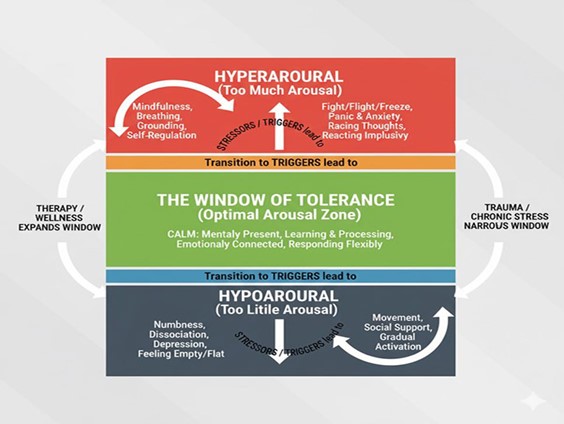
Regulation is not about forcing the body to be calm at all times. It is about gradually expanding this window, so that different emotional and physical states can be experienced without becoming overwhelming. This process takes time, and it often begins with small, manageable practices that help the body feel a sense of stability. Many of these practices are “bottom-up,” meaning they work directly through somatic sensation to calm the brain stem, rather than relying on cognitive thought alone. This can include gentle breathing exercises that lengthen the exhalation, grounding through the senses, slow and intentional movement, or noticing contact with the surrounding environment, such as feeling your feet on the ground or your back against a chair. These approaches can help signal to the nervous system that, in this moment, there is no immediate danger.
Regulation also does not have to happen alone. For many people, co-regulation plays an important role. This means that the presence of another safe, attuned person can help the nervous system settle. This might happen in therapy, but it can also occur in supportive relationships where there is patience, consistency, and emotional safety. It is important that these tools are approached gently. Trying to do too much, too quickly, can sometimes feel overwhelming in itself. What matters is finding what feels manageable and slowly building from there. Over time, these small shifts can begin to create a greater sense of steadiness, making it easier to stay connected to the present without being pulled into past patterns of survival.
Frequently Asked Questions
It is very common to feel unsure or conflicted about your experience, especially if it did not fit what is typically shown or talked about, and many people question themselves before they are able to name what happened. From a clinical perspective, trauma is defined less by the event itself and more by how it is experienced and stored in the nervous system, which means experiences where consent was unclear, pressured, or absent can still have a significant psychological impact. Survivors often minimize their experiences due to social conditioning, internalised beliefs, or lack of validation, and this uncertainty is frequently part of the trauma response itself rather than a sign that the experience was insignificant.
Therapists at Coach for Mind can help you explore your experience in a safe, non-judgmental space. The focus remains on helping you make sense of your feelings at your own pace without pressure to label or define anything before you are ready.
If you are noticing changes in your emotions, body, or relationships, you are not alone, and these experiences are more common than people often realise. Sexual trauma can show up through anxiety, hypervigilance, shame, numbness, intrusive thoughts, or difficulty trusting others. Some people also experience physical symptoms like fatigue, tension, or sleep disturbances, along with changes in sexual desire or comfort with intimacy. These responses are connected to how the nervous system processes and stores trauma over time.
At Coach for Mind, therapists help you understand these patterns without judgment, as work with you to build stability and clarity at a pace that feels manageable.
It can feel confusing when your reactions seem stronger than the situation, but there is a biological reason for this. Sexual trauma activates survival responses like fight, flight, freeze, or fawn, which can become ingrained over time. The brain may store trauma in implicit ways, meaning it shows up as sensations or emotions rather than clear memories, which is why triggers can feel immediate and physical. The nervous system may remain in a state of heightened alertness or shutdown even after the danger has passed.
At Coach for Mind, we use trauma-informed approaches to help regulate these responses, and therapists here guide you in working with your nervous system in a safe and gradual way.
Yes, and it can be unsettling when reactions appear long after the event, but this is a recognised pattern in trauma. Sometimes the nervous system suppresses or delays processing when the experience first occurs, especially if there was no support or safety at the time. Later in life, certain triggers, life changes, or relationships can activate unresolved trauma responses. This does not mean the trauma is new, but that the body is now attempting to process what was previously held back.
Experts at Coach for Mind can help you understand these delayed responses, the focus is on gently working through them without overwhelm.
Many people struggle with this question, but freezing is a very common and automatic response to threat. The nervous system may shift into a freeze state when fight or flight is not possible or safe, leading to immobility or shutdown. This response is not a conscious choice but a protective mechanism aimed at survival. It can also include going along with the situation to reduce harm.
Therapists at Coach for Mind help you understand these responses without self-blame. We work with you to reframe these reactions as survival strategies rather than personal failures.
It is common to wonder whether your experience is “serious enough” to seek help, but needing support is not based on comparison. If your experience continues to affect your emotions, body, relationships, or sense of safety, it is worth paying attention to. Trauma can show up in subtle ways, and therapy can help make sense of patterns that feel confusing or overwhelming. Early support can also prevent symptoms from becoming more deeply ingrained over time.
At Coach for Mind, experts provide a safe space to explore your concerns, and help you decide what kind of support feels right for you.
It is important to feel safe and respected in any healing process, especially when working with trauma. A trauma-informed approach prioritises safety, consent, pacing, and the individual’s sense of control throughout therapy. It recognises the impact of trauma on the nervous system and avoids overwhelming the person by moving too quickly. This approach focuses on stabilisation before deeper processing and adapts to each person’s capacity.
At Coach for Mind, therapists consistently use trauma-informed methods, ensuring that your pace and comfort remain central to the process.
If relationships feel more difficult after trauma, you are not alone in this experience. Sexual trauma can impact trust, boundaries, communication, and comfort with closeness. Some people may avoid intimacy, while others may feel disconnected or unsafe during it. These patterns are often linked to how the body associates closeness with threat or vulnerability.
Experts at Coach for Mind help you understand these relational patterns, while we support you in rebuilding trust and connection at your own pace.
Healing can look different for each person, and it does not always mean erasing the past. Clinically, healing involves integrating the experience so that it no longer feels like an ongoing threat in the present. Over time, triggers may reduce in intensity, and there is more capacity to stay grounded and connected. The goal is not to forget, but to change how the memory is held in the mind and body.
At Coach for Mind, therapists focus on helping you build this sense of integration. We guide you toward a more stable and empowered relationship with your experience.
Feeling disconnected from your body can be confusing, but it is a common response to trauma. Dissociation is a protective mechanism where the mind creates distance from overwhelming sensations or emotions. Over time, this can lead to a sense of numbness or lack of connection with physical experiences. While it may feel unsettling, it originally developed as a way to cope with distress.
At Coach for Mind, therapists gently work on reconnecting you with your body, and we use safe, gradual approaches to rebuild that connection.
It is natural to want a clear timeline, but healing from trauma does not follow a fixed schedule. The process depends on factors like the nature of the experience, available support, and individual capacity. Recovery is often non-linear, with periods of progress and difficulty. What matters more than speed is moving at a pace that feels safe and sustainable.
Experts at Coach for Mind help you navigate this process with patience as we focus on steady, long-term healing rather than quick fixes.