TL;DR
- Recovery from burnout is not a willpower problem; it is an architecture problem: The things that will genuinely help are mostly structural, not motivational. You do not need to try harder. You need to change what you are building your days around.
- There are things you can do right now, without waiting for your organisation to change: Protecting sleep, restoring genuine recovery time, reducing the chronic low-level engagement that AI tools have made habitual, and rebuilding the emotional honesty that silent burnout requires you to suppress.
- Self-help has a real ceiling, and knowing where that ceiling is matters: Breathwork, exercise, sleep hygiene, and journalling are genuinely useful. They are also insufficient for many burnout presentations, particularly when the burnout is longstanding, when it has produced clinical levels of anxiety or depression, or when the patterns driving it trace back further than the current job.
- Therapy for burnout is not talking about your feelings for 50 minutes: It is a clinical process with specific tools, nervous system regulation, cognitive restructuring, schema work, and somatic approaches that address the presentation at the level where it is actually occurring, not just at the level where it is most visible.
- The most important thing therapy gives you is accurate self-knowledge: Understanding why you burn out, not just that you do. Understanding perfectionism, the inability to ask for help, and the identity investment in performance that made you specifically vulnerable. That understanding is what prevents the next cycle.
- In the Indian corporate context, therapy is not a weakness: It is the most efficient use of the analytical capacity you already bring to every other problem in your professional life. You deserve the same quality of diagnosis and intervention for this problem that you would expect for any other.
Introduction: You Already Know Something Is Wrong
You have probably been managing it for a while. You have tried the gym phase, the early mornings, the productivity system, and the weekend digital detox that lasted most of Saturday. You have told yourself that things will settle down after this project, this quarter, this restructure. You have read the articles about work-life balance, agreed with all of them, and changed almost nothing.
The gap between knowing and changing is not a character failing. It is a specific feature of burnout's neurological profile. The chronic stress that produces burnout also depletes the prefrontal cortical resources required for behavioural change. The person most in need of the change is physiologically least resourced to execute it. This is not an excuse. It is a clinical fact worth knowing because it tells you that the path forward is not more effort applied to the same approach. It is a different approach.
This article is the practical companion to understanding what burnout is. It is about what you can actually do, with specificity and clinical grounding, and without the vague reassurance of generic wellness advice. It covers what is genuinely within your control to change right now, where the realistic limits of self-directed recovery are, and what therapy for burnout specifically involves in practice.
Part One: What You Can Do Right Now?
- Audit Your Recovery, Not Your Productivity
The first structural change that genuinely matters is shifting your audit lens from output to recovery. Most professionals who are burning out have a sophisticated system for tracking what they produce, but no system for tracking whether they are recovering from producing it.
Recovery is not the absence of work. It is the presence of experiences that restore the nervous system's regulatory capacity, like genuine rest, physical activity, social connection that is not instrumentalised as networking, and leisure that is not colonised by what the 2026 Workplace Mental Health Report calls 'work snacks': the habitual, conversational AI queries and message checks that fill what used to be the natural pauses in a working day.
The audit question is simple and uncomfortable: In the past week, how many hours did you spend in genuine recovery, doing something that was genuinely restorative rather than merely less effortful than work? For most professionals experiencing silent burnout, the honest answer is close to zero. The recovery infrastructure has been quietly dismantled, usually without a single deliberate decision, through the gradual colonisation of evenings, weekends, and commutes by devices and obligations.
Practical starting point: For one week, track not what you produced but what genuinely restored you and how long it lasted. The data will tell you more about your current risk level than any well-being survey.
- Protect Sleep as a Clinical Priority
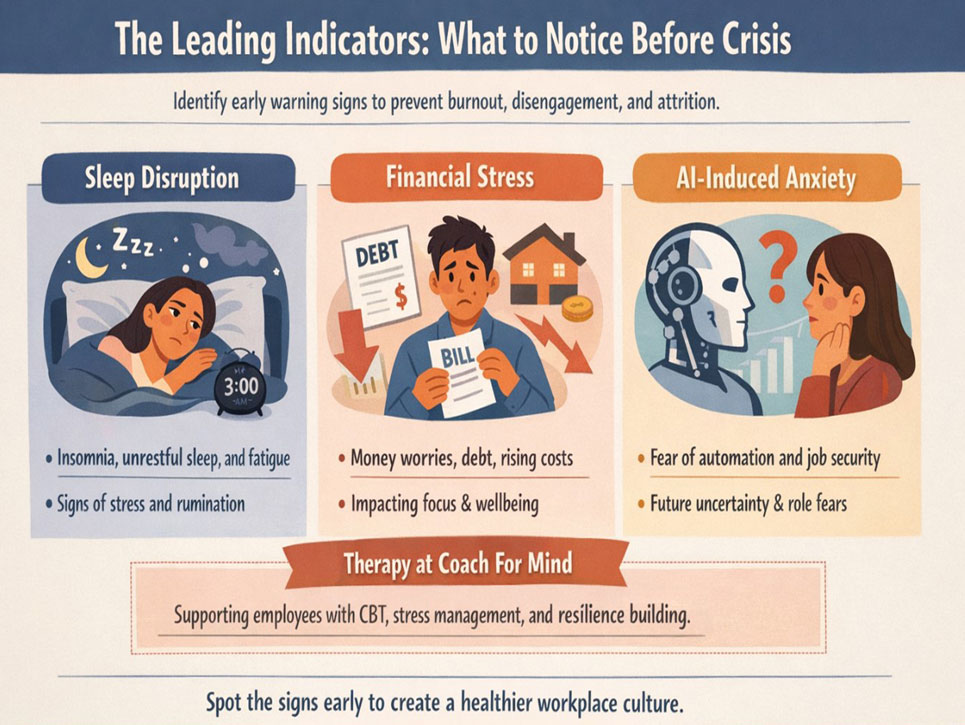
The 2026 data identifies sleep disruption as the leading indicator of burnout, cited by 36% of employees as their primary challenge, with a 15-point perception gap from HR leaders, who do not register it as a priority concern. This underregistration is the problem. Sleep is not a lifestyle preference. It is the primary mechanism through which the nervous system clears the metabolic waste products of a day's cognitive labour, restores the prefrontal regulatory capacity that emotional regulation and clear thinking require, and recalibrates the HPA axis that chronic stress dysregulates.
The specific sleep protection behaviours with the strongest evidence base are unglamorous and consistent: a fixed wake time regardless of when you fell asleep, which stabilises the circadian cortisol rhythm; screen elimination for 30–45 minutes before sleep, which prevents the blue-spectrum light suppression of melatonin; and the removal of work-related content (email, Slack, work notifications of any kind) from the pre-sleep environment entirely.
The last point matters more than it sounds. The professional who checks their phone at 10:30 pm has not done ten minutes of work. They have activated the anticipatory cognitive processing that prevents the transition from waking to sleep. The nervous system cannot move into the restorative sleep stages that matter if it is processing work-related threat signals. The inbox will be there at 7 am. The sleep cannot be retrieved.
Clinical note: If your sleep disruption has been present for more than four weeks and is not responding to standard sleep hygiene measures, this is a clinical presentation rather than a lifestyle problem. It warrants a clinical assessment, not more sleep hygiene advice.
- Deliberately End the 'Work Snack' Habit
The 2026 report describes a phenomenon specific to the AI era: the gradual colonisation of recovery time by tasks that feel conversational rather than effortful because they involve prompting an AI tool. A query during lunch. A quick output check on the commute home. An evening prompt that takes three minutes and feels nothing like work.
Over time, these micro-engagements eliminate the genuine pauses that the nervous system requires to reset between periods of cognitive demand. The working day develops into a state of continuous low-level engagement that is more cognitively depleting than an equivalent number of focused hours with genuine breaks, because the regulatory system never fully disengages.
The deliberate interruption of this pattern requires an explicit decision about which time periods are non-negotiable recovery zones and the removal of the tools that enable the habit from those zones. Not reduced access. Removed. The phone should be in a different room during lunch. The laptop should be closed and not reopened after a defined evening hour. These are not dramatic self-care gestures. They are the minimum structural conditions for recovery.
- Rebuild the Practice of Honest Self-Assessment
One of the most consistent clinical features of silent burnout is the progressive erosion of honest internal accounting. The professional learns to manage the professional image so completely that the management extends inward. They stop giving themselves accurate internal readings of how they actually are, because the honest reading is too inconvenient to act on, given the demands of the role.
Rebuilding this practice does not require dramatic disclosure to others. It requires a private, regular, honest accounting that is not filtered through the professional self-image. A ten-minute journalling practice, not gratitude journalling or productivity journalling, but simply asking 'what is actually happening for me right now, and am I being honest about it?' restores the internal signal-reading that burnout suppresses.
The clinical relevance: you cannot navigate toward recovery from a state you are not accurately assessing. The honest internal reading is the GPS. Without it, you are managing a presentation, not a problem.
- Do the Physical Basics With Mechanism Awareness
Vigorous aerobic exercise, practised regularly, is one of the most robustly evidence-supported interventions for burnout and chronic stress, not because it is generally healthy, but because it directly addresses the physiological mechanisms underlying the problem. Chronic psychosocial stress mobilises the sympathetic nervous system for physical action and then denies that action. Exercise provides the physical completion that the stress response was designed for. The catecholamines are metabolised. The cortisol is cleared. The nervous system can return to baseline in a way it cannot when the activation has no discharge.
This is not a recommendation to train for a marathon. It is a recommendation to understand why 30 minutes of exercise that elevates your heart rate, three to five times per week, has a physiologically specific effect rather than simply burning calories. Mechanism awareness matters because it changes how you relate to the practice: from an optional wellness habit to a direct clinical intervention targeting the stress system producing your symptoms.
Similarly, breathwork, specifically extended exhalation breathing, where the exhale is longer than the inhale, directly activates the vagal brake on the cardiac stress response within minutes. Four counts in, six to eight counts out, repeated for five minutes, produces measurable reductions in heart rate and sympathetic activation. It is not a soft technique. It is a direct neurophysiological intervention that is available anywhere, at any time, without equipment.
Part Two: Where Self-Help Has a Ceiling?
What Self-Directed Recovery Can and Cannot Address
Everything in Part One is genuinely useful. It is also genuinely insufficient for a significant proportion of people experiencing workplace burnout, and being clear about this distinction is more clinically responsible than pretending that consistent breathwork and better sleep hygiene will resolve all presentations.
Self-directed recovery is most effective when: the burnout is relatively recent (months rather than years), the structural causes are primarily situational (the job is genuinely too demanding) rather than characterological (perfectionism, inability to delegate, chronic self-sacrifice), and there is no co-occurring clinical presentation, no significant depression, anxiety disorder, or trauma history that is being activated by or contributing to the burnout.
Self-directed recovery reaches its ceiling when: the burnout has been developing for years and is embedded in the person's basic way of operating in professional and relational contexts; when there are patterns, such as people-pleasing, perfectionism, the inability to accept help, the identity investment in performance, driving it are long-standing features of the person's psychological architecture rather than situational responses to a demanding job; or when the burnout has produced clinical levels of depression, anxiety, or somatic symptoms that are now operating independently of the original situational trigger.
The most important question is not, “Can I manage this on my own?” but rather, “Has what I have been doing actually helped?” If you have been carrying this for months or even years without meaningful relief, that in itself is an answer.
The Specific Limitations of the Indian Professional Context
In the Indian corporate context, there are two additional ceiling factors that are worth naming explicitly.
The first is social isolation. Silent burnout, by definition, involves suppressing honest communication that would allow the social support network to engage with what is actually happening. The professional who is managing the functional facade is also, by that management, preventing the people around them from seeing what they are dealing with. The isolation is structural, not incidental. It is produced by the same cultural context that makes composure the professional default. Self-directed recovery in isolation is significantly less effective than recovery with genuine human support.
The second is the limitation of insight alone. Understanding why you burn out, recognising the perfectionism, the people-pleasing, the inability to ask for help, is valuable and necessary. It is not, on its own, sufficient to change the patterns. The patterns were installed by experience, they are maintained by habit and by the nervous system's automatic responses, and they change through new experience rather than through intellectual understanding. This is precisely the gap that clinical therapeutic support is designed to close.
Part Three: Neurological Components of Burnout?
Burnout Is Not Just Emotional, It Is Biological
Burnout is often described in emotional terms such as exhaustion, detachment, and loss of motivation, but these experiences are rooted in measurable biological changes within the brain and body. Prolonged stress alters the way the nervous system regulates energy, attention, mood, and recovery. Over time, the body adapts to chronic demand by remaining in a persistent state of activation, prioritising short-term functioning over long-term restoration. This is why burnout often feels physical even when the stress appears psychological. Symptoms such as fatigue, irritability, poor concentration, disrupted sleep, and emotional numbness reflect changes in neurobiological functioning rather than simply a lack of resilience. Understanding these mechanisms helps explain why burnout cannot be resolved through willpower alone.
The Stress Response System Becomes Overactivated
One of the core biological features of burnout is chronic activation of the body’s stress response system, particularly the hypothalamic-pituitary-adrenal (HPA) axis. This system regulates the release of stress hormones such as cortisol, which help the body respond to challenge and threat. In healthy stress cycles, cortisol rises in response to demand and then returns to baseline during recovery. In burnout, repeated and prolonged stress keeps this system activated for too long, disrupting the body’s natural rhythm. Cortisol patterns may become irregular, leaving the person feeling wired at night, fatigued in the morning, and unable to experience true restoration. This prolonged dysregulation places strain on both the brain and body, contributing to the ongoing exhaustion that defines burnout.
The Nervous System Gets Stuck in Survival Mode
Burnout also affects the autonomic nervous system, which regulates the balance between activation and recovery. Under chronic stress, the sympathetic branch of the nervous system remains dominant, keeping the body in a state of readiness even when there is no immediate danger. This can produce symptoms such as rapid thoughts, shallow breathing, muscle tension, digestive discomfort, and persistent vigilance. When the body spends too long in this activated state, the parasympathetic processes responsible for rest and recovery become less accessible. The result is a system that struggles to slow down even when external demands decrease. This is one reason people experiencing burnout often say they are exhausted but unable to relax. Read more about the symptoms of a dysregulated nervous system here.
Cognitive Function Begins to Decline
Chronic stress also affects the prefrontal cortex, the part of the brain responsible for planning, decision-making, emotional regulation, and attention. When stress hormones remain elevated for prolonged periods, prefrontal functioning becomes less efficient. This can lead to difficulty concentrating, mental fog, forgetfulness, reduced flexibility in thinking, and an increased sense of overwhelm. Tasks that once felt manageable begin to require far more effort, and decision-making may become exhausting. This is not a sign of reduced competence but a consequence of the brain operating under chronic strain. Burnout reduces the brain’s executive capacity, which is why people often feel they are “not functioning like themselves.”
The Emotional Brain Becomes More Reactive
As the brain's regulatory systems become depleted, the amygdala, which processes threat and emotional salience, can become more reactive. This increases sensitivity to pressure, criticism, uncertainty, and perceived demands. Situations that would normally feel manageable may trigger disproportionate stress responses because the brain is prioritising threat detection over regulation. This heightened reactivity often presents as irritability, emotional volatility, or persistent anxiety. In silent burnout, this reactivity may not always be visible externally, but it often creates a constant sense of internal strain. The person may appear calm while their nervous system is responding as though they are under threat.
Reward Pathways Become Less Responsive
Burnout also affects the brain’s reward circuitry, particularly systems involving dopamine, the neurotransmitter associated with motivation, reward, and anticipation. Under chronic stress, activities that once felt satisfying may no longer produce the same sense of engagement or reward. This contributes to the emotional flatness and reduced motivation commonly seen in burnout. The work may still be completed, but the sense of meaning or satisfaction that once accompanied it begins to disappear. This is why burnout often feels like “going through the motions” despite maintaining performance. The brain’s motivational systems become blunted, making effort feel increasingly disconnected from reward.
Sleep and Recovery Mechanisms Break Down
One of the earliest biological consequences of burnout is disruption to sleep architecture. Chronic stress interferes with the body’s ability to move through restorative sleep cycles, especially the deeper stages required for physical recovery and cognitive repair. A person may sleep for several hours but still wake feeling unrefreshed because the nervous system has remained partially activated through the night. This leads to cumulative fatigue, reduced emotional tolerance, and impaired cognitive functioning. Poor sleep then further elevates stress reactivity, creating a reinforcing cycle of activation and exhaustion. Over time, the body loses confidence in its ability to fully rest.
Why This Matters for Recovery
Understanding the neurobiology of burnout changes the way recovery is approached. If burnout is understood only as emotional fatigue, the solution often becomes advice to “rest more” or “manage stress better.” While these recommendations matter, they are incomplete because they do not address the biological dysregulation underlying the symptoms. Recovery requires restoring nervous system balance, improving sleep regulation, reducing chronic activation, and rebuilding the brain’s capacity for regulation and reward. This is why recovery often takes more than motivation or time off. The goal is not simply to feel less stressed, but to help the brain and body regain the capacity for genuine restoration.
Part Four: How Therapy for Burnout Actually Works
What a Clinical Assessment Looks Like
The first thing therapy offers in burnout recovery is clarity. Many people come into therapy saying they are “stressed,” “tired,” or “not coping as well as they used to,” but those descriptions often only capture the surface of what is happening. A proper clinical assessment helps separate the different layers of the experience. It looks at the emotional symptoms such as exhaustion, irritability, anxiety, numbness, and hopelessness. It also explores physical symptoms such as sleep disruption, headaches, digestive issues, fatigue that does not improve with rest, and the sense of always being “on.” This creates a much clearer understanding of whether the person is experiencing burnout alone, burnout alongside anxiety or depression, or a deeper pattern of chronic nervous system dysregulation.
The deeper purpose of assessment is not simply to name symptoms but to understand the pattern behind them. Two people may both feel exhausted at work, but the psychological drivers beneath that exhaustion can be entirely different. One person may be burning out due to unrealistic workload demands, while another may be burning out due to an internal belief that they cannot disappoint anyone. Therapy helps identify the specific combination of external stress and internal pattern that is driving the burnout. This is what allows support to be tailored rather than generic. Instead of offering broad stress-management advice, therapy begins by understanding why this particular person is reaching burnout in this particular way.
For example, a 34-year-old manager may seek support because she feels constantly exhausted and emotionally detached from work. On the surface, the explanation appears to be workload. But in assessment, it becomes clear that she struggles to delegate, says yes to every request, and feels intense guilt when she rests. The burnout is not only about the volume of work but also about the internal pressure to be endlessly reliable. Without identifying this internal driver, recovery efforts may focus only on reducing workload while leaving the deeper mechanism untouched. Assessment reveals the pattern that needs intervention.
At Coach For Mind, this assessment process is conversational, not mechanical. We explore the current symptoms, the professional context, the body’s stress responses, and the personal patterns that may be perpetuating the cycle. The aim is to build a clinical formulation that explains not just what the symptoms are, but why they have developed. That understanding becomes the foundation for all therapeutic work that follows.
Cognitive Behavioural Therapy: Changing the Thinking That Sustains Burnout
Once the burnout pattern is understood, cognitive behavioural therapy in India often begins by examining the thoughts that perpetuate it. Many professionals experiencing burnout live with automatic beliefs they rarely question. They may believe that rest is laziness, that saying no is selfish, or that slowing down will lead to failure. These beliefs create constant internal pressure, even when no one is explicitly demanding more. The person feels driven to keep producing, keep proving, and keep pushing because the alternative feels psychologically unsafe. CBT therapy in India helps bring these patterns into awareness and challenge the assumptions behind them.
The goal is not simply to “think positively.” It is to examine whether the current thinking is accurate, helpful, and sustainable. For example, a professional may hold the belief, “If I do not respond immediately, people will think I am incompetent.” That belief may drive constant vigilance, late-night work, and inability to disconnect. Therapy helps examine the evidence for this belief and explore more balanced alternatives. Over time, this weakens the automatic urgency attached to every demand. As the thinking shifts, behaviour begins to shift as well.
Consider a software engineer who checks messages late into the night because he believes that being constantly available is what keeps him valuable. He knows rationally that this is exhausting, but emotionally it feels necessary. In therapy, he begins to recognise that this belief was shaped by years of linking his worth to his performance. By testing what happens when he delays responses, he learns that the feared consequences do not occur. This creates space for healthier patterns to emerge. Cognitive therapy helps loosen the mental rules that make burnout feel unavoidable.
Our experts at Coach For Mind focus on cognitive work, examining the specific beliefs and assumptions that maintain overwork, guilt, and chronic pressure. The goal is to help clients develop thinking patterns that support performance without sacrificing well-being. When the internal pressure changes, burnout recovery becomes far more sustainable.
Schema Therapy: Addressing the Patterns Beneath the Stress
Sometimes, burnout is maintained not only by present-day thoughts but also by much deeper emotional patterns that have been operating for years. These are often patterns around approval, perfectionism, self-sacrifice, or fear of failure. A person may know intellectually that they do not need to overwork, but emotionally, it still feels dangerous to slow down. This is where schema therapy becomes useful. It works with the deeper beliefs and emotional expectations that shape how a person relates to work, achievement, and self-worth.
These schemas often develop early in life and become reinforced over time. Someone who learned that praise came through achievement may grow into an adult who feels valuable only when performing at a high level. Someone who learned to prioritise others’ needs may find it almost impossible to set limits without guilt. These patterns do not disappear just because the person understands them logically. They operate emotionally and relationally, especially under stress. Schema therapy helps bring these patterns into awareness and gradually shift them.
For example, a consultant may repeatedly burn out across different roles despite changing jobs and reducing workload. Through therapy, she recognises that the deeper issue is an “unrelenting standards” pattern, where anything less than perfection feels like failure. This means that every job becomes emotionally high stakes, regardless of the environment. Until that deeper schema changes, burnout repeats itself in different forms. Therapy helps her understand that the pressure is not only external but internal. This awareness allows for lasting change.
Schema work helps clients identify the underlying patterns that lead to burnout recurrence. By addressing these patterns at their root, therapy helps create changes that go beyond coping with the current stressor and move toward lasting resilience.
Somatic Therapy: Working With the Body That Holds the Stress
Burnout is not only held in thoughts. It is held in the body. Many people experiencing burnout live with constant muscular tension, shallow breathing, headaches, digestive discomfort, and chronic fatigue without fully recognising these as stress responses. Over time, the body learns to remain in a state of readiness, even when there is no immediate threat. This is why many people feel unable to relax even when they stop working. The body has adapted to chronic activation.
Somatic therapy in India helps rebuild awareness of these physical patterns. It teaches the person to notice where stress shows up in the body and how the body signals overload before collapse occurs. This might involve recognising tension in the jaw when saying yes to too much, noticing shallow breathing when opening emails, or feeling the body tighten when considering rest. These signals are clinically important because they often appear before conscious awareness of stress. Therapy helps restore the ability to notice them.
For example, a finance professional may report that she “feels fine” emotionally but experiences migraines and insomnia. Through somatic work, she begins to notice that her body becomes tense every time she anticipates criticism. She had learned to ignore this reaction and continue performing. Once she begins to notice and regulate these responses, her symptoms begin to change. The body is no longer forced to carry unprocessed stress alone.
At Coach For Mind, we integrate somatic work, with the client’s consent, to help them reconnect with the body’s signals and build physiological regulation. This creates a stronger foundation for recovery because burnout is being addressed where it is actually being experienced.
Nervous System Regulation: The Foundation of Recovery
All therapeutic work for burnout depends on restoring nervous system regulation. When the body is in a chronic state of fight-or-flight, it becomes difficult to think clearly, rest deeply, or process emotions effectively. Cognitive insight alone does not create change if the body remains in a state of constant threat. This is why nervous system regulation is often the first priority in therapy. It helps create the physiological conditions needed for recovery.
This work involves helping the body experience safety again. It may include breath regulation, pacing, body awareness, structured rest, and learning how to move out of chronic activation. These are not relaxation techniques in the casual sense. They are interventions that help restore the body’s capacity to regulate stress. Once this begins to happen, the person often notices improvements in sleep, concentration, patience, and emotional steadiness.
For example, a senior executive may understand that work is unsustainable but feel physically unable to stop. Even when taking time off, he feels restless and guilty. Therapy helps him recognise that his nervous system has learned to associate stopping with threat. Through consistent regulation work, the body gradually learns that slowing down is safe. This creates the possibility of real recovery.
At Coach For Mind, nervous system regulation is integrated into the therapeutic process to support recovery at both the psychological and physiological levels. This allows deeper therapeutic work to take hold. You can book your free discovery call here!
What Therapy Offers That Self-Help Cannot
Self-help strategies can provide useful tools, but recovery from burnout often requires something deeper than information alone. Most people experiencing burnout already know they need rest, boundaries, and balance. The difficulty lies not in knowing what to do but in understanding why it feels so difficult to do it. Therapy helps uncover the fears, beliefs, and stress responses that block recovery. This level of personalised insight is difficult to access on one's own.
Therapy also provides relational support. Burnout often develops in isolation, with the person maintaining outward competence while privately struggling. Having a space where the pressure does not need to be hidden can be profoundly healing in itself. Being understood without needing to perform creates relief that no productivity strategy can provide. This changes the recovery process from private struggle to supported repair.
At Coach For Mind, therapy offers not just tools but a clinically informed understanding of why burnout has developed and what will actually help it shift. That understanding is what turns temporary recovery into lasting change.
"Recovery without understanding is rest. Recovery with understanding is change. The first gets you back to where you were. The second gets you somewhere different."
Part Five: A Note on the Indian Professional Context
Seeking therapy as an Indian professional in 2026 entails a specific set of cultural considerations worth naming directly, as they are among the primary barriers to accessing genuinely helpful support.
The first is the persistent stigma equation: therapy equals weakness equals professional risk. This equation is empirically false and practically costly. The professionals who seek clinical support for burnout are not those who lack resilience. They are, consistently, those with the most sophisticated understanding of their own functioning, who have applied the same analytical rigour to their mental health that they apply to every other professional problem. Seeking support is not the opposite of strength. It is its expression.
The second is the cultural expectation of managing privately. In a context where family, community, and professional identity are deeply interwoven, and where vulnerability is not culturally supported in professional settings, many Indian professionals carry an enormous psychological load with no external outlet. They manage, and manage, and manage, until they cannot. The clinical support that would have been most effective six months earlier is now being accessed at a crisis point, when the recovery is longer and harder.
The third is the specific intersection of family expectation, professional aspiration, and the contemporary reality of AI-driven job insecurity. The Indian professional in 2026 may be managing their own burnout alongside the weight of family financial dependence, the background anxiety of potential role displacement, and a cultural context in which admitting to either is experienced as a failure of the social contract. A therapy that does not understand and work within this context is not a useful therapy for this population. Cultural competence is a clinical requirement, not an optional add-on.
At Coach For Mind, we work within the specific cultural reality of Indian professional life, not around it, not despite it, but as the actual context in which the clinical work is situated. We understand what it means to be the earning member of an extended family in a volatile IT environment, and we hold that reality as part of the formulation, not as background noise.
Support at Coach For Mind
If you have read this article and recognised yourself in more than one of its descriptions, that recognition is the beginning of something, not the end of it.
At Coach For Mind, we work with professionals across India and internationally — people who are functioning, who have not stopped showing up, but who know that the experience of showing up has fundamentally changed and that what they have been doing to manage it is not working well enough.
Our approach to workplace burnout integrates clinical assessment, nervous system regulation, cognitive and schema-level work, and the specific cultural competence required when working with Indian and NRI professionals. We do not offer generic wellness advice. We offer a clinical process that is tailored to the specific formulation of what is happening for you.
Sessions are available online across India and internationally for NRI clients, as well as in person in Gurgaon.
www.coachformind.com | coachformind@gmail.com
Begin with a free 15-minute discovery call. RCI-registered clinical psychologists. Evidence-based. Culturally informed.
References
2026 Workplace Mental Health Report. Released April 9, 2026. Survey of 2,000+ HR leaders and full-time employees across the US, Canada, Mexico, India, and UK.
Maslach, C. & Leiter, M.P. (2016). Burnout. In Stress: Concepts, Cognition, Emotion, and Behavior. Academic Press.
Young, J.E., Klosko, J.S., & Weishaar, M.E. (2003). Schema Therapy: A Practitioner's Guide. Guilford Press.
Porges, S.W. (2011). The Polyvagal Theory: Neurophysiological Foundations of Emotions, Attachment, Communication, and Self-Regulation. Norton.
van der Kolk, B. (2014). The Body Keeps the Score. Viking.
Cotman, C.W. & Berchtold, N.C. (2002). Exercise: A behavioural intervention to enhance brain health and plasticity. Trends in Neurosciences, 25(6), 295–301.
Ogden, P., Minton, K., & Pain, C. (2006). Trauma and the Body: A Sensorimotor Approach to Psychotherapy. Norton.
Hofmann, S.G. et al. (2012). The efficacy of cognitive behavioral therapy: A review of meta-analyses. Cognitive Therapy and Research, 36(5), 427–440.
This article is for informational purposes only and does not constitute clinical advice. If you are in significant distress, please seek assessment from a qualified mental health professional. iCall (India): 9152987821.
© Coach For Mind | RCI-Registered Clinical Psychologists | Online & In-Person, Gurgaon
Frequently Asked Questions
A useful question is not whether you should be able to manage this on your own, but whether what you have been doing is creating meaningful improvement. Self-help strategies such as better sleep routines, exercise, reduced screen time, and stress management practices can be helpful, but if you have been trying them consistently for months without a clear and sustained shift in how you feel, it may be a sign that the burnout has moved beyond what self-directed strategies can resolve. Temporary relief or occasional better days are not the same as recovery. When symptoms such as persistent exhaustion, anxiety, emotional numbness, low mood, or physical stress symptoms continue despite genuine effort, clinical support becomes important because the issue often involves deeper psychological and physiological patterns that require more targeted intervention.
At Coach For Mind, we help assess where self-help is helping, where it is no longer enough, and what kind of support is needed for meaningful recovery.
Yes, because functioning well does not necessarily mean functioning well internally. One of the defining features of silent burnout is that people often continue performing at a high level while privately struggling with exhaustion, anxiety, detachment, and emotional strain. Many professionals assume that therapy is only necessary once work performance begins to decline, but waiting for visible dysfunction often means waiting until the burnout has become far more severe. Therapy can be most effective when someone is still functioning because they have greater emotional and cognitive capacity to engage in the recovery process before the strain deepens.
At Coach For Mind, we often work with professionals who are still meeting every expectation externally but know internally that sustaining that level of performance is becoming increasingly costly. Start your therapy with counselling psychologist in gurgaon
The difference lies in what is driving the burnout. Coaching can be useful when the challenge is primarily about goals, accountability, routines, or performance habits, and when the person is otherwise functioning from a stable psychological baseline. Therapy becomes important when burnout is being driven by deeper clinical factors such as chronic anxiety, depressive symptoms, trauma history, perfectionism, people-pleasing patterns, or a nervous system that has become dysregulated under stress. In these cases, the issue is not simply about better habits but about addressing the emotional and psychological patterns sustaining the burnout. A proper assessment helps determine which level of support is appropriate.
At Coach For Mind, we help clients understand whether they would benefit from coaching-based strategies, therapeutic interventions, or an integrated approach tailored to the underlying clinical picture.
The length of therapy depends on what is driving the burnout, which is why a clear assessment is essential at the start. If the burnout is primarily related to recent occupational stress and there are no significant underlying patterns such as anxiety, depression, or longstanding perfectionism, meaningful improvement may happen within a few months of focused work. If the burnout is connected to deeper patterns such as chronic self-pressure, unresolved stress responses, or long-standing relational patterns around worth and performance, the work often takes longer because the goal is not just symptom relief but lasting change. Recovery timelines vary because each burnout presentation has its own clinical complexity.
At Coach For Mind, we provide realistic guidance tailored to each person’s specific presentation, helping clients understand both what recovery may entail and what sustainable progress looks like.
Yes, online therapy can be highly effective for addressing burnout when the therapeutic relationship is strong, and the sessions provide consistency, privacy, and meaningful engagement. Much of burnout recovery involves emotional processing, nervous system regulation, behavioural change, and relational support, all of which can be effectively facilitated online when the work is done in a structured clinical setting. For many professionals, online therapy improves access by removing barriers related to travel, scheduling, and location, making it easier to sustain support. What matters most is not whether therapy is online or in person, but whether the therapeutic work is clinically grounded and relationally attuned.
At Coach For Mind, online therapy is an intentional and effective mode of care, especially for busy professionals and clients seeking flexible access to consistent support.
This concern is completely understandable, and many professionals hesitate to seek support for exactly this reason. Confidentiality is central to effective therapy because people need to know that they can speak openly without professional consequences. While employer-provided mental health benefits can be valuable, some people feel more comfortable seeking support independently so that the therapeutic space feels entirely separate from the workplace. In private therapy, confidentiality is protected through professional ethical standards, and nothing discussed in sessions is shared with employers or third parties without informed consent. This privacy is what allows the work to be honest, safe, and effective.
At Coach For Mind, confidentiality is treated as a foundational part of the therapeutic process, creating a secure space where professionals can seek support without concern that their vulnerability will affect their work environment.