Why EMDR therapy is the gold standard for Trauma treatment in India
Have you ever felt like you're stuck on the same repeating scene from a movie you don't even want to watch? Like no matter how much you've talked about it, distracted yourself or read about it, your mind keeps replaying the same memory over and over again?
Your mind knows you’re not in the situation you were once in long ago, but your body doesn’t.
You keep repeating the same patterns despite knowing otherwise, not being able to get over that abusive relationship, overreacting or shutting down like you’re on autopilot, feeling anxious or getting triggered by things you “should be over by now”. Not just your emotions, your physical health also plummets. Your sleep gets impacted, your energy levels decrease, you might start experiencing brain fog, your memory becomes a distant memory and you’re unable to focus. This creates a domino effect on your work, as your performance also gets impacted.
You keep reminding yourself to focus on the “positives” and to “move on”, but it feels like your body didn’t get the memo and keeps screaming for your attention.
This is the stubborn and persistent nature of trauma. It's not just an event, but a physiological imprint on your mind and body. Until this trauma is processed safely with the help of an experienced trauma informed therapist, it can silently run the show in the basement of your mind. This is where EMDR therapy can help you hit pause on the movie scene and take charge of your life script.
But let’s take a step back and look at what trauma is, what EMDR therapy is and how it can help you process trauma.
WHAT IS TRAUMA?
Trauma is often understood as one big life threatening event such as being in a car crash, war, natural disaster or sexual assault. However, trauma isn’t always a loud dramatic event. It’s often subtle, albeit equally damaging experiences such as growing up walking on eggshells, being shamed for feeling emotions or having needs, chronic emotional invalidation and emotion suppression, abandoning your own needs in exchange for love and acceptance, not being allowed to say “no” or have boundaries without feeling guilt or shame or feeling like you are the parent of your household.
So simply put, trauma is distress without resolve. It’s an invisible wound as a result of your experience, not the event itself. To explore this further, read our guide on what emotional trauma really means.
We all have a window that helps us decide how to respond to external events. Trauma shortens that window, so much so that people who have experienced trauma often report as being on “autopilot” or “out of control”. They describe it as diminishing or losing the ability to choose their response and they just “act out”.
HOW INDIAN CONTEXT EXASPERBATES TRAUMA
In most Indian families, "adjust, tolerate and compromise" is the conventional wisdom dressed as being the “strong one”. Harsh parenting, physical violence, your worth being dependent on your academic achievements and what college you get into and gender-based expectations are often normalised in Indian households. However, now you’re
- overthinking,
- procrastinating,
- people pleasing,
- overworking,
- hyperindependent
- hypervigilant or anxious all the time
- feel numb or disconnected
- Feeling like you’re either “too much” or “not enough”
- struggling to maintain relationships due to fear of abandonment or intimacy,
- abandoning yourself to avoid loneliness
- call yourself a perfectionist but are secretly afraid of being seen or failing.

As Gabor Mate, a world-renowned trauma psychotherapist, reminds us:
“What we call normal in our culture is often deeply traumatizing.”
In other words, what our society labels as "normal" is often trauma in disguise.
If you can recognize yourself in this list, know that it is okay and totally normal to experience this. There is nothing wrong with you and that healing is possible with the help of a trauma informed therapist at Coach for Mind.
So, this begs the question, what is EMDR therapy and how can it help? Let's have a closer look at EMDR therapy to understand that.
WHAT IS EMDR THERAPY?
EMDR (Eye Movement Desensitization and Reprocessing) is a structured psychotherapy approach that uses guided eye movements, called bilateral stimulation, to process and re-integrate traumatic or distressing experiences without re-traumatization. EMDR was initially developed in 1987 by Francine Shapiro to treat PTSD (Post-Traumatic Stress Disorder), however, its application has since been expanded on to treat a wide range of trauma-related conditions such as childhood abuse, dissociation, anxiety, depression, grief, phobias, and panic disorders.
EMDR works directly with the brain’s information processing system and doesn’t require verbal processing of traumatic memories, as opposed to traditional talk therapies. EMDR enables you to reduce the emotional and physiological charge connected to the traumatic memories, helping you increase your window of tolerance which helps you respond instead of react.
EMDR is backed by over 44 randomized controlled trials and is considered the first-line of treatment for PTSD and trauma-related disorders by the World Health Organization (WHO Clinical Guidelines for PTSD 2013), the American Psychiatric Association (APA), and the Department of Veterans Affairs (USA).
SCIENCE BEHIND EMDR THERAPY
In the book "The body keeps the Score", Bessel van Der Kolk popularised the idea that trauma not only impacts the mind, but is also stored in the body somatically.
Moreover, numerous empirical research also backed this idea that trauma is, in fact, "stored" in the body’s sensory and neural systems, leaving its imprints behind long after the traumatic event passed away.
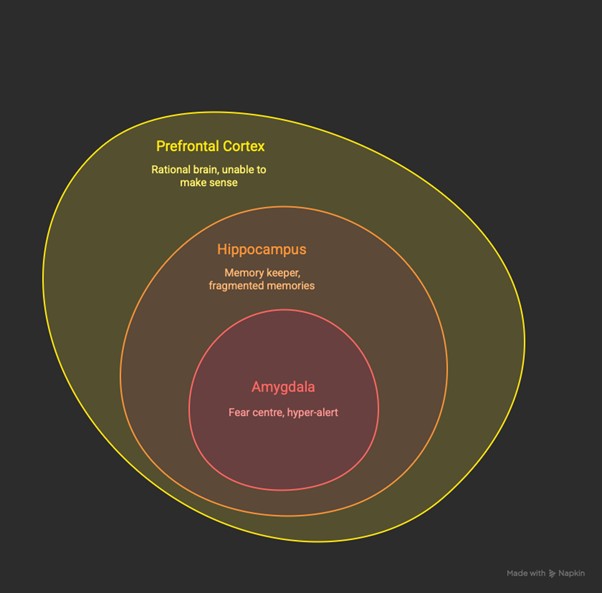
Recent neuropsychological literature suggests that traumatic memories aren’t stored like regular memories as one cohesive event. When you experience something overwhelming, your brain “freezes”, taking a snapshot of the scary or overwhelming experience. It impacts your brain as:
- Your fear centre, Amygdala, becomes hyper-alert.
- Your memory keeper, Hippocampus, is unable to differentiate past memories from present, recording information in a fragmented manner with no clear beginning, middle and end.
- Your rational brain, Prefrontal Cortex, is unable to make sense of whatever happened.
As a result, trauma gets “stuck”. Your body keeps reacting like the danger is still happening in the present moment and reinforcing the maladaptive beliefs you acquired during that time long after the original threat has passed. This is why you feel stuck in the same emotional loop trying to “make sense” of your experience.
HOW EMDR THERAPY HELPS YOU HEAL
EMDR functions by accessing those stuck or frozen memories where they can finally be processed, reframed and resolved.
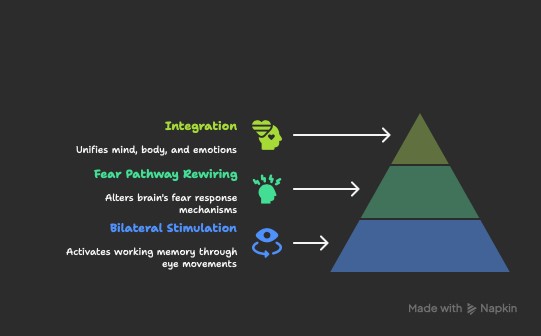
- Activates the working memory through Bilateral Stimulation -
The therapist used bilateral stimulation during EMDR while you briefly recall a traumatic memory. Bilateral stimulation can be rhythmic eye movements, tapping or auditory tones. This activates both hemispheres of the brain, facilitating the reprocessing of traumatic memories. In other words, this dual focus on past + present helps your brain to engage with the past memory while staying grounded in the present, making emotion processing safe. This process mimics the natural memory consolidation that occurs during REM sleep, allowing you to reframe distressing memories and restore emotional balance.
- Brain’s Fear Pathway Gets Rewired -
Research involving fMRI and EEG has shown that EMDR results in:
- Calming overactive Amygdala, hence reducing emotional reactivity and increasing your window of tolerance.
- Activating Hippocampus, leading to better organisation of memory, placing it in correct time and narrative restructuring.
- Strengthening of Prefrontal Cortex, helping you to reassess the memory logically and regulate your emotions.
- Improving connectivity in brain areas involving memory integration.
“EMDR helps patients ‘unfreeze’ trauma by linking stored fragments to a coherent narrative.” — Kaul, 2025
- Integrates Mind, Body and Emotion -
Most trauma therapies focus on either thoughts (like CBT) or feelings. However, EMDR focuses on integrating body sensations, emotions, beliefs, and memories, so that healing is felt, not just understood intellectually.
This is critical, especially in the Indian cultural context, where shame, guilt, emotion suppression and emotion bypassing run rampant from gullies to metropolitan cities.
To summarise, EMDR helps you understand what happened and release how it lives in the body. EMDR doesn’t just help you think differently, but also feel differently.
A reddit user shared,
“I feel unshackled and lighter, as if I’m reborn. EMDR helped me significantly decrease my anger and irritability, improved my relationship with my partner and newfound comfort in my body. It also helped me increase my productivity and energy levels and I’ve started enjoying working and stopped unhealthy habits like escapism through videogames.”
HOW EMDR THERAPY IS DIFFERENT FROM TALK THERAPY
- Moves beyond Talk therapies:
Trauma is often subtle and invisible in India. It shows up in hushed whispers inciting shame to unsaid expectations eliciting guilt. Speaking openly about your traumatic experience, especially those involving parental neglect, domestic abuse, sexual violence or intergenerational conflict, can be stigmatised or forbidden in many Inidan households. Trauma is often layered with family expectations, duties, and pressure, gender roles, intergenerational pain or just never being allowed to feel and express emotions safely.
Many clients hit a wall in talk therapy as their trauma wasn’t just one big event but a “lifestyle” or “culture” they lived. Talking about everything feels overwhelming and impossible as verbalising was stigmatised, to begin with. This is where EMDR can be revolutionary as it doesn’t require a full verbal disclosure. You don’t need to divulge every detail in order to heal from it. This can be especially powerful in a culture where silence is not just a coping strategy but a survival response. EMDR provides space for what’s unspoken to emerge and process what your mind might have locked away in a closet.
- Targets the root cause:
Unlike traditional talk therapy that often focuses on cognitive restructuring, EMDR addresses the physical and emotional imprint of trauma by working at the deeper neurobiological level. EMDR facilitates adaptive information processing and meaning making by accessing unprocessed traumatic memories through sensory stimulation and emotional reflection. This helps you integrate the past event without the risk of being re-traumatised.
- Holistic Approach:
Trauma often shows up in your body as brain fog, chronic fatigue, digestive issues, headaches, skin flare ups, sleep issues, hormonal issues, autoimmune conditions, and so on. EMDR doesn’t just address emotional pain, but also takes into account how your body might be communicating, taking a holistic approach to healing.
- Quicker & long-lasting results:
Numerous studies suggest that EMDR requires fewer sessions as compared to modalities like CBT or psychodynamic psychotherapy. Clients often report significant improvement in as few as 6-12 sessions.
- Reduces Re-traumatisation:
Emotional vulnerability is often stigmatised in Indian households. EMDR’s minimal intrusive and non verbal format makes it easier for clients to process the memory without feeling the risk of emotional flooding.
As this reddit user shared, “I was stuck in a rut for 20 years, trying different types of therapies and methods, to no success. EMDR therapy was a turning point in my life as it finally helped me heal and move on. It improved my physical symptoms of anxiety, healed my relationship with my siblings and helped me choose to become the kind of parent I want to be.”
WHAT EMDR THERAPY SESSION WOULD LOOK LIKE
EMDR follows a structured, client-centred approach, moving at your pace ensuring your safety. This is what a typical EMDR session looks like:
- History Taking – Identifying past traumatic events, triggers, and goals
- Preparation – Establishing safety, resourcing, and building trust
- Assessment – Targeting specific traumatic memories
- Desensitization – Bilateral stimulation begins, allowing memory reprocessing
- Installation – Replacing negative beliefs with positive, adaptive ones
- Body Scan – Ensuring no residual distress remains in the body
- Closure – Grounding and containment at the end of each session
- Re-evaluation – Reviewing progress and identifying future targets
This not just minimizes emotional overwhelm but also allows for deep healing without getting lost in stories.
A REAL LIFE EMDR TRANSFORMATION STORY
A client came to therapy claiming "she is too sensitive and she wants to stop feeling so much."
I explained to her what EMDR is and asked if she'd be up for trying it. She nodded.
I gently guided her and asked her to track what's coming up.
She picked a memory she called "small", being yelled at by her mother for speaking up at age eight.
We began the process. As we continued, she started tearing up and started crying.
She mentioned she felt shame and fear.
She said it wasn't just about speaking up. It was more about never being allowed to speak her truth and still feel loved and accepted. Either she could speak her truth or maintain a connection with her mother. Both never existed together.
After a few sessions, she began noticing:
- The tension in her jaw softened
- She was able to say “no” without guilt
- A softer compassionate voice replaced the harsh inner critic
WHAT HEALING CAN LOOK LIKE
Many clients report feeling:
- Less emotionally reactive and in charge of their reactions and their life.
- Able to make sense of the traumatic memory without shaming, or blaming themself.
- Feeling safer in their body, without wanting to “escape” their life.
- Reframe the narrative and beliefs created by those experiences with more clarity and compassion.
- Feel better about themself.
EMDR doesn’t erase your past, but it helps you reduce its hold on you. For layered or long-standing trauma, also see our guide on healing complex trauma in adulthood.
Why CoachForMind?
Experienced Psychologists: We are a team of licensed RCI-registered clinical psychologists. Our team is well-experienced in various forms of therapy such as CBT, DBT, EMDR therapy in India, and Narrative Therapy.
Personalized Approach: We are dedicated to treating our clients in the best-suited way, carefully curated as per the client's needs, and adhering to one-on-one, client-centered therapy.
Scientific Techniques: Our treatment plans and therapeutic methods are based on highly researched scientific findings such as CBT, DBT, EMDR and Narrative Therapy.
Quality service: We at CoachForMind ensure quality services in our treatment regime and therapeutic approaches. Our clients hold the most value to us, so we ground our techniques in empathy while maintaining professionalism.
Begin with a free 15-minute discovery call For more information, please visit our website or contact us directly at coachformind@gmail.com
Written by the therapists at Coach For Mind
FAQs
EMDR (Eye Movement Desensitization and Reprocessing) is a structured psychotherapy approach that uses guided eye movements, called bilateral stimulation, to process and re-integrate traumatic or distressing experiences without re-traumatization. EMDR was initially developed in 1987 by Francine Shapiro to treat PTSD (Post-Traumatic Stress Disorder), however, its application has since been expanded on to treat a wide range of trauma-related conditions such as childhood abuse, dissociation, anxiety, depression, grief, phobias, and panic disorders.
EMDR works directly with the brain's information processing system and doesn't require verbal processing of traumatic memories, as opposed to traditional talk therapies. EMDR enables you to reduce the emotional and physiological charge connected to the traumatic memories, helping you increase your window of tolerance which helps you respond instead of react.
EMDR is backed by over 44 randomized controlled trials and is considered the first-line of treatment for PTSD and trauma-related disorders by the World Health Organization (WHO Clinical Guidelines for PTSD 2013), the American Psychiatric Association (APA), and the Department of Veterans Affairs (USA).
Activates the working memory through Bilateral Stimulation -
The therapist used bilateral stimulation during EMDR while you briefly recall a traumatic memory. Bilateral stimulation can be rhythmic eye movements, tapping or auditory tones. This activates both hemispheres of the brain, facilitating the reprocessing of traumatic memories. In other words, this dual focus on past + present helps your brain to engage with the past memory while staying grounded in the present, making emotion processing safe. This process mimics the natural memory consolidation that occurs during REM sleep, allowing clients to reframe distressing memories and restore emotional balance.
Brain's Fear Pathway Gets Rewired -
Research involving fMRI and EEG has shown that EMDR results in:
- Calming overactive Amygdala, hence reducing emotional reactivity and increasing your window of tolerance.
- Activating Hippocampus, leading to better organisation of memory, placing it in correct time and narrative restructuring.
- Strengthening of Prefrontal Cortex, helping you to reassess the memory logically and regulate your emotions.
- Improving connectivity in brain areas involving memory integration.
"EMDR helps patients 'unfreeze' trauma by linking stored fragments to a coherent narrative." — Kaul, 2025
Integrates Mind, Body and Emotion -
Most trauma therapies focus on either thoughts (like CBT) or feelings. However, EMDR focuses on integrating body sensations, emotions, beliefs, and memories, so that healing is felt, not just understood intellectually.
This is critical, especially in the Indian cultural context, where shame, guilt, emotion suppression and emotion bypassing run rampant from gullies to metropolitan cities.
To summarise, EMDR helps you understand what happened and release how it lives in the body. EMDR doesn't just help you think differently, but also feel differently.
A reddit user shared,
"I feel unshackled and lighter, as if I'm reborn. EMDR helped me significantly decrease my anger and irritability, improved my relationship with my partner and newfound comfort in my body. It also helped me increase my productivity and energy levels and I've started enjoying working and stopped unhealthy habits like escapism through videogames."
Moves beyond Talk therapies:
Trauma is often subtle and invisible in India. It shows up in hushed whispers inciting shame to unsaid expectations eliciting guilt. Speaking openly about your traumatic experience, especially those involving parental neglect, domestic abuse, sexual violence or intergenerational conflict, can be stigmatised or forbidden in many Inidan households. Trauma is often layered with family expectations, duties, and pressure, gender roles, intergenerational pain or just never being allowed to feel and express emotions safely.
Many clients hit a wall in talk therapy as their trauma wasn't just one big event but a "lifestyle" or "culture" they lived. Talking about everything feels overwhelming and impossible as verbalising was stigmatised, to begin with. This is where EMDR can be revolutionary as it doesn't require a full verbal disclosure. You don't need to divulge every detail in order to heal from it. This can be especially powerful in a culture where silence is not just a coping strategy but a survival response. EMDR provides space for what's unspoken to emerge and process what your mind might have locked away in a closet.
Targets the root cause:
Unlike traditional talk therapy that often focuses on cognitive restructuring, EMDR addresses the physical and emotional imprint of trauma by working at the deeper neurobiological level. EMDR facilitates adaptive information processing and meaning making by accessing unprocessed traumatic memories through sensory stimulation and emotional reflection. This helps you integrate the past event without the risk of being re-traumatised.
Holistic Approach:
Trauma often shows up in your body as brain fog, chronic fatigue, digestive issues, headaches, skin flare ups, sleep issues, hormonal issues, autoimmune conditions, and so on. EMDR doesn't just address emotional pain, but also takes into account how your body might be communicating, taking a holistic approach to healing.
Quicker & long-lasting results:
Numerous studies suggest that EMDR requires fewer sessions as compared to modalities like CBT or psychodynamic psychotherapy. Clients often report significant improvement in as few as 6-12 sessions.
Reduces Re-traumatisation:
Emotional vulnerability is often stigmatised in Indian households. EMDR's minimal intrusive and non verbal format makes it easier for clients to process the memory without feeling the risk of emotional flooding.
As this reddit user shared,
"I was stuck in a rut for 20 years, trying different types of therapies and methods, to no success. EMDR therapy was a turning point in my life as it finally helped me heal and move on. It improved my physical symptoms of anxiety, healed my relationship with my siblings and helped me choose to become the kind of parent I want to be."
Trauma is often subtle and invisible in India. It shows up in hushed whispers inciting shame to unsaid expectations eliciting guilt. Speaking openly about your traumatic experience, especially those involving parental neglect, domestic abuse, sexual violence or intergenerational conflict, can be stigmatised or forbidden in many Inidan households. Trauma is often layered with family expectations, duties, and pressure, gender roles, intergenerational pain or just never being allowed to feel and express emotions safely.
Many clients hit a wall in talk therapy as their trauma wasn't just one big event but a "lifestyle" or "culture" they lived. Talking about everything feels overwhelming and impossible as verbalising was stigmatised, to begin with. This is where EMDR can be revolutionary as it doesn't require a full verbal disclosure. You don't need to divulge every detail in order to heal from it. This can be especially powerful in a culture where silence is not just a coping strategy but a survival response. EMDR provides space for what's unspoken to emerge and process what your mind might have locked away in a closet.
Emotional vulnerability is often stigmatised in Indian households. EMDR's minimal intrusive and non verbal format makes it easier for clients to process the memory without feeling the risk of emotional flooding.
Most trauma therapies focus on either thoughts (like CBT) or feelings. However, EMDR focuses on integrating body sensations, emotions, beliefs, and memories, so that healing is felt, not just understood intellectually.
This is critical, especially in the Indian cultural context, where shame, guilt, emotion suppression and emotion bypassing run rampant from gullies to metropolitan cities.
To summarise, EMDR helps you understand what happened and release how it lives in the body. EMDR doesn't just help you think differently, but also feel differently.
Activates the working memory through Bilateral Stimulation -
The therapist used bilateral stimulation during EMDR while you briefly recall a traumatic memory. Bilateral stimulation can be rhythmic eye movements, tapping or auditory tones. This activates both hemispheres of the brain, facilitating the reprocessing of traumatic memories. In other words, this dual focus on past + present helps your brain to engage with the past memory while staying grounded in the present, making emotion processing safe. This process mimics the natural memory consolidation that occurs during REM sleep, allowing clients to reframe distressing memories and restore emotional balance.
Brain's Fear Pathway Gets Rewired -
Research involving fMRI and EEG has shown that EMDR results in:
- Calming overactive Amygdala, hence reducing emotional reactivity and increasing your window of tolerance.
- Activating Hippocampus, leading to better organisation of memory, placing it in correct time and narrative restructuring.
- Strengthening of Prefrontal Cortex, helping you to reassess the memory logically and regulate your emotions.
- Improving connectivity in brain areas involving memory integration.
"EMDR helps patients 'unfreeze' trauma by linking stored fragments to a coherent narrative." — Kaul, 2025
A reddit user shared,
"I feel unshackled and lighter, as if I'm reborn. EMDR helped me significantly decrease my anger and irritability, improved my relationship with my partner and newfound comfort in my body. It also helped me increase my productivity and energy levels and I've started enjoying working and stopped unhealthy habits like escapism through videogames."
Trauma is often subtle and invisible in India. It shows up in hushed whispers inciting shame to unsaid expectations eliciting guilt. Speaking openly about your traumatic experience, especially those involving parental neglect, domestic abuse, sexual violence or intergenerational conflict, can be stigmatised or forbidden in many Inidan households. Trauma is often layered with family expectations, duties, and pressure, gender roles, intergenerational pain or just never being allowed to feel and express emotions safely.
Many clients hit a wall in talk therapy as their trauma wasn't just one big event but a "lifestyle" or "culture" they lived. Talking about everything feels overwhelming and impossible as verbalising was stigmatised, to begin with. This is where EMDR can be revolutionary as it doesn't require a full verbal disclosure. You don't need to divulge every detail in order to heal from it. This can be especially powerful in a culture where silence is not just a coping strategy but a survival response. EMDR provides space for what's unspoken to emerge and process what your mind might have locked away in a closet.
In the book "The body keeps the Score", Bessel van Der Kolk popularised the idea that trauma not only impacts the mind, but is also stored in the body somatically.
Moreover, numerous empirical research also backed this idea that trauma is, in fact, "stored" in the body's sensory and neural systems, leaving it's imprints behind long after the traumatic event passed away.
Recent neuropsychological literature suggests that traumatic memories aren't stored like regular memories as one cohesive event. When you experience something overwhelming, your brain "freezes", taking a snapshot of the scary or overwhelming experience. It impacts your brain as:
- Your fear centre, Amygdala, becomes hyper-alert.
- Your memory keeper, Hippocampus, is unable to differentiate past memories from present, recording information in a fragmented manner with no clear beginning, middle and end.
- Your rational brain, Prefrontal Cortex, is unable to make sense of whatever happened.
As a result, trauma gets "stuck". Your body keeps reacting like the danger is still happening in the present moment and reinforcing the maladaptive beliefs you acquired during that time long after the original threat has passed. This is why you feel stuck in the same emotional loop trying to "make sense" of your experience.
EMDR is backed by over 44 randomized controlled trials and is considered the first-line of treatment for PTSD and trauma-related disorders by the World Health Organization (WHO Clinical Guidelines for PTSD 2013), the American Psychiatric Association (APA), and the Department of Veterans Affairs (USA).
EMDR functions by accessing those stuck or frozen memories where they can finally be processed, reframed and resolved.
Activates the working memory through Bilateral Stimulation -
The therapist used bilateral stimulation during EMDR while you briefly recall a traumatic memory. Bilateral stimulation can be rhythmic eye movements, tapping or auditory tones. This activates both hemispheres of the brain, facilitating the reprocessing of traumatic memories. In other words, this dual focus on past + present helps your brain to engage with the past memory while staying grounded in the present, making emotion processing safe. This process mimics the natural memory consolidation that occurs during REM sleep, allowing clients to reframe distressing memories and restore emotional balance.
Brain's Fear Pathway Gets Rewired -
Research involving fMRI and EEG has shown that EMDR results in:
- Calming overactive Amygdala, hence reducing emotional reactivity and increasing your window of tolerance.
- Activating Hippocampus, leading to better organisation of memory, placing it in correct time and narrative restructuring.
- Strengthening of Prefrontal Cortex, helping you to reassess the memory logically and regulate your emotions.
- Improving connectivity in brain areas involving memory integration.
"EMDR helps patients 'unfreeze' trauma by linking stored fragments to a coherent narrative." — Kaul, 2025
Integrates Mind, Body and Emotion -
Most trauma therapies focus on either thoughts (like CBT) or feelings. However, EMDR focuses on integrating body sensations, emotions, beliefs, and memories, so that healing is felt, not just understood intellectually.
This is critical, especially in the Indian cultural context, where shame, guilt, emotion suppression and emotion bypassing run rampant from gullies to metropolitan cities.
Numerous studies suggest that EMDR requires fewer sessions as compared to modalities like CBT or psychodynamic psychotherapy. Clients often report significant improvement in as few as 6-12 sessions.
EMDR was initially developed in 1987 by Francine Shapiro to treat PTSD (Post-Traumatic Stress Disorder), however, its application has since been expanded on to treat a wide range of trauma-related conditions such as childhood abuse, dissociation, anxiety, depression, grief, phobias, and panic disorders.
EMDR works directly with the brain's information processing system and doesn't require verbal processing of traumatic memories, as opposed to traditional talk therapies. EMDR enables you to reduce the emotional and physiological charge connected to the traumatic memories, helping you increase your window of tolerance which helps you respond instead of react.
Many clients report feeling:
- Less emotionally reactive and in charge of their reactions and their life.
- Able to make sense of the traumatic memory without shaming, or blaming themself.
- Feeling safer in their body, without wanting to "escape" their life.
- Reframe the narrative and beliefs created by those experiences with more clarity and compassion.
- Feel better about themself.
EMDR doesn't erase your past, but it helps you reduce its hold on you.
Unlike traditional talk therapy that often focuses on cognitive restructuring, EMDR addresses the physical and emotional imprint of trauma by working at the deeper neurobiological level. EMDR facilitates adaptive information processing and meaning making by accessing unprocessed traumatic memories through sensory stimulation and emotional reflection. This helps you integrate the past event without the risk of being re-traumatised.
Emotional vulnerability is often stigmatised in Indian households. EMDR's minimal intrusive and non verbal format makes it easier for clients to process the memory without feeling the risk of emotional flooding.
Numerous Indian clients have experienced trauma, which is:
- Unspoken
- Somatic (stored in the body)
- Intergenerational
- Filled with shame, guilt, or obligation
EMDR provides healing without requiring verbal disclosure in societies where emotions are repressed and therapy is stigmatised. It works not only with what your mind can or cannot explain, but also with what your body remembers.
You can find qualified EMDR therapists at:
- At CoachForMind. Always look for someone who is EMDR-trained (Level 1 & 2) and trauma-informed.
- The Indian EMDR Association