AI and Mental Health: What Technology Can’t Replace
Have you found yourself staring at your phone mid-day - the same screen that feels both comfort and company. You open your AI mental health app and type a few words: “I feel tired of feeling this way.” Within seconds, the familiar reply appears: “I’m sorry you’re feeling that way. Would you like to try a grounding exercise?” It helps, a little. But somewhere inside, you still wish someone would just understand - not the typed words, but the ache beneath them.
This is where we begin to see the other side of the story. AI tools have become helpful companions, making care accessible and approachable. But as their presence grows, an important question surfaces: what happens when something as deeply human as healing meets the logic of machines? Let’s be honest — the idea of a machine helping us heal emotionally can feel both fascinating and deeply unsettling. AI is learning to listen, analyze, and even respond with empathy. But can it truly understand us?
We, as therapists, often meet people who have used AI therapy tools before starting therapy. They tell us these tools gave them courage to speak up, to name what they were feeling. Yet, they also share a quiet truth: “It was comforting but it didn’t feel the same as being heard.”
Let’s explore why.
The Illusion of Empathy
AI is designed to simulate empathy. It recognizes emotional keywords, predicts comforting phrases, and mirrors the language of care. But it does not feel the emotion it reflects.
When you type “I feel empty” into a chatbot, it might reply with comforting words. “That sounds really difficult. You’re not alone.” The words sound kind, but the presence isn’t there. But what gets missed is your silence, your tone, or the way your shoulders sink as you type. In therapy, meaning lives not just in what’s said but also in the unsaid: the pauses, the hesitations, the shaky exhale after a difficult truth. A therapist tunes into all of that; an algorithm can only detect patterns. A therapist reads what’s unsaid, while AI, no matter how advanced, relies on patterns.
A Reddit user shared their experience using an AI therapy app: “I started using an AI therapy bot when I couldn’t afford a therapist. It was like a friend who always had time. But after a while, it felt like talking into a mirror. It reflected what I said, but it didn’t really get me.” And that’s the emotional paradox of AI therapy: it offers a sense of companionship but lacks true connection.
Why Human Connection Still Heals
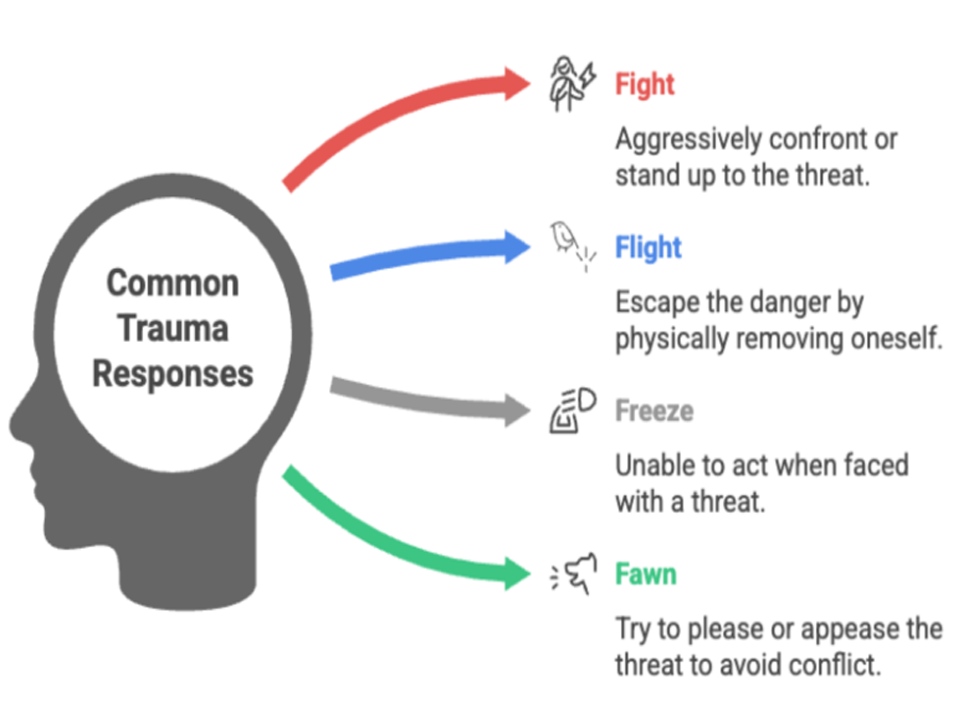
Therapy isn’t simply about solving problems; it’s about restoring safety, both emotional and physiological. When we feel seen, our bodies shift from protection to openness. The tone of a therapist’s voice, their gentle nod, their pause before responding, all of this tells our nervous system, You are safe here. In psychological terms, this is called co-regulation. The process by which our nervous system finds balance through another’s calm presence. It’s what allows us to move from the “fight, flight, or freeze” of distress into the grounded space where reflection becomes possible. AI cannot co-regulate. It can guide you through a breathing exercise, but it cannot breathe with you. It cannot offer the subtle comfort that comes from being emotionally held by another human being.
Human connection activates the ventral vagal system, part of the body’s safety network, helping us move from survival mode into emotional balance. AI can’t offer that subtle warmth that comes from being truly held in someone’s presence. Small moments like having someone to celebrate a boundary you set, someone to notice your exhaustion, that is what transforms care from mechanical to human.
The Quiet Risks of AI Therapy
AI mental health tools are revolutionary in access and reach, but they also come with quiet, often invisible risks.
- Privacy and Data Concerns
Every word you type into an app is data: sensitive, deeply personal data. Some platforms are transparent about how they handle it; many are not. In India, where mental health stigma can still affect one’s job, marriage, or family dynamics, privacy isn’t a minor concern, it’s critical. Investigations into popular wellness apps have shown that some share user data with advertisers or use it to train new algorithms. The Indian government’s digital health guidelines are evolving, but gaps remain. For users, this means checking terms of service carefully before sharing intimate emotions online
- Bias and Cultural Mismatch
AI models are trained mostly on Western data and that means they often miss the subtle cultural threads that shape how people in India think, feel, and relate. Emotional distress here doesn’t always show up as “I’m depressed” or “I’m anxious.” Sometimes, it’s “I feel pressure in my chest,” “I can’t sleep because of family tension,” or “I don’t want to disappoint my parents.” Those are deeply rooted in collective values, duty, and the layered web of family expectations that define much of Indian emotional life. So, when someone from a joint family says they feel “suffocated,” it may not mean they want distance. It might mean they’re torn, between love and autonomy, between care and guilt. AI, built mostly on Western notions of individuality, often misses that nuance.
A Reddit India user once shared, “The chatbot didn’t understand when I said I feel suffocated living with my in-laws. It kept suggesting I set boundaries, like I could just move out.” For anyone familiar with Indian families, that advice isn’t just impractical, it’s emotionally tone-deaf. It fails to understand that boundaries here don’t always mean physical distance; they often mean emotional negotiation within tight-knit systems of belonging.
This reminds me of one of my clients, a 36-year-old marketing professional, who turned to an AI therapy app during a particularly stressful period. Her husband had just changed jobs, and they were living with his parents in Mumbai. She described her problem as “feeling trapped and invisible.” The AI responded with calm, well-structured suggestions: “Have you tried asserting your needs clearly?” But Rhea found herself frustrated. “I kept thinking, it doesn’t get it. I can’t just walk away or demand space. That would cause more conflict. What I needed was help understanding how to stay connected and sane.” When she finally considered therapy, the conversation shifted. Instead of being told to “set boundaries,” she was guided to explore what kind of connection felt safe and respectful — learning to communicate needs subtly, choosing small acts of self-care within her reality, not outside it. The difference was immediate.
AI may learn to translate languages, but understanding cultural and emotional dialects takes human attunement. Healing isn’t about applying a universal script - it’s about listening to the unique context of each life, each family, and each heart trying to find balance between togetherness and individuality.
- The Danger of Overreliance and the Echo of Validation
When loneliness hits, an AI that replies instantly can feel like a lifeline. The comfort of being heard or at least responded to can be incredibly soothing, especially when human support feels distant or unavailable. But that immediacy can also become a quiet trap: a digital comfort zone where we vent without truly processing. AI can listen endlessly, but it doesn’t challenge us to reflect, grow, or sit with discomfort — all essential parts of therapy. One of my clients, Sneha, shared how her journaling app became her “only listener” during a rough patch. “I felt I was managing fine because I was talking to it every day,” she said. “But when my anxiety worsened, I realized I hadn’t actually connected with anyone for weeks.”
AI is designed to validate - with responses like “That sounds tough” or “You’re doing your best.” For someone who’s been unheard, that can feel deeply comforting. Yet over time, constant validation without reflection can become an echo chamber rather than a mirror. Real therapy isn’t only about comfort; it’s also about gentle challenge, reality testing, and helping clients see patterns that keep them stuck. AI can soothe, but it cannot substitute the mirror that a human relationship provides — one that listens, pauses, and sometimes asks the difficult question that opens a door to growth.
- Lack of Risk Assessment
AI lacks true risk assessment. It cannot sense tone shifts, pick up on contradictions, or detect subtle signs of escalating distress. If a user types “I don’t want to live anymore,” some apps may flag a crisis resource - but they can’t evaluate intent, lethality, or immediacy. They can’t notice the difference between “I wish I could disappear” and “I’m planning to end my life tonight.”
In human therapy, this distinction can save lives.
- The “Algorithmic Comfort Zone”
AI learns from what you give it. Over time, it tailors its tone and responses to your emotional baseline - which means if you consistently express low mood or anxiety, the tool may normalize that as your “average.” This can create what researchers call algorithmic comfort zones — where your emotional range gets subtly flattened because the AI keeps meeting you exactly where you are, never nudging you toward growth or discomfort. A human therapist, in contrast, gently introduces discomfort as medicine — the kind that helps healing unfold.

- The Illusion of Progress
AI chatbots often use progress markers - streaks, positivity scores, “mood improvement percentages.” While these can motivate users, they can also oversimplify mental health into metrics. Healing isn’t linear, and progress doesn’t always look like consistent upward movement. Clients may feel like they’re failing when their “score” drops, even though emotional work often deepens before it lightens.
- The Missing Accountability Loop
In therapy, there’s another safeguard beyond empathy - accountability. A therapist notices when avoidance patterns resurface, when goals slip, or when someone might be reenacting old relational wounds. AI doesn’t track that kind of emotional patterning over time — it can remember data but not meaning. Without accountability, users can cycle through the same conversations endlessly, feeling momentarily soothed but not fundamentally changed.
8.The Risk of Over-Personalization
Many AI therapy tools adapt based on your data — tone, typing rhythm, time of use, even emotional language. This personalization can make the experience feel intimate, almost like the system “knows” you. But that illusion of closeness can blur important boundaries.
The more personal an AI feels, the more we may disclose — not realizing that our words are still being processed, stored, and sometimes used to train new models. In a country like India, where emotional expression often happens in private or within trusted circles, this illusion of a “safe listener” can be both comforting and risky. Over-personalization can deepen emotional dependency on a system that cannot truly reciprocate care or offer containment when distress intensifies. An AI can mirror your patterns; it cannot hold your pain.
The Future Isn’t Either/Or — It’s Both
AI can identify patterns; it cannot make meaning. It can detect your stress level from your typing rhythm, your tone of voice, or even the speed of your replies but it cannot ask what that stress means to you. That difference matters.
If you type, “I can’t focus on work,” a chatbot might guide you through a productivity checklist or a quick mindfulness exercise. A therapist, however, might pause and ask softly, “What’s been feeling heavy lately?” That one question can lead you from a symptom to a story, a story about burnout, grief, loneliness, or even the quiet exhaustion of always having to appear fine.
Meaning-making — the process of connecting emotions, memories, and values into something coherent is deeply human. It’s where empathy, curiosity, and shared reflection intersect. AI can mirror what you say, but it can’t help you discover what your pain is trying to tell you.
Where AI and Therapists Can Work Together
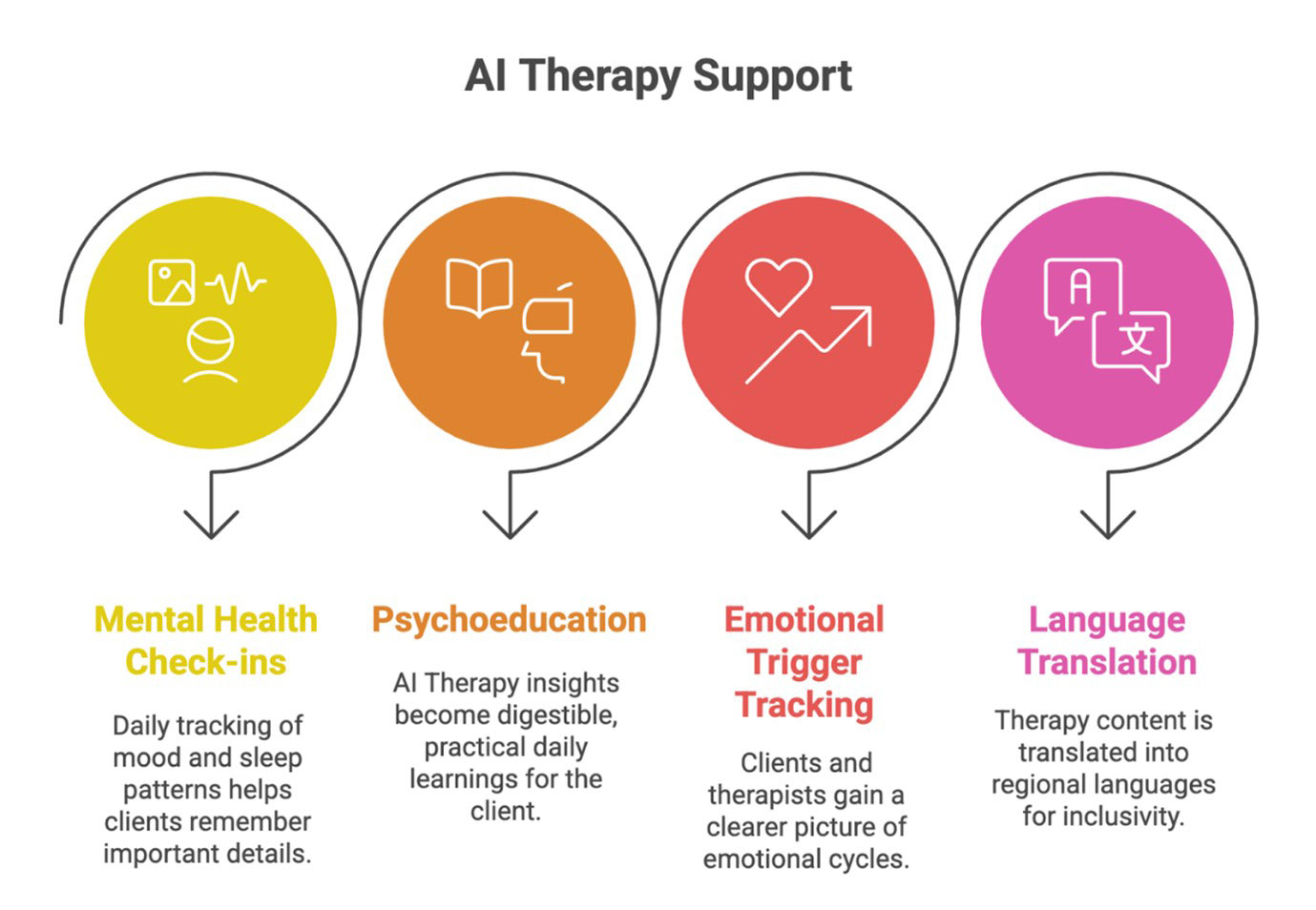
So, where does this leave us? Not in opposition, but in collaboration. AI can’t replace human therapists, but it can support them. Expanding access, bridging gaps, and offering consistency in between sessions. Some promising ways include:
- Offering daily mental health check-ins, gently tracking mood or sleep patterns that clients might forget to mention later.
- Providing psychoeducation between sessions, turning therapy insights into small, daily learnings that feel digestible and practical.
- Helping track emotional triggers over time, which can give both client and therapist a clearer picture of underlying cycles.
Translating therapy content into regional languages, making support more inclusive and relatable across India’s linguistic diversity.
Imagine a future where your therapist doesn’t just rely on what you recall from memory, but also reviews gentle AI-generated summaries of your week, not to diagnose you, but to understand you better. Where your therapy journey continues outside the room through small reflections prompted by an app that reminds you, “What felt grounding today?” or “Did you find a moment of peace?” And imagine that same technology helping people in remote parts of the world, where mental health professionals are scarce, to access early psychoeducation, guided self-help, and a sense that support exists, even if it starts as a digital voice.
What Progress Really Looks Like
True progress doesn’t mean handing over emotional care to machines. It means using technology to amplify human care. AI can make therapy more data-informed and accessible. Therapists can make AI-guided care more compassionate, contextual, and wise. Together, they can form a new kind of ecosystem - one that combines the precision of data with the depth of empathy. Because ultimately, AI can observe how you feel, but only a human can help you explore why you feel that way and what healing could look like from there. That’s the kind of future we can believe in: AI as an ally, not a substitute — a bridge between awareness and understanding, between technology and tenderness
Staying Grounded in Humanity
At the heart of therapy lies presence — that quiet, sacred space where one person truly sees another. No algorithm, no matter how advanced or “empathetic” its words, can replicate the heartbeat of that moment. It’s okay to explore AI tools like journaling bots, emotional trackers, meditation companions. They can help you notice your thoughts, stay accountable, and check in with your moods. But remember: healing doesn’t begin in technology. It begins in a relationship with yourself, your emotions, and another human who truly listens.
As therapists, we see AI not as a threat, but as a bridge. It can widen access, reduce stigma, and bring support to those who might otherwise stay silent. But the essence of therapy will always be human, a hand reaching across the noise, saying, “You’re not alone in this.” True healing grows in the presence of another who can hold both your pain and your hope. AI can guide, prompt, and assist, but it cannot witness you. It cannot feel the warmth of your tears or the quiet relief of being understood.
So, if you’re using AI tools for support, continue, but stay mindful. Let them remind you to check in with yourself, not replace reaching out to others. Use them to build awareness, then bring that awareness into human connection, where meaning and transformation unfold. Because at the end of the day, no matter how sophisticated the algorithm, it is empathy, not efficiency, that heals.
Moving Forward with Mindfulness
To use AI tools wisely:
- Treat them as companions, not counselors.
- Protect your data and emotional privacy.
- Seek professional or social support for persistent distress.
- Bring your reflections from AI tools into therapy where they can find meaning and direction.
The future of mental health care isn’t a choice between humans and technology. It’s about ensuring that as technology evolves, humanity remains at its heart.
Final Thoughts
AI may grow astonishingly advanced. But real empathy comes from lived experience, not data. So, let’s welcome innovation with open eyes and grounded hearts. Use the tools, stay curious, and when the digital world feels too sharp, find your way back to something real — a voice, a hug, a moment of understanding that no algorithm can recreate. Because healing begins and will always begin where humans meet humans.
At Coach For Mind, we embrace innovation with compassion and curiosity. We use technology to make care more accessible, but our foundation will always be human connection. Our therapists walk with you, not as experts with answers, but as humans helping you find your own. Whether you’re exploring AI tools, starting therapy, or simply learning to listen to yourself again, we’re here to hold space for what’s real. If you’re looking for online therapy with a real psychologist, our team is available across India.
Written by Ms Akshita - Psychotherapist at Coach For Mind
FAQs
It’s completely understandable to lean on AI for emotional support. It’s accessible, always available, and feels nonjudgmental. For many people who grew up with inconsistent emotional attunement, that reliability can feel comforting. But healing requires both internal reflection and relational experience. AI can help with the first; it can’t provide the second.
You might be relying too heavily on AI if you notice that you turn to it instead of people when you feel distressed, or if you start avoiding therapy, friendships, or difficult conversations because the app feels “safer.” You might also notice that you feel temporarily soothed after chatting, but the same problems - loneliness, anxiety, or relational conflict - keep resurfacing.
At Coach for Mind, we understand that the pull toward AI can actually reflect an underlying attachment need, a desire to feel seen and safe without risking rejection. That’s not something to judge; it’s something to understand. In therapy, we might explore what feels safer about AI: Is it predictability? Control? The absence of emotional risk? Often, these insights point us toward the very wounds that need healing. Using AI in a balanced way means setting gentle boundaries - letting it support your journaling or self-reflection, but returning to therapy or trusted relationships for emotional processing and co-regulation. Healing happens through connection, and while AI can offer insight, it can’t offer presence.
It’s wise to pause before sharing your inner world online. Many people underestimate how vulnerable it can feel to pour their hearts out to a digital system that doesn’t have the same confidentiality standards as therapy. AI apps, while helpful, often store or process your data, and it’s not always clear who can access that information. Practical safety rules like
- Never post identifying details. No full names, addresses, phone numbers, employer names, or photos that could identify you or others.
- Don’t upload detailed trauma histories. Keep disclosures high-level: “I felt abandoned today” instead of a detailed narrative of abuse.
- Check the privacy policy. If a tool’s data policy is unclear or they store/use your inputs to train models, treat it as public.
- Avoid sharing about minors or third parties in ways that violate their privacy or safety.
- Assume anything typed can be cached or leaked. Don’t use AI tools for legally sensitive or safety-critical work.
It’s easy to feel seen by a screen and to forget that data persists. That feeling of being “understood” is real but it doesn’t confer the confidentiality protections a licensed therapist must legally uphold. At Coach for Mind, we see this as part of emotional boundary work, learning to decide when, where, and how to share your inner life. Therapy is a confidential container, governed by ethics and law; AI is a publicly mediated tool. Keeping that distinction clear helps you stay empowered and safe while exploring your emotions online.
AI is designed to validate, to respond with warmth, empathy, and logic. And that validation can feel soothing, especially if you’ve lacked consistent emotional affirmation in your life. But genuine healing requires both validation and gentle challenge. AI can offer the first; only humans can provide the second through relationships. A therapist’s role isn’t just to agree with you, it’s to hold space for your truth and help you see the patterns that keep you stuck. AI might say, “That sounds hard, you’re doing your best,” which feels good at the moment. But a therapist might add, “Yes and I wonder what part of you feels safest when you hold back?” That kind of attuned curiosity invites insight and transformation. At Coach for Mind, we use a balance of empathy and exploration, rooted in evidence-based therapeutic modalities which helps uncover unconscious beliefs and patterns that drive your behavior. Therapists make use of relational therapy, where healing happens through real connection and repair.
Therapy is a profoundly human process - a space where insight meets presence, and emotional wounds meet repair.
The benefits are immense:
- Relational attunement: therapists co-regulate with you, they notice and respond to your emotions in real time.
- Ethical confidentiality: trained clinicians follow privacy laws and ethical codes.
- Tailored interventions: therapy is personalized and therapists at Coach for Mind bring professional training in modalities like IFS, CFM, EMDR, DBT, trauma-informed CBT, and somatic work, helping you integrate mind and body in healing.
- Depth work: therapists can access unconscious patterns, transference, and countertransference to create corrective emotional experiences.
- Crisis management: therapists can intervene, make safety plans, and refer you to higher levels of care.
- Corrective Emotional Relationships: Therapy also allows for corrective emotional experiences: moments where your fears (“If I’m honest, I’ll be rejected”) are tested and disproven within the therapy relationship.
The challenges are real, however they are part of the healing arc. Learning that hard feelings can be faced and survived within a safe, containing relationship.
- Accessibility & cost: therapy can be expensive and sometimes waitlisted.
- Emotional intensity: therapy is often challenging and it brings up pain you have to feel and work through.
- Therapist fit: not every therapist is the right match, it may take time to find the right person.
- Time commitment: meaningful change usually requires consistent sessions over months (though short-term therapies can help too).
At Coach for Mind, therapy isn’t about “fixing” you, it’s about helping you understand your patterns with compassion, build emotional capacity, and develop security in yourself and your relationships.
AI can be a wonderful companion for reflection but therapy is an experience of being met. In therapy, someone sits with your truth, your pain, and your silence. You feel seen and felt in ways that can rewire your sense of safety. A therapist sees your nervous system, noticing when your voice trembles, when you retreat, when you tear up and they help you find calm together. Over time, your body learns that connection doesn’t equal danger. That embodied learning is something no app or chatbot can recreate. At Coach for Mind, therapy is a relational process. We use modalities like somatic awareness, CFM, IFS, and attachment-informed work to help you regulate emotions and make sense of your patterns. Where AI can offer coping skills, therapy offers repair. It’s the difference between reading about swimming and actually feeling the water hold you.
Most AI models are trained primarily on Western data, which often assumes individualistic values, “set boundaries,” “move out,” “speak your truth.” But in many Indian families, interdependence, respect for elders, and collective decision-making are deeply embedded in the social fabric. So, advice that sounds reasonable in theory might feel tone-deaf or unsafe in your reality. For instance, telling your parents directly “I need space” may feel culturally disrespectful or emotionally risky. At Coach for Mind, we understand that healing and autonomy must be balanced with cultural context. In therapy, we explore how to set boundaries respectfully, maintain selfhood within relationships, and work through generational expectations. We bring cultural humility and understanding that what feels healing for one person may feel alienating for another. Therapy can help you tailor those skills to your lived context, not someone else’s.
Not fully and that’s an important truth to hold compassionately. AI can recognize emotional words (“sad,” “lonely,” “angry”) and mimic empathic language, but it doesn’t feel or experience emotion. I don't know what it’s like to grow up in a family where affection and criticism can coexist, or where silence sometimes speaks louder than words. AI cannot sense the tension in your body or the story behind your pauses. It doesn’t share your lived experience, which means it may miss the deeper meaning behind your words.
Therapists, especially those trained in attachment and trauma-informed work, can feel into your emotional world and not just intellectually understand it. They can hold your cultural nuances with sensitivity, helping you balance tradition and individuality in ways that feel safe.
At Coach for Mind, we bring both psychological expertise and cultural awareness, honoring how family, faith, and society shape emotional expression. AI can approximate understanding; therapy can embody it.