TL;DR – Dealing with a Narcissistic Partner
- Narcissistic abuse is a cycle of idealization, devaluation, and control that slowly erodes your sense of self. Common patterns include gaslighting, manipulation, emotional withdrawal, and subtle blame-shifting that make you doubt your reality.
- Survivors often stay due to trauma bonding, fear, hope for change, or conditioning to meet the partner’s needs at the cost of their own.
- Healing starts with awareness - naming the abuse and understanding that it’s not your fault.
- Emotional regulation and grounding techniques help break free from the nervous system’s “fight, flight, freeze, or fawn” responses.
- Setting boundaries, limiting contact, and seeking safe support (friends, therapy, communities) are crucial to rebuilding autonomy.
- Leaving doesn’t always mean immediate peace, grief, confusion, and guilt are normal parts of recovery.
- Therapy (especially trauma-informed or somatic approaches) helps survivors reconnect with their body, rebuild self-trust, and process guilt and shame.
How to deal with a Narcissistic Partner Effectively?
To safely manage and deal with a narcissistic partner or spouse, execute these core psychological boundaries:
- Establish Firm Emotional Boundaries: Disengage from circular arguments and refuse to accept unwarranted blame.
- Practice the Gray Rock Method: Render interactions brief, unemotional, and completely uninteresting to starve narcissistic supply.
- Document Everything Clearly: Keep strict records of financial, text, and verbal commitments to prevent gaslighting.
- Seek Specialized Professional Guidance: Consult a trauma-informed therapist or marriage counselor to process systemic abuse.
Do you feel like you're losing your mind? Trapped in a relationship that drains your spirit, leaving you confused, exhausted, and questioning everything you once knew? You're not alone. Many describe feeling like a "shell of their former self," unable to remember the vibrant person they once were. The nature of narcissistic abuse doesn't just hurt; it slowly erodes your very identity, leaving you isolated by a partner who once seemed so charming and confident.
A common experience is feeling like no matter how much love, patience, or reassurance you offer your partner, it is never enough. Maybe you find yourself walking on eggshells, constantly trying to prevent the next argument or emotional withdrawal. If this resonates deeply, you might be in a relationship with someone who shows strong narcissistic traits.
Before you blame yourself for being “too sensitive” or “not doing enough,” pause. This isn’t about fault, it’s about understanding the reality of the dynamic, and how to take fierce ownership of your emotional health within it. This guide can be your roadmap. Whether you're contemplating an exit, navigating the complexities of co-parenting, or simply striving to maintain your sanity while still entangled. We'll demystify the dynamics, equip you with practical, actionable strategies for dealing with a narcissistic partner, and provide a clear roadmap for healing and reclaiming your authentic self.
Is This You?
- You feel like you're losing yourself, walking on eggshells every day
- No matter how much you give, it's never enough for your partner
- You question your own memory or sanity after arguments
- Friends or family don't see the side of them that you experience
At Coach for Mind, we support individuals in India and beyond in understanding and healing from patterns of narcissistic abuse in relationships. Our trauma-informed and culturally attuned approach is grounded in compassion, evidence-based methods, and a deep respect for your pace and lived experience.
Understanding the Narcissistic Dynamic
You may already have heard the term “narcissist” and worried: “Is my partner a narcissist? Is that what’s happening to me?”
In popular culture, the word is used loosely “Oh, he’s so narcissistic”, for anyone who is self centered. However, clinically, it has a more precise meaning: Narcissistic Personality Disorder (NPD) involves a stable pattern of grandiosity, need for admiration, and lack of empathy. But that doesn’t mean your partner needs to tick every box to have deeply harmful behaviours. Many people show narcissistic traits like entitlement, devaluation, attention-seeking and the impact on you can be very real. This is because narcissism exists on a wide spectrum, from people showing deeply damaging narcissistic behaviors to having the full diagnosis of NPD.
Narcissism is often tragically misunderstood as mere vanity, but NPD is a complex, entrenched mental health condition. It’s characterized by an overwhelming sense of superiority and an expectation of constant special treatment. While they may intellectually recognize someone's emotions, they simply don't possess the necessary emotional compassion to be moved to care or prioritize that person's well-being. This distinction is critical: The problem is in their wiring, not your behavior.
Recognizing the Red Flags: Early Warning Signs and Manipulation Tactics
Narcissistic partners are masters of disguise, often appearing incredibly charming, confident, and exciting in the beginning, a phase often called "The Idealization Phase" making them incredibly hard to spot. This initial stage is characterized by love bombing - an intense, overwhelming display of affection, flattery, and grand gestures designed to quickly hook you and forge a powerful, often dizzying, emotional bond. This stage can mean you feel deeply connected, alive, seen, and uniquely chosen. Then the dynamic subtly begins to shift: the compliments fade, the expectations rise, you feel you cannot do enough.
This pattern is not your fault - but it is something you can recognise and begin to protect yourself from. Commonly, the experience of being in a relationship with a narcissistic partner is referred to as narc abuse. One Reddit user shared:“I’m sick of the top comments on almost every reddit post about an abusive partner being ‘wow he sounds like such a narcissist’ … Just say ‘your partner is abusive’, because that’s what it is.”
It’s easy to second-guess yourself when something feels off, especially in a society where relational harmony is valued and “keeping the peace” can feel safer than speaking up. So let’s name some of the tactics, so you can see them in real life without shame or confusion.
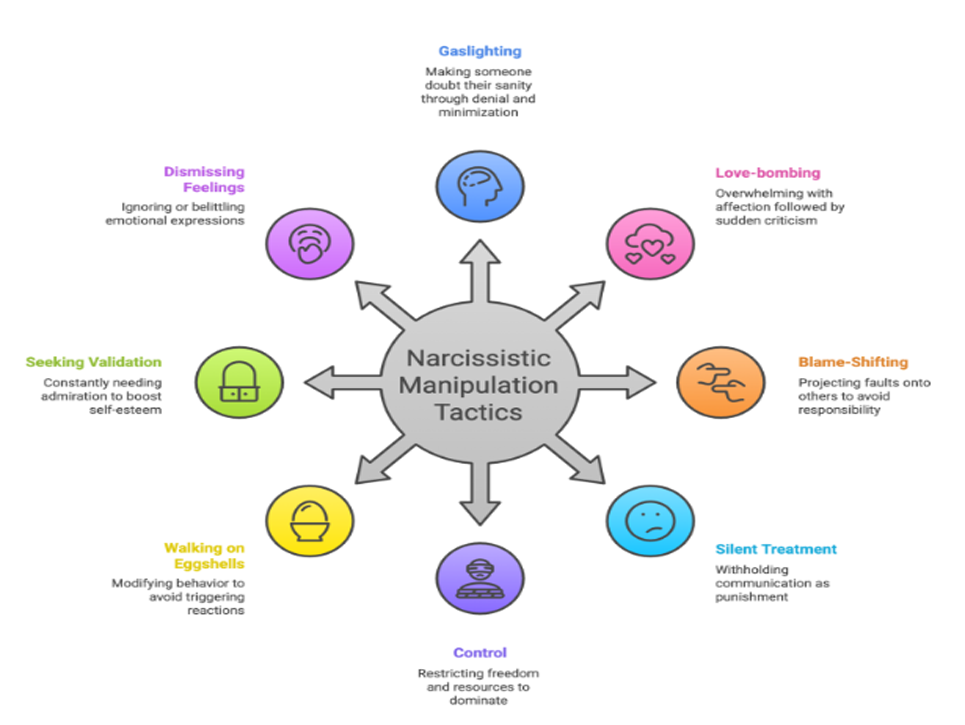
- Gaslighting: This is a particularly insidious form of psychological manipulation where the abuser systematically makes you question your own memory, perception, or even your sanity. They deny what you remember, minimize your feelings, make you feel you’re “too sensitive” or “imagining things.” This can lead to immense confusion and self-doubt, making you feel like you're losing your mind. A reddit user shared their experience, “I used to believe everything he would say even if my normal self would believe it’s all crazy talk. “
- Love-bombing → devaluation cycle: At first you’re praised, then subtly or overtly criticised. The swing from “you’re amazing” to “you always mess things up” is jarring.
- Blame-Shifting: Narcissists rarely take responsibility for their actions. Instead, they expertly project their faults onto you, making you feel responsible for their behavior and their problems in the relationship. You might hear them say, “You are the one with the problem.”
- Silent Treatment: Withholding communication as a cruel form of punishment, leaving you feeling isolated, desperate for their attention, and questioning what you did wrong.
- Control: This can manifest in various ways, from monitoring your movements and isolating you from friends and family to restricting your access to financial resources. These behaviors collectively constitute coercive control, a degrading and depriving pattern of actions that inflict severe mental health consequences.
- Walking on eggshells: You may feel you must modify yourself or your behaviour to avoid “triggering” them. The relational landscape can be volatile with you not knowing how your partner will react. You may feel pressured to maintain family harmony, or minimise your discomfort.
- Seeking Validation The narcissist constantly needs validation or admiration to regulate their fragile self-esteem. Your job becomes an endless, exhausting performance to meet this insatiable need.
- Dismissing Your Feelings: Any attempt to express your feelings or experiences is met with sharp dismissal: “You’re overreacting,” “Stop being so dramatic,” or a complete deflection to their own pain.
These relationships are confusing precisely because they feel loving at times. You might remember how vibrant you were, how “in love” you felt. And then you start to doubt: “Was it real? Am I making this up?” When you’re gaslit, your nervous system starts turning inward, questioning your own perception.
Recent research in India shows that coercive control by partners is associated with higher odds of depression, anxiety, suicidal thinking among women. So yes, what you’re feeling is real. Your nervous system is telling you something. Many clients come to Coach for Mind unsure if their pain "counts" as Narc Abuse. Together, we gently explore these signs through conversation, body-based awareness, and reflection - helping you connect the dots in a way that feels grounded, not overwhelming.
The Profound Impact of Narcissistic Abuse on Your Well-being
Let’s shift from what’s happening to you, to how it affects you and your body, mind, heart. Because the effects go far deeper than “arguments at home”. Living with a narcissistic partner creates emotional exhaustion. You might start doubting your own perceptions, shrink your needs, or stay hypervigilant to avoid conflict. Over time, this systematically leads to low self-worth, and trauma responses such as emotional numbing or compulsive over-pleasing behaviors.
In therapy, clients often describe feeling both trapped and deeply attached - a confusing mix of love, fear, and hope. This phenomenon is fueled by what psychologists call intermittent reinforcement: moments of idealization (affection, charm, promises) followed by devaluation (criticism, withdrawal). This unpredictable cycle activates the brain’s reward system, making the victim addicted to the possibility of the "good times" returning, making it exponentially harder to step away.
The pain of narcissistic abuse is a systematic, soul-crushing erosion of your identity and mental health. You're not "just hurt"; you're experiencing profound psychological damage that can linger long after the relationship ends.
Emotional and Psychological Toll
Research consistently shows that exposure to coercive control, a hallmark of narcissistic relationships, is linked to long-term mental health issues. Its mental health impacts are comparable in strength to those of intimate partner violence. Survivors often experience:
- Complex Post-Traumatic Stress Disorder (C-PTSD): The chronic, ongoing nature of the abuse, particularly the coercive control, creates deep, lasting trauma, leading to C-PTSD symptoms like emotional flashbacks and chronic difficulty regulating emotions.
- Severe Depression and Anxiety: Coercive control is strongly linked to depressive symptoms and high anxiety. This can be particularly severe in vulnerable populations, such as new mothers experiencing postnatal depression linked to control.
- Substance Use: Some studies suggest a link between coercive control and increased drug and alcohol use as a coping mechanism for the relentless pain and distress.
- Erosion of Self-Worth: The constant criticism, gaslighting, and devaluation leave victims feeling worthless, confused, and questioning their own sanity. "I can't even remember what my favorite color is anymore," a client once shared, illustrating the complete erasure of self.
What this means is that the erosion you feel is not imaginary. It is real and it is serious. And you deserve to respond to it as you would any other trauma. In the Indian context, several factors can make recovery more complicated:
- Families may emphasise staying in the relationship, not “making waves”.
- The shame around “relationship failure” can reinforce staying.
- Financial dependence, social stigma, joint families may limit options.
- A partner with narcissistic style may exploit these cultural dynamics (e.g. insisting on image, controlling contact with your family).
At Coach for Mind we work with these cultural dimensions, recognising that you need relief within your ecosystem, not just Western techniques.
You Don't Have to Carry This Alone
Our trauma-informed therapists specialize in narcissistic abuse recovery — helping you rebuild safety, trust, and your sense of self.
Book a Free Discovery Call →Financial Abuse: A Hidden Chain
One of the most hidden yet devastating forms of control in narcissistic relationships is financial abuse. It often doesn’t start loudly, instead it creeps in quietly, disguised as “care,” “support,” or “help.” But over time, it leaves the person feeling completely stuck - emotionally and practically. Financial abuse isn’t just about money; it’s about power and dependence. One Reddit user shared, “To a narcissist, money is a tool to manipulate you with and a weapon to abuse you with.”
Here’s how it often shows up in narcissistic dynamics:
- Creating Financial Dependence: They might suggest you quit your job or take a break “for your own good.” What feels like support at first can quietly become a trap.
- Controlling Access to Money: They keep control of the shared bank accounts, track your spending, or guilt you for “wasting” money. Sometimes, they make you pay for everything while secretly hoarding their own funds. One Reddit user described it as, “Mine won't have a joint account, is the sole money earner and is vague about the account balance
- Sabotaging Career or Growth: They might mock your ambitions, “forget” to pick you up from work, or start fights before important meetings - anything to destabilize your professional confidence. Many survivors on Quora have shared how their partners would belittle their work, saying things like “You’ll never earn as much as me anyway.”
- Creating Hidden Debt: Some even take out loans or credit cards in your name, leaving you financially destroyed and legally responsible. This kind of financial betrayal can take years to recover from both, emotionally and economically.
Over time, this kind of economic control can lead to severe anxiety, depression, and learned helplessness, reinforcing the belief that escape is impossible. Survivors of financial abuse experience higher rates of depression and PTSD symptoms due to the chronic stress of financial instability and control. It’s important to remember, financial abuse isn’t about being “bad with money.” It’s a system of control designed to keep you small, scared, and dependent.
Trauma Bonding and Co-dependency
One of the most painful reasons people struggle to leave narcissistic relationships is, trauma bonding, an intense emotional attachment formed through cycles of reward and punishment. At first, it looks like passion or “once-in-a-lifetime love.” But beneath it is a pattern of psychological conditioning that keeps you emotionally hooked.
In therapy, we describe trauma bonding as the emotional glue that forms when abuse and intermittent affection occur in cycles. The narcissist partner alternates between showering you with attention, promises, and affection and devaluating, criticizing, ignoring, or blaming you. This unpredictable pattern creates a neurochemical rollercoaster. Every small return of affection releases dopamine and oxytocin, the same brain chemicals linked with addiction and bonding.
Over time, this cycle rewires your brain to equate chaos with connection and anxiety with love. Even when the abuse becomes unbearable, leaving feels like losing oxygen. This is why trauma bonds can feel stronger than healthy love - they’re rooted not just in emotion, but in survival wiring.
Trauma bonding often feeds further, into co-dependency, where your self-worth becomes fused with the narcissist’s moods and validation. You start monitoring their emotions, trying to “keep the peace,” or earning love through compliance. In therapy, we often hear clients say things like: “If I can just be good enough, maybe they’ll love me like they used to.”
Co-dependency is rooted in self-abandonment, neglecting your own needs to meet someone else’s. Narcissists exploit this tendency by making you responsible for their happiness, guilt-tripping you when you assert boundaries, and convincing you that love equals sacrifice.
Research shows that people in narcissistic relationships often experience symptoms similar to addiction withdrawal after separation including intrusive thoughts, cravings, and emotional dysregulation. This explains why “just leaving” rarely feels simple or safe - the bond itself must be slowly and gently healed.
Breaking the Cycle
Healing from trauma bonding and co-dependency often begins with psychoeducation and nervous system regulation. Understanding the pattern is the first crack in the illusion of control. In therapy, survivors work on:
- Naming the cycle
- Rebuilding self-trust and autonomy
- Reconnecting with body signals of safety
- Practicing emotional detachment and boundary repair
The path out is slow, but possible. With time, therapy, and safety, you can rewire the belief that love must hurt and learn that peace, not intensity, is the real sign of connection.
Practical Strategies for Dealing with a Narcissistic Partner
You may be reading this thinking: “Leaving is not an option yet.” That’s okay. Many clients come to therapy while still entangled: shared children, finances, social ties, mandatory contact. The good news: you can start protecting your emotional health now. In cases where leaving is not immediate, managing the relationship requires strategic self-protection and unwavering resolve.
Setting Unbreakable Boundaries
Boundaries are non-negotiable rules you set for yourself and others. Think of them like a protective container you build for your emotional safety. With a narcissist, these must be rigid, clearly communicated, and consistently enforced.
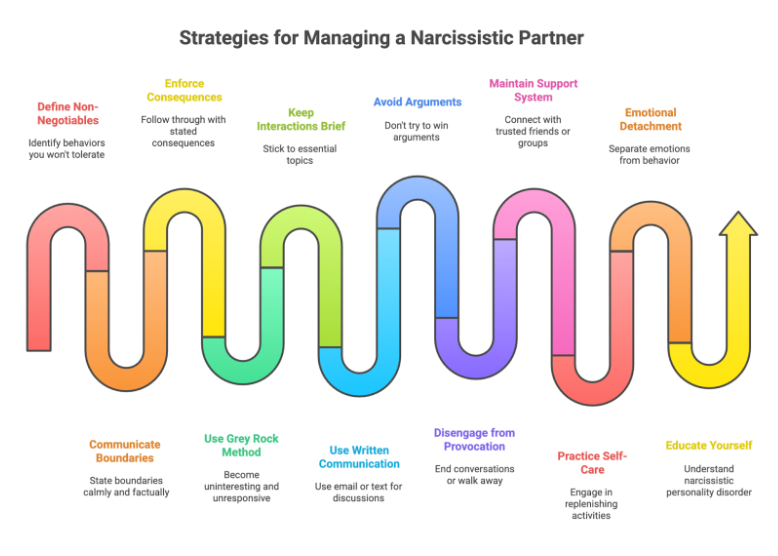
- Define Your Non-Negotiables: Clearly identify what behaviors you will no longer tolerate. This could be yelling, name-calling, gaslighting, or financial demands.
- Communicate Clearly and Concisely: State your boundary calmly and factually, without emotion or lengthy explanation. For example, "If you raise your voice, I will end this conversation and leave the room."
- Enforce Consequences: This is the most crucial step. If a boundary is crossed, you must follow through with the stated consequence. This teaches the narcissist that your boundaries are real and your word is your bond.
- The "Grey Rock" Method: The "Grey Rock" Method is a powerful technique that involves becoming as uninteresting and unresponsive as a "grey rock" when interacting with a narcissist. One person on Reddit described: “You basically become as boring as possible and only answer questions directly.” Using neutral language and minimal emotional fuel reduces their ability to pull you into their drama.
Limited Contact and Strategic Responses
When leaving is not yet on the table, you can still dial down the emotional entanglement.
- Keep Interactions Brief and Factual: Stick to essential topics. Avoid emotional discussions, justifications, or explanations, as these provide ammunition for their manipulation.
- Use Written Communication: For crucial discussions (especially co-parenting or financial matters), use email or text. This creates a clear record, prevents gaslighting, and allows you to respond thoughtfully rather than reactively.
- Don't Try to "Win": Engaging in arguments or trying to prove your point only feeds the narcissist's desire for conflict and control. They will twist your words and blame you, leaving you more frustrated and drained. Your goal is self-preservation, not victory.
- Disengage from Provocation: Narcissists "know exactly how to get under your skin". When they try to provoke a reaction, disengage immediately. End the conversation, walk away, or ignore the message. Your peace is paramount. For example: “I’m sorry you feel that way. Let’s speak when we’re both calm.”
- Maintain your circle: Speak to friends, therapist, trusted person who can mirror your reality and help you ground your perception.
Self-Care and Reclaiming Your Inner World
Surviving this means reclaiming your interior life. Your emotional, spiritual and physical well-being matter. This isn't selfish; it's essential for your healing.
- Practicing Self-Care: Engage in activities that genuinely replenish you, whether it's exercise, creative hobbies, meditation, spending time in nature, or simply quiet reflection. Self-soothing techniques help calm the chronically hypervigilant nervous system. Maybe you stopped painting, dancing, writing because it didn’t “fit” the relationship anymore. Re-connect with them.
- Building a Strong Support System: Connect with trusted friends, family, or a support group who truly understand what you're going through. Validation from others is crucial when your reality is constantly being undermined.
- Emotional Detachment: Learn to separate your emotions from the narcissist's behavior. Understand that their actions are a reflection of their disorder, not your worth. This helps you "not let them get to you or ruin your day".
- Educate Yourself: Understanding narcissistic personality disorder (NPD) and its manipulative tactics helps you depersonalize the abuse. Knowledge is power in regaining control of your narrative and recognizing their patterns.
- Affirm your worth: Daily reminders that your feelings are valid, your needs matter.
- Inner work: Narcissistic relationships often keep your nervous system in fight/flight/freeze mode. Use grounding practices like breathing, yoga, gentle movement, touch awareness. Journaling or writing out what happened, how you felt, what you would want in future. It helps reverse gaslighting internally.
When to Consider Leaving: The Path to Liberation
Sometimes, despite therapy or strategic boundaries, the relationship remains emotionally unsafe. If manipulation, emotional abuse, or isolation persist, it may be time to consider leaving. Ending a relationship with a narcissistic partner can trigger intense self-doubt and grief. Working with a therapist during this phase is crucial, not to “fix” them, but to support you through disentangling from the trauma bond.
Many survivors emphasize that no contact is the "only way" or "true fix" for dealing with a narcissistic partner. This often stems from the painful, yet liberating, realization that narcissists typically do not change.
Recognizing the Point of No Return
You might ask yourself: “How do I know I’m done trying?”
- Your mental or physical health is deteriorating.
- You’ve repeatedly tried safety-measures, boundary-work, therapy, and still the same cycle continues.
- The partner shows no interest in introspection or repair, only in controlling.
- You realise you are more invested in fixing the relationship than living your life.
One Reddit voice puts it: “They will break you down until there’s nothing left. … You’ll be left a shell of your former self.”
Accepting the Unchanging Nature
A common misconception is that narcissists can be "cured" or will change if their partner is patient or empathetic enough. However, experts often say that narcissists rarely change significantly. They lack the capacity for genuine self-reflection and empathy required for fundamental change, and empirical evidence suggests they may even worsen with age. Holding onto hope for change only prolongs your suffering.
Safety Planning: Emotional, Physical, Financial
Leaving a narcissistic partner can be dangerous, as they may escalate their tactics when they lose control. Prioritize your safety above all else.
- Emotional Preparation: Seek support before you leave. This emotional fortification is vital for the challenging road ahead.
- Physical Safety: If you fear for your physical safety, create a detailed safety plan, including a safe place to go, a packed "go bag" with essentials, and a trusted contact.
- Financial Independence: Start discreetly saving, collecting important documents, opening an account under your name. Financial abuse is a common tether
- No-contact strategy: If you can, limiting or terminating contact helps cut the cycles of manipulation.
- Therapy: Engage a trauma-informed therapist who understands narcissistic relational trauma. This is not just “couples therapy”- style; this is safety, regulation, healing, rebuilding. Book your free discovery call with Coach For Mind.
Healing and Reclaiming Your Self
Leaving a narcissistic relationship isn’t just about walking away, it’s about walking back to yourself. It’s a process of peeling away years of manipulation, shame, and self-doubt to rediscover who you were before the control took hold.
It’s slow, it’s painful, and it’s deeply human. But every small step is a step toward freedom - emotional, psychological, and spiritual.
Navigating the Separation: "No Contact" and Its Challenges
The “no contact rule” is one of the hardest yet most essential boundaries you’ll ever set. It means cutting off communication completely: blocking calls, messages, emails, and avoiding shared spaces. It’s not cruelty; it’s self-preservation. When survivors talk about this online, there’s a common theme - the fear of silence. One Quora user wrote, “You want to know if they miss you as much as you miss them. That’s normal too. It took strength for you to block them and you have to take that strength and put it to work for you making your life better.” That “withdrawal” feeling is real. Neuroscience shows that trauma bonds activate the same brain regions as addiction and withdrawal, creating cravings for contact even when the relationship is harmful.
- Dealing with "Hoovering": Narcissists often attempt to "hoover" or suck you back into the relationship with apologies, promises, or even threats when they sense you pulling away. You might hear, “I’ve changed,” or “You’ll never find someone like me.” These are not signs of remorse, they’re manipulation tactics designed to regain control
- "Flying Monkeys": They may recruit mutual friends or family members ("flying monkeys") to pressure you to reconcile or gather information, often under the guise of concern. In narcissistic systems, enablers play a major role in keeping the cycle going. Setting firm boundaries or limiting contact with such individuals protects your peace and healing space.
- Coping with Confusion and Anger: Post-separation, you might teeter between hoping they reach out to apologize / talk, and also being so angry that they don’t care. This emotional rollercoaster is a normal part of processing the trauma bond and grief. Allow yourself to feel it.
Undoing the Damage: "Un-grooming" Your Mind
After leaving, one of the hardest parts isn’t physical distance, it’s the mental ungrooming: gently dismantling those false narratives. One of the most critical aspects of healing is "un-grooming" yourself from the narcissist's manipulation and internalized narratives. Narcissistic abuse often involves years of rewriting your sense of worth, truth, and perception of reality.
- Cognitive Reframing: You may hear echoes of their voice in your mind — “You’re too sensitive,” “You’ll never manage without me,” “You’re the problem.” Cognitive-behavioral work helps you challenge these internalized lies and replace them with truth: "I am worthy of love and respect." or “I can take care of myself.” CBT and trauma-informed approaches are proven to help survivors of narcissistic abuse rebuild healthy thinking patterns.
- Rebuilding Your Identity: Narcissistic relationships often hollow out your sense of self. Many survivors say, “I don’t even know who I am anymore.” Healing means reconnecting with lost parts like old hobbies, music, friends, creativity, solitude. Start small: take a morning walk or explore something that once made you feel alive. Ask yourself: “What parts of me were silenced?” and “Who was I before their voice became louder than mine?” This could be an opportunity to find new creative pursuits like journaling. Writing is both reflection and reclamation. Studies show journaling can significantly improve
- Mindfulness and Self-Compassion: Practice being present and kind to yourself. Acknowledge the pain you've endured and offer yourself the empathy and understanding the narcissist never did. You'll have days of strength and days of collapse — both are valid. Mindfulness helps you recognize triggers as remnants of old pain, not signs of relapse.
Seeking Professional Support: Your Allies in Healing
Abuse keeps your body in constant survival mode - hyper-alert, tense, and anxious. Long after leaving, your nervous system may still act as though danger is imminent. Healing requires retraining your body to feel safe again. As your sense of safety returns, you may begin to explore what healthy connection looks like again, both with yourself and others.
Therapy can help with rebuilding trust in a relationship, autonomy, and a secure attachment to self. At Coach for Mind, we often see that relational trauma leaves survivors doubting their own perceptions and feeling unsafe even in kind relationships. The goal of therapy isn’t just insight, it’s reconnection.
Effective therapeutic paths may include:
- Trauma-informed CBT: To dismantle guilt, self-blame, and learned helplessness.
- Schema Therapy: To uncover early attachment wounds that made you vulnerable to narcissistic dynamics, such as the need to rescue, the fear of abandonment, or chronic people-pleasing
- Somatic and Polyvagal Work: To restore safety in the body and help you regulate emotions after years of volatility. Somatic therapists often use Polyvagal-informed exercises to calm the body’s defense systems and restore connection.
- Relational Repair: Relearning what trust, safety, and mutual respect feel like , with a therapist first, then in life.
- Support Groups: Connecting with others who have similar experiences can provide invaluable validation, coping strategies, and a vital sense of community. You are not alone.
Advanced Strategies for Unique Situations
While “no contact” remains the most effective path to healing, life’s complexities like shared children, financial dependence, family ties, or professional entanglements can sometimes make complete separation difficult. In such cases, healing requires both strategy and self-compassion. You’re not failing for needing boundaries instead of total distance, you’re adapting to reality with strength and care.
Co-Parenting with a Narcissistic Ex: Protecting Your Children
Co-parenting with a narcissistic ex-partner is often one of the most emotionally draining and legally complex challenges survivors face. The goal isn’t to “fix” the dynamic, it’s to minimize conflict and safeguard your child’s emotional safety.
- Parallel Parenting: This approach minimizes direct interaction between co-parents. All communication should be factual, child-focused, and in writing. Avoid phone calls or in-person exchanges.
- Strict Boundaries and Schedules: Work with a lawyer or mediator to create detailed parenting plans including schedules, holidays, decision-making rights, and financial responsibilities. Narcissistic exes often thrive on ambiguity; clarity protects you. Stick to them rigidly, and do not deviate.
- Document Everything: Keep meticulous records of all communication, missed visitations, and any concerning behavior from the narcissistic parent. This is crucial if legal intervention becomes necessary.
- Protecting Children from Manipulation: Narcissistic parents may attempt parental alienation, turning children against you or making them feel responsible for adult conflicts. Never retaliate by speaking ill of the other parent. Instead, validate your child’s emotions: “I’m sorry that happened. You didn’t do anything wrong.” This gentle reassurance anchors your child in safety and truth. If you notice anxiety, guilt, or withdrawal in your child, consider child therapy with a trauma-informed practitioner who understands high-conflict family dynamics
- Legal Considerations: Consult with a family law attorney experienced in high-conflict divorces and narcissistic abuse to understand your rights and protect your children's best interests.
Regaining Financial Independence: Breaking the Chains of Economic Abuse
Financial control is one of the most powerful ways narcissists maintain dominance. Survivors often describe feeling “trapped, even after leaving” because of lingering debt, fear, or economic instability.
- Identify Subtle Financial Control: Recognize patterns like your partner controlling bank accounts, scrutinizing your spending, discouraging your employment, or creating debt in your name.
- Build Personal Assets Discreetly: If still in the relationship, start saving small amounts of money in a separate, undisclosed bank account. Gather copies of all important financial documents (bank statements, tax returns, deeds, titles).
- Create a Budget and Financial Plan: Understand your current financial situation and develop a realistic plan for financial independence, including income generation and debt repayment.
- Seek Legal and Financial Advice: Consult a financial advisor or legal expert specializing in domestic or economic abuse. They can help you understand your rights, recover assets, and prevent further exploitation. In India, for instance, domestic violence laws under the Protection of Women from Domestic Violence Act (2005) also recognize economic abuse as a legitimate form of violence.
Financial recovery is not just practical, it’s psychological. It restores agency and teaches your nervous system what safety feels like when you no longer depend on the person who hurt you.
Managing Narcissistic Dynamics in Non-Romantic Relationships
Narcissistic dynamics can surface beyond romantic contexts, in parents, siblings, friendships, or the workplace. Recognizing these patterns helps you protect your emotional space without unnecessary guilt.
- Adult Children of Narcissistic Parents: Growing up with a parent who oscillates between criticism and conditional affection leaves deep wounds. Healing often begins by grieving the relationship you wished you had and accepting the one you did. Boundaries may mean limited contact or even no contact if the abuse continues. Therapy can help you process long-standing guilt and rebuild an internal sense of worth separate from parental approval.
- Siblings/Friends: You have the power to choose your level of engagement. Practice grey rocking and set firm boundaries. It's okay to distance yourself from relationships that are consistently draining or toxic. Your peace matters.
- Professional Relationships: Maintain unwavering professionalism. Keep interactions strictly work-related and document all communications. Avoid personal disclosures. Focus on your performance and seek support from HR if the behavior constitutes harassment or a hostile work environment.
When to Seek Professional Support
If you find yourself saying things like “I feel like I’ve lost myself,” “I’m walking on eggshells,” or “I can’t trust my own memories anymore,”these are not overreactions. They’re signs of trauma.Consider trauma-informed therapy at Coach For Mind if you experience:
- Persistent depression, anxiety, nightmares, or hypervigilance
- Loss of identity or emotional numbness
- Physical symptoms (heart racing, fatigue, dissociation)
- Complex situations involving children, finances, or family ties
- Patterns that echo early-life trauma or generational cycles
A therapist trained in narcissistic abuse recovery, C-PTSD, and attachment repair can help you navigate this safely. At Coach for Mind, we emphasize culturally attuned therapy, understanding how Indian relational and familial systems often normalize dependency, guilt, or self-sacrifice. Healing means reclaiming autonomy without disconnecting from your cultural values of family and care - finding balance, not rebellion. Therapy provides a compassionate, structured space to understand what happened, rebuild trust in your emotions, and repair your relationship with yourself. Effective approaches include:
- Cognitive Behavioral Therapy (CBT): To challenge internalized guilt, shame, and cognitive distortions planted by the abuser.
- Schema Therapy: To explore early-life patterns like fear of abandonment or people-pleasing, that might have made the narcissist’s attention feel familiar or irresistible.
- Somatic and Polyvagal Work: To calm the body’s chronic hypervigilance, helping your nervous system rediscover safety.
Healing isn’t about labeling the narcissist, it’s about understanding why the dynamic felt magnetic and learning how to choose differently next time. Therapy gently guides you back to your intuition, that quiet voice that always knew something wasn’t right.
Moving Forward
The journey of healing from a narcissistic relationship is deeply personal and takes time. It involves confronting profound pain, rebuilding your identity from the ground up, and learning to trust yourself again. However, by understanding these insidious dynamics, implementing strategic boundaries, and fiercely prioritizing your well-being, you will break free from the cycle of abuse.
Embrace this process of profound self-reclamation. your future, free from the shadow of abuse, is waiting – a future filled with authentic self-worth, genuine peace, and healthy, reciprocal relationships. If you are navigating relational healing with a partner, explore our couples therapy in India services.
FAQs
Understanding narcissism, trauma bonds, boundaries, and how healing begins — safely and at your pace
It’s normal to wonder, the word “narcissist” is often used loosely, but narcissism exists on a spectrum. Being self-centered sometimes means someone lacks awareness or empathy in moments. True narcissistic personality traits run deeper: a chronic inability to take responsibility, lack of empathy, manipulation to maintain control, and emotional reactions that center only their own needs.
The key question isn’t whether they meet a diagnosis, but how you feel around them. Do you often feel small, confused, or like you have to manage their moods to stay safe? Are apologies rare, and accountability absent?
At Coach for Mind, we help clients focus less on labeling and more on impact. Using relational and attachment-based therapy, we explore how your body responds in the relationship — tightening, freezing, or walking on eggshells — signs your nervous system no longer feels safe. Through psychodynamic and somatic work, you learn to trust your own reality again.
Change is possible but only if they choose it, consistently, over time. Narcissistic traits form as deep protective adaptations, often rooted in early shame and emotional neglect. These defenses are rigid because they protect against vulnerability.
Love alone cannot undo those defenses. True change requires long-term, insight-oriented therapy, such as Schema Therapy, Psychodynamic Therapy, or Trauma-Focused CBT, where the person confronts their inner emptiness and shame without deflecting it onto others.
At Coach for Mind, we gently remind clients: You can’t love someone into self-awareness. Your empathy can invite growth, but it cannot create it. Healing begins by shifting your focus from “Can they change?” to “What happens to me when I keep waiting?”
Missing someone who hurt you doesn’t mean you’re weak, it means you’re human. Trauma bonds often create powerful emotional ties that mimic love but are built on cycles of intensity and relief: idealization, devaluation, and intermittent affection.
Your brain and body become addicted to that emotional rollercoaster. When the relationship ends, you don’t just miss the person, you miss the chemical highs of hope, validation, and relief.
In therapy, we use somatic and attachment repair work to help your nervous system stabilize after emotional volatility. IFS (Internal Family Systems) helps you meet the part that still longs for the “good” version of them, while another part holds the pain. Healing happens when those parts learn they can miss the fantasy and still protect your reality.
Couples therapy can be powerful, but only when both partners are willing to take responsibility and engage in self-reflection. In relationships with narcissistic dynamics, couples therapy often becomes unsafe because the narcissistic partner may use sessions to manipulate, deflect blame, or further shame the other.
At Coach for Mind, we first ensure safety before considering joint sessions. Often, individual trauma therapy for the survivor comes first. Using Somatic Regulation, Boundary Work, and Attachment Repair to rebuild a sense of autonomy. If the other partner is truly committed to therapy, they’ll seek individual treatment focused on accountability and empathy development.
Therapy should never be a space where you are re-gaslighted. Healing begins with safety, not performance.
With narcissistic or emotionally volatile partners, boundaries can trigger defensiveness or rage because they interpret limits as rejection. That doesn’t mean you shouldn’t set them. It means you must do it strategically and safely.
At Coach for Mind, we teach clients nervous-system-informed boundary setting:
- Ground yourself first (slow breath, orient to surroundings).
- State your limit briefly and calmly.
- Don’t over-explain or defend — clarity is safer than justification.
- Follow through with action, not debate.
Through Somatic Therapy, you’ll learn to regulate the body’s fear of conflict. IFS helps soothe the part of you terrified of losing love by asserting needs. Boundaries aren’t punishments — they’re acts of self-respect that teach your nervous system safety through consistency.
Trauma bonding happens when cycles of abuse and affection create a powerful emotional dependency. When the same person who causes pain also provides temporary relief, your body confuses intensity for love.
Each cycle of idealization and devaluation releases stress hormones followed by dopamine and oxytocin, creating a biochemical loop of hope and despair. You’re not “addicted to abuse”; your nervous system is hooked on intermittent safety.
Therapy at Coach for Mind helps you break this loop gently. Somatic and EMDR therapy process the body’s panic around separation. Attachment and IFS work help you comfort the parts that equate chaos with connection. Healing trauma bonds isn’t about cutting off emotion, it’s about teaching your body that peace doesn’t mean danger anymore.
This is one of the most painful and delicate challenges. You can’t control the other parent, but you can create a secure emotional base for your children within your care.
That means:
- Listening and validating their feelings without criticizing the other parent (children internalize loyalty conflicts as shame).
- Keeping predictable routines and calm environments — this helps regulate their nervous system.
- Teaching emotional language (“It’s okay to feel sad or scared”) to counteract gaslighting.
At Coach for Mind, we support parents through Attachment-Based Family Work and Parent Coaching, combining Polyvagal and Mindful Parenting tools to help your children’s bodies feel what consistent safety is.
Remember: one regulated parent can heal what two dysregulated ones can’t.
Control often begins subtly. Early signs include:
- Criticizing how you spend or dress.
- Wanting access to your accounts “for transparency.”
- Withholding affection or approval until you comply.
- Isolating you from friends or shaming your independence.
- Turning every discussion into your fault.
In therapy, we call this coercive control. It's less about money or power and more about eroding your autonomy. At Coach for Mind, we help clients name these behaviors early through Psychoeducation, Boundary Coaching, and Somatic Tracking. By noticing how your body tightens or shrinks in response to certain interactions, you begin to trust your internal alarm system again, often the first thing eroded in controlling relationships.
Narcissistic abuse erodes self-worth through constant invalidation, blame-shifting, and emotional withdrawal. Healing means rebuilding the inner relationship, the one you have with yourself.
At Coach for Mind, we integrate IFS, Compassion-Focused Therapy (CFT), and Somatic Regulation to help you reconnect with the parts of you that were silenced or shamed. We practice self-soothing, boundary repair, and body-based grounding to rebuild trust in your intuition.
You’ll begin to shift from “What’s wrong with me?” to “I did my best in a system that thrived on my self-doubt.” True self-esteem isn’t about confidence alone, it’s about safety. The moment you stop negotiating your worth is the moment healing begins.
Love is mutual and it honors two separate selves. Co-dependency blurs that line: your sense of peace depends on another person’s moods, choices, or validation. You might find yourself over-giving, rescuing, or feeling empty without their approval.
This often stems from early attachment experiences, learning love meant caretaking, compliance, or self-erasure. In therapy, we use Attachment Repair, Inner Child Work, and Somatic Awareness to help you reconnect to your own needs and boundaries. Through Psychodynamic exploration, you begin to see how your relational patterns repeat past dynamics, not as failure, but as a longing for repair. At Coach for Mind, we redefine love as interdependence: two grounded selves choosing each other freely, not fearfully.