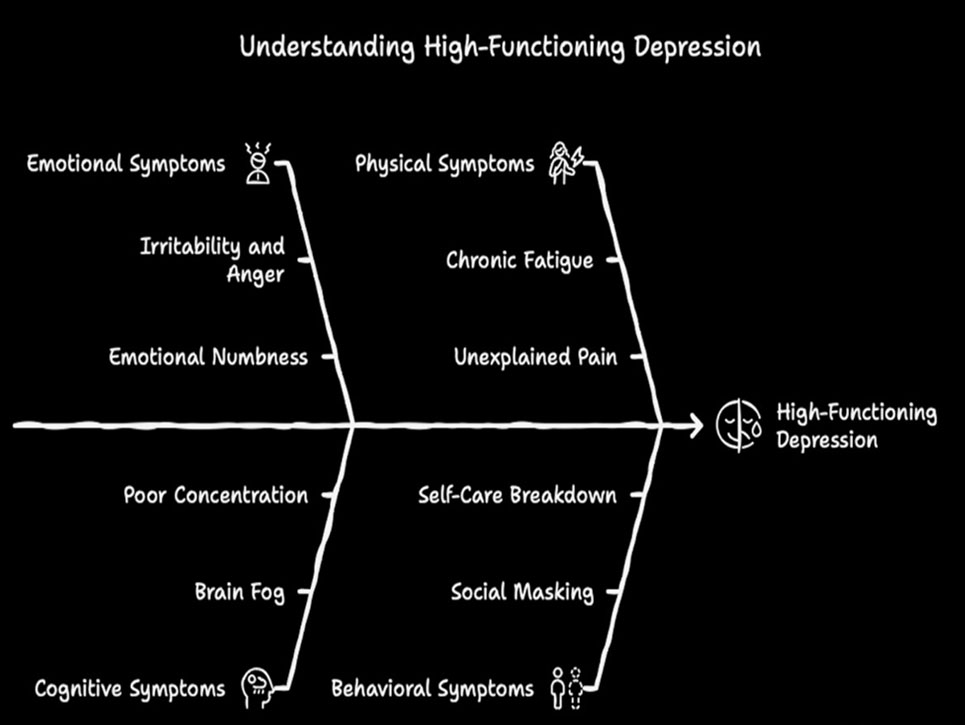
TL;DR
- Dysthymia, or Persistent Depressive Disorder (PDD), is a chronic form of depression marked by long-term low mood, fatigue, apathy, and reduced pleasure.
- “Low-grade” does not mean low impact; years of emotional depletion can profoundly affect identity, motivation, relationships, and self-worth.
- PDD is often missed or misdiagnosed because people remain outwardly functional and symptoms blend into daily life.
- Unlike Major Depressive Disorder, dysthymia is persistent rather than episodic, often starting early and becoming part of one’s perceived baseline.
- Effective treatment is long-term and integrative, combining medication (when appropriate) with specialized psychotherapy.
- Therapy helps by addressing identity fusion, relational withdrawal, trauma, and nervous system shutdown, along with negative thoughts.
- Modalities like CBASP, psychodynamic therapy, CBT, trauma-focused work, EMDR, somatic therapy, and group therapy each target different maintaining factors of dysthymia.
- Lifestyle interventions (sleep regularity, movement, social support) are foundational, not optional, but they work best alongside therapy.
Recovery from dysthymia is not about becoming happy all the time; it’s about feeling more alive, connected, and able to influence your own life again.
Dysthymia Explained: Why Long-Term Depression Needs Long-Term Care
Do you feel like you are perpetually running on 10% battery?
You might be holding down a job, showing up to family events, and replying to messages. On the outside, you look "functional." But inside, life feels strangely hollow - like you’re an NPC (non-player character) in your own story. You are present, but you aren’t really living.
For millions, this chronic, low-grade sense of exhaustion and emotional flatness isn’t a personality flaw or a "bad mood" that won’t quit. It is a clinical condition known as Dysthymia, or Persistent Depressive Disorder (PDD).
As one person with PDD described it: “The weight of feeling sad, kinda always, for over 3 decades has accumulated to become incredibly burdensome.” While another shared “I feel like it’s stolen my life.”
The good news is this: Dysthymia is treatable. But because it is chronic, overcoming it requires a different framework than short‑term depression. Not a quick fix. Not just “thinking positive.” But a long‑term, compassionate, and structured blueprint.
One reason dysthymia is so painful is because it rarely announces itself dramatically. There is no obvious “crash.” No clear breaking point. Instead, it slowly blends into daily life. Many people with PDD were praised for being responsible, mature, or resilient early on, learning to function through emotional depletion rather than questioning it. Over time, the absence of joy becomes familiar, even expected. This quiet normalization is not strength; it is survival.
This guide breaks down what Dysthymia really is, how it’s diagnosed, why it’s so often misunderstood, and what evidence‑based recovery actually looks like in a way that honors how hard this condition truly is. At Coach For Mind, we believe that "low-grade" depression deserves high-level care.
What Is Dysthymia?
One of the most harmful myths about dysthymia is that it’s mild. Yes, the symptoms may not always be as intense as a major depressive episode but their endurance is what makes them devastating.
Living for years with low energy, muted joy, and constant heaviness slowly erodes motivation, identity, and hope. We have to stop equating low-grade with low impact.
The Clinical Definition
According to the DSM-5, dysthymia is classified as Persistent Depressive Disorder (PDD).
To receive a diagnosis:
- Adults experience a depressed mood for most of the day, more days than not, for at least two years (one year for children/adolescents)
- Symptoms never fully remit for more than two months at a time
This chronicity, the unbroken stretch, is what differentiates PDD from episodic depression.
Why PDD Is Often Misdiagnosed or Missed Entirely
Because dysthymia is chronic and subtle, it is frequently mistaken for a personality style rather than a mood disorder. Individuals may be labelled as “naturally pessimistic,” “low-energy,” or “emotionally reserved,” especially if symptoms began in adolescence or early adulthood.
In clinical settings, PDD can also be overshadowed by anxiety disorders, burnout, or relationship distress, conditions that often coexist with it. Without careful longitudinal assessment, the underlying depressive baseline may remain unaddressed for years.
Core Symptoms and Diagnostic Criteria (DSM-5)
The symptoms are persistent and pervasive. To meet the criteria for PDD, you must experience at least two of the following:
- Poor appetite or overeating.
- Insomnia or hypersomnia (sleeping too much).
- Low energy or fatigue.
- Low self-esteem.
- Poor concentration or difficulty making decisions
- Feelings of hopelessness.
A defining feature of PDD is anhedonia, the reduced ability to feel pleasure and apathy, a disruption of motivation itself.
As many clients tell us: “I am always tired, and feel like it's a struggle to enjoy my daily life.”
“I feel like I am in a giant rut in my life.” This isn’t laziness. It’s a nervous system that has been running in survival mode for years
Dysthymia vs. Major Depressive Disorder (MDD)
| Feature | Persistent Depressive Disorder (Dysthymia) | Major Depressive Disorder (MDD) |
|---|---|---|
| Duration | Chronic; minimum two years (one year for minors). | Episodic; minimum two weeks. |
| Severity | Low-grade, persistent, functional impairment. | Severe, acute, often disabling. |
| Comorbidity Risk | High risk of developing MDD (Double Depression). | High risk of recurrence, but not chronic low mood |
| Treatment Focus | Long-term maintenance, interpersonal skills, behavioral activation. | Acute symptom relief, cognitive restructuring. |
Double Depression occurs when someone with PDD develops a major depressive episode on top of their chronic low mood. This is very common and often why people finally seek help.
Dysthymia vs Burnout vs Laziness
Many people with dysthymia delay seeking help because they assume they are simply burnt out, or worse, lazy. These distinctions matter, because each reflects a very different underlying process and therefore requires a very different response.
- Burnout is typically situational. It develops after prolonged stress, overload, or lack of recovery, often in work or caregiving roles. While deeply exhausting, burnout usually improves with rest, boundaries, reduced demands, or a change in environment.
Dysthymia is persistent and pervasive. It is not caused by one environment and does not fully lift with vacations, job changes, or time off. It often begins early, quietly becomes a person’s emotional baseline, and affects motivation, identity, and relationships over years.
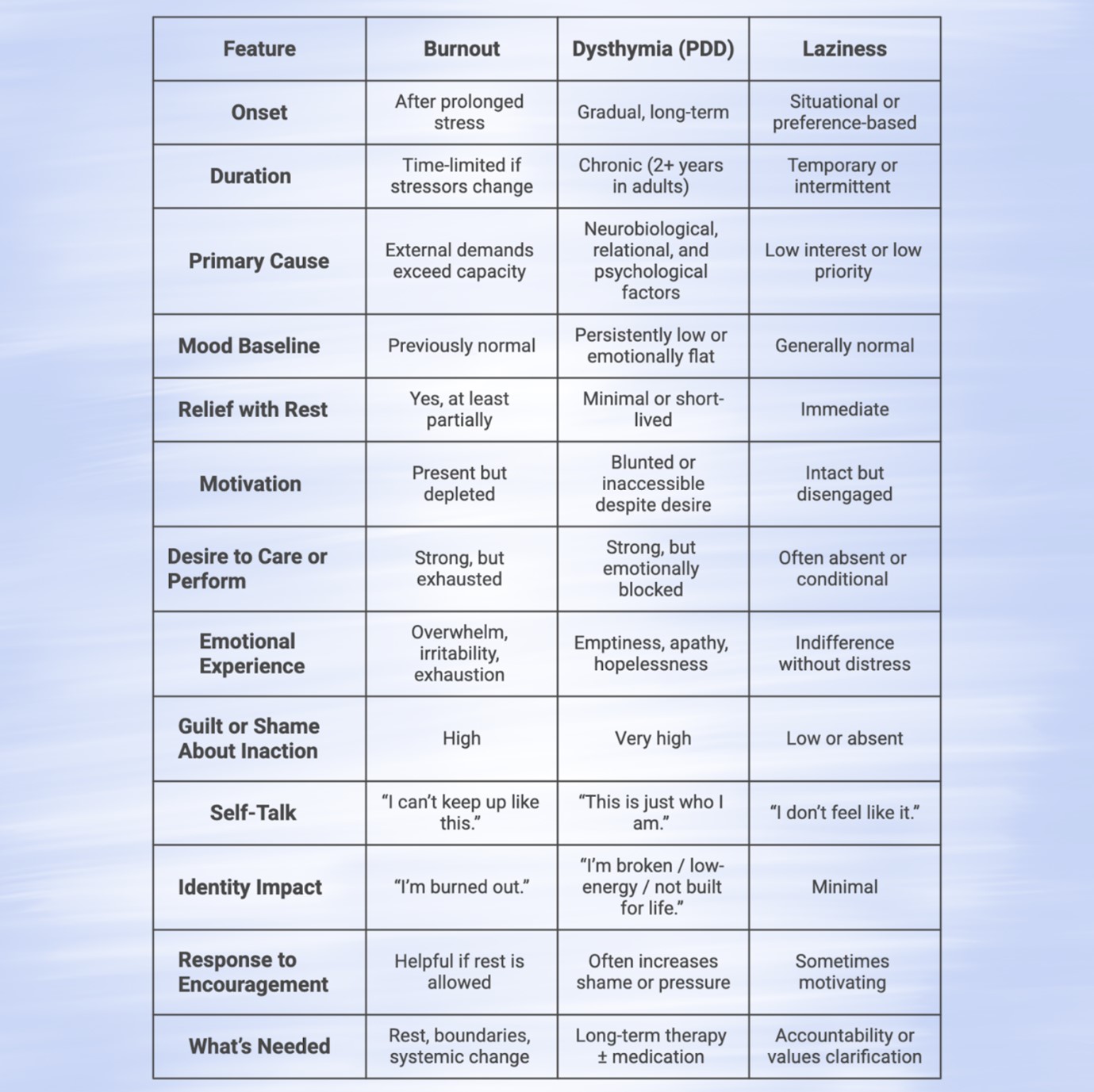
- Laziness implies a choice not to act despite having sufficient energy, interest, and emotional capacity. It does not involve chronic distress, shame, or a longing to feel different. If guilt, self-criticism, and shame accompany your “lack of motivation,” it is almost never laziness. Laziness does not cause years of suffering.
Many people with PDD experience burnout on top of dysthymia. Treating burnout alone, through rest or lifestyle changes, may bring temporary relief, but it does not address the underlying depressive baseline. Likewise, chronic guilt about “not doing enough” is not a sign of laziness; it is often a sign of depression that has gone unrecognised for years. Understanding the difference is often the first step toward seeking the right kind of help.
Dysthymia's Impact Unpacked
Dysthymia (Persistent Depressive Disorder) is sometimes referred to as “low-grade depression,” but this label minimises its true impact. While symptoms may appear less intense than a major depressive episode, they are chronic, often lasting years. The cumulative psychological cost can be profound, quietly reshaping how a person sees themselves, engages with life, and relates to others.
Identity: When Mood Becomes “Who I Am”
When low mood, fatigue, self-doubt, and pessimism persist over long periods, they stop feeling like symptoms and start feeling like personality traits. People often grow up or spend formative adult years with dysthymia, never knowing a different internal state. Over time, this can lead to identity fusion with depression:
- Sadness becomes interpreted as realism
- Emotional flatness becomes “being low-key” or “not expressive”
- Hopelessness becomes “being practical” or “not expecting much from life”
As therapists, I often notice this moment in sessions, the quiet pause when someone realizes they’ve never asked who they might be without the weight they’ve always carried. There is usually grief there. And relief. Naming dysthymia is not about pathologizing identity; it is about giving people permission to imagine themselves with more emotional room. At Coach for Mind, we commonly hear internal narratives like:
- “This is just my baseline.”
- “I’ve always been like this.”
- “Other people are naturally more alive than me.”
Because there is no clear “before,” individuals may not recognise that anything is wrong. Instead, they often blame themselves, believing they are inherently flawed, lazy, emotionally limited, or incapable of joy. This erosion of identity can quietly reduce self-compassion and shrink a person’s sense of possibility.
Motivation: When Willpower Is Not Enough
Motivation in dysthymia is not simply about mindset or discipline. Persistent depressive states affect the brain systems responsible for reward, anticipation, and effort. This means:
- Tasks don’t register as rewarding, even if they matter deeply
- The emotional “fuel” needed to start or sustain action feels unavailable
- Effort feels disproportionately exhausting compared to the outcome
People often want to care, to engage, to move forward but the internal experience is one of heaviness, numbness, or indifference. This creates painful self-contradictions:
- “I know this matters, but I feel nothing.”
- “I want to want more from my life.”
- “Everything feels like too much, even when nothing is wrong.”
In reality, this is not a lack of ambition or character, it is a neuropsychological impact of long-term depression that blunts drive and distorts effort.
From a nervous system perspective, dysthymia often reflects long-term dorsal vagal shutdown, a state where the body conserves energy after prolonged emotional stress. When the system has learned that effort does not reliably lead to safety, reward, or relief, motivation naturally diminishes. This is not resistance; it is protection. Healing motivation, therefore, is less about pushing harder and more about restoring safety, predictability, and emotional reward over time.
Functionality: The Cost of Being “High-Functioning”
One of the most overlooked aspects of dysthymia is how many people continue to function outwardly. They go to work, meet responsibilities, care for others, and appear “fine.” This often leads to reassurance from others and dismissal of their own pain. But functioning does not equal thriving.
Behind the scenes, many experience:
- Chronic emotional loneliness, even in relationships
- A sense of disconnection from joy, intimacy, and meaning
- Social withdrawal masked as independence or introversion
- Difficulty maintaining friendships due to low energy, flat affect, or apathy.
The “high-functioning” mask can delay help-seeking for years. People may tell themselves:
- “It’s not bad enough for therapy.”
- “Others have it worse.”
- “This is just adulthood.”
Yet the emotional cost accumulates, leading to burnout, increased isolation, and sometimes the sudden onset of a major depressive episode after years of endurance.
Differentiating Between Symptoms vs. Self
Because PDD often starts early in life, many people mistake their symptoms for their personality. You might think, "I'm just a pessimistic person" or "I'm just lazy."
This is the "identity trap" of chronic depression. Learning to separate the illness from your identity is a pivotal therapeutic shift. It is crucial to understand that the negative traits often associated with PDD such as chronic pessimism, self-criticism, and social withdrawal are symptoms, not character defects.
| PDD Symptom | Often Mislabelled As |
|---|---|
| Apathy/Anhedonia | Lazy, Unmotivated |
| Low Self-Esteem | Insecure, Needy |
| Pessimism | Negative, Difficult to be around |
| Social Withdrawal | Cold or uninterested |
This confusion is one of the most damaging aspects of dysthymia. “I feel like it’s stolen my life.” Learning to separate the illness from the self is the first step toward self-compassion and effective treatment.
The Cost of the High-Functioning Mask
Many with PDD are considered "high-functioning." They maintain jobs, manage families, and socialize, often by expending immense emotional energy to hide their internal suffering.This High-Functioning Mask is a survival mechanism, but it prevents true healing by maintaining the illusion that everything is fine.
The mask leads to profound loneliness. Over time, sustaining this mask often leads to emotional burnout or sudden collapse. Many individuals with PDD seek help only after developing severe anxiety, physical health symptoms, or a major depressive episode, not because the dysthymia was mild, but because endurance finally ran out. Recovery requires consciously lowering the mask and prioritizing emotional energy and making life sustainable.
Dysthymia in High Achievers: When Functioning Masks Suffering
Dysthymia is not limited to people who struggle outwardly. In fact, it is disproportionately common among high achievers, individuals who are competent, responsible, productive, and often admired.
Many high-functioning individuals with PDD:
- Excel academically or professionally
- Are dependable, conscientious, and self-sacrificing
- Rarely “fall apart” publicly
- Receive praise for resilience, discipline, or maturity
But internally, they often experience:
- Chronic emptiness rather than sadness
- A sense of life being joyless or mechanical
- Difficulty feeling pride, satisfaction, or reward even after success
- Persistent self-criticism despite objective achievement
For high achievers, dysthymia often hides behind over-functioning. Productivity becomes a way to stay numb. Structure replaces pleasure. Achievement replaces emotional nourishment. To know more about high-functioning depression, you can click here.
Because they meet external expectations, high achievers are often the last to be identified, both by others and by themselves. Therapy is frequently delayed until burnout, anxiety disorders, relationship breakdowns, or a major depressive episode forces a pause.
In therapy, many high achievers discover that their drive was not just ambition but a long-standing adaptation to emotional neglect, unpredictability, or early pressure to perform. Healing dysthymia in high achievers is not about lowering standards; it’s about restoring aliveness, flexibility, and self-worth that isn’t earned through exhaustion.
Step 3: Navigating Professional Treatment
Given the chronic nature of PDD, recovery is not about eliminating sadness overnight. It is about gradually rebuilding emotional range, motivation, and self-trust. Progress is often slow, nonlinear, and deeply relational. Effective treatment respects the long-term nature of the condition and focuses on consistency, compassion, and recalibrating what “feeling better” truly means.
Combination Treatment
The gold standard for PDD is a mix of medication and structured psychotherapy. Because symptoms are long-standing and often intertwined with identity, habits, and nervous system functioning, single interventions rarely address the full picture.
Medication
SSRIs or SNRIs are commonly prescribed first-line treatments. For many people, medication helps reduce the constant emotional heaviness, mental fatigue, and cognitive slowing that make therapy and daily functioning difficult. Because PDD is chronic, treatment often lasts 1–2 years or longer to allow the brain’s baseline mood and stress response to meaningfully recalibrate.
That said, medication for PDD is rarely a simple or linear experience.
Medication Resistance
A significant number of individuals with PDD experience partial response or non-response to antidepressants. This is not a personal failure or a sign that “nothing will work.” Chronic depression involves long-term neurobiological changes, early relational patterns, and trauma-related nervous system adaptations that medication alone cannot always shift.
Medication resistance may look like:
- Mood lifting slightly, but emptiness or lack of motivation persisting
- Reduced sadness, but continued numbness or disengagement
- Temporary improvement followed by plateauing
When this happens, psychiatrists may explore:
- Augmentation strategies: adding another medication (such as mood stabilizers or atypical antidepressants) to enhance effect
- Medication class changes: moving beyond SSRIs/SNRIs when needed
- Alternative biological treatments: such as Transcranial Magnetic Stimulation (TMS) for treatment-resistant chronic depression
- Pharmacogenetic testing: which may offer clues about how your body metabolizes different medications and reduce trial-and-error
Resistance does not mean medication has “failed”, it often means the treatment plan needs to be more nuanced and collaborative.
Side Effects and Emotional Trade-offs
Side effects are one of the most common reasons people feel discouraged or discontinue medication. These can include:
- Emotional blunting or increased apathy
- Sleep disturbances (insomnia or excessive sleepiness)
- Sexual side effects
- Gastrointestinal discomfort
- Increased anxiety early in treatment
For people with PDD, this can feel especially disheartening, when energy is already low, managing side effects can feel like an additional burden. It’s important to know that:
- Side effects are not something you should simply “tolerate” in silence
- Dosage adjustments or slow titration can significantly reduce discomfort
- Sometimes what looks like “emotional numbing” is actually unresolved depression that needs deeper psychotherapeutic work alongside medication
Medication is meant to support life, not flatten it. Ongoing dialogue with a psychiatrist is essential.
Psychotherapy: Treating What Medication Can’t Reach
While medication can reduce symptom intensity, psychotherapy addresses the relational, emotional, and behavioral patterns that keep PDD entrenched.
Specialized therapies for chronic depression focus on:
- Rebuilding a sense of agency (“my actions matter”)
- Repairing long-standing relational expectations (“nothing I do changes things”)
- Increasing emotional range rather than just reducing sadness
- Understanding how early experiences shaped current self-beliefs and coping styles
Therapy helps you reconnect with the world, yourself, and others in ways medication alone cannot. Over time, this combination, biological support plus relational repair, creates the conditions for genuine, sustainable change.
How Therapy Helps in Dysthymia (PDD)
At Coach For Mind, therapy for dysthymia is not about “fixing negativity” or forcing motivation. It is about gently undoing years of emotional adaptation, helping the nervous system relearn safety, and rebuilding a sense of agency, connection, and vitality. So book your free discovery call with us today.
Why Dysthymia Needs Therapy (Not Just Symptom Relief)
Persistent Depressive Disorder doesn’t just affect mood. Over time, it shapes:
- how you relate to yourself (“I’m just low-energy”)
- how you interpret relationships (“People don’t really need me”)
- how you respond to effort (“Why try? It won’t change much”)
These aren’t just thoughts, they’re deeply learned patterns, often formed early in life and reinforced quietly over years. That’s why short-term, surface-level interventions often feel disappointing for PDD. The work required is not about “fixing negativity,” but about undoing long-standing emotional learning.
Therapy helps by working at three levels simultaneously:
- Symptom management (energy, motivation, hopelessness)
- Relational repair (withdrawal, apathy, loneliness)
- Identity separation (“this is not who I am—this is something I carry”)
Therapy Modalities Used in Treating Dysthymia
- Cognitive Behavioral Analysis System of Psychotherapy (CBASP)
CBASP is uniquely designed for chronic depression. Unlike standard CBT, which focuses primarily on identifying and restructuring current negative thoughts, CBASP works with the long-standing interpersonal and behavioral patterns that maintain dysthymia.
People with dysthymia often live with an implicit belief: “Nothing I do makes a difference.” CBASP directly challenges this belief, not through reassurance, but through lived experience.
Core Elements of CBASP
- Situational Analysis: Clients learn to examine specific real-life situations:
- What did I want?
- What did I do?
- What actually happened?
- How did my behavior contribute to the outcome?
This helps clients see cause-and-effect links that chronic depression tends to obscure.
- Interpersonal Learning: CBASP focuses on how past relational trauma shapes present interactions. Clients begin to recognize how early experiences with neglect, criticism, or emotional unavailability influence current withdrawal, passivity, or hopelessness.
- Restoring Perceived Impact: A central goal of CBASP is helping clients experience themselves as having an effect on others. This is critical for people with PDD, who often feel invisible, irrelevant, or emotionally disconnected.
Over time, CBASP helps patients modify entrenched patterns of disengagement and learn that their actions can lead to different, and better outcomes.
- Group Therapy
Even when medication successfully reduces core depressive symptoms, many individuals with PDD continue to experience residual symptoms and impaired psychosocial functioning. Research has shown that adding manualized group psychotherapy to medication leads to significant additional improvements in interpersonal and psychosocial functioning. Group Therapy is especially powerful for PDD because:
- Breaks Isolation: Chronic depression often comes with a sense of being fundamentally different or emotionally alone. Group therapy provides lived evidence that others struggle in similar ways.
- Real-Time Relational Feedback: Patterns like withdrawal, self-silencing, or pessimism show up naturally in groups. This allows for gentle awareness and experimentation with new ways of relating.
- Strengthens Social Functioning: Research indicates that while therapies like CBT and IPT are similarly effective in reducing depressive symptoms, group formats significantly enhance interpersonal functioning - an area where medication alone often falls short.
- Psychodynamic Therapy
Psychodynamic therapy is especially valuable for dysthymia because it focuses on what has been emotionally carried for years, often outside awareness. People with PDD frequently have:
- Internalized critical or emotionally absent caregivers
- Long-standing feelings of guilt, emptiness, or inadequacy
- A sense that joy or desire is unsafe or undeserved
Psychodynamic work helps by:
- Identifying unconscious beliefs formed in early relationships
- Understanding how early emotional neglect or inconsistency shaped current mood and identity
- Exploring why sadness, emotional flatness, or self-criticism became “familiar”
Rather than pushing change, this approach allows clients to understand why depression made sense once, which often reduces shame and self-blame, two powerful maintainers of dysthymia.
- Cognitive Behavioral Therapy (CBT)
CBT remains an important component of dysthymia treatment, particularly when adapted for chronic depression. In PDD, negative thoughts are not fleeting, they are well-rehearsed life philosophies, such as:
- “Nothing will really change”
- “Trying leads to disappointment”
- “I should expect less from life”
At Coach for Mind, therapists are trained in CBT and it helps by:
- Identifying automatic pessimistic thinking patterns
- Challenging cognitive distortions shaped by years of depressive reinforcement
- Supporting behavioral activation when motivation is chronically low
However, in dysthymia, CBT works best when combined with deeper relational or trauma-informed approaches, as thoughts alone are often rooted in emotional memory rather than logic.
- Trauma-Focused Therapy
Many individuals with dysthymia have histories of:
- Emotional neglect
- Chronic invalidation
- Growing up with depressed, addicted, or unpredictable caregivers
- Long-term stress rather than single-event trauma
Trauma-focused therapy recognizes dysthymia as a state of emotional shutdown, not weakness. This work focuses on:
- Understanding depression as a nervous system adaptation
- Identifying freeze or collapse responses (low energy, numbness, disengagement)
- Rebuilding emotional safety before pushing for change
Trauma work helps clients move from surviving quietly to feeling again, at a pace that does not overwhelm the system.
- EMDR (Eye Movement Desensitization and Reprocessing)
While EMDR is often associated with PTSD, it can be highly effective for dysthymia, especially when depression is linked to unresolved emotional memories. EMDR helps by:
- Processing early experiences of rejection, neglect, or chronic failure
- Reducing the emotional charge of memories that silently reinforce hopelessness
- Shifting deeply held beliefs like “I’m not important” or “Nothing I do matters”
For many people with PDD, EMDR helps unlock emotional movement where talk therapy alone feels stuck. You can also book EMDR sessions offline in Gurgaon at our center.
- Somatic and Body-Based Approaches
Chronic depression often lives in the body as:
- Persistent fatigue
- Emotional numbness
- Low arousal or collapsed posture
- Difficulty accessing pleasure or desire
Somatic therapy focuses on:
- Reconnecting with bodily sensations safely
- Expanding emotional range without overwhelm
- Teaching the nervous system that activation and pleasure can be tolerated
These approaches are especially important for clients who understand their depression cognitively but feel emotionally unchanged.
Persistent Depressive Disorder doesn’t respond to one-size-fits-all solutions because it isn’t one single experience. Some people need structure and behavioral momentum, others need relational repair, and many need trauma processing before motivation is even accessible.
Therapy helps not through quick insights or forced positivity, but through a long-term rewiring process built on consistency, emotional attunement, and repeated corrective experiences. At Coach For Mind, treatment for dysthymia thoughtfully integrates CBT for day-to-day functioning, psychodynamic work for identity and meaning, trauma-informed approaches and EMDR for stuck emotional patterns, and group therapy to address chronic loneliness.
Dysthymia doesn’t mean you’re resistant to therapy; it means your system adapted early and deeply. Therapy works by understanding the logic of your low mood, respecting the pace of your nervous system, and gradually restoring choice, energy, and connection - until, as many clients say, “I didn’t become a different person; I became more available to my life.”
Coping Mechanisms & Lifestyle Interventions
The core struggle in Dysthymia is the lack of motivation and the inability to feel joy (anhedonia). You know what you should do, but you feel stuck in a "giant rut."
Lifestyle changes are not replacements for treatment but they form the foundation that allows treatment to work.
Regular movement improves energy, mood regulation, and motivation - even gentle, consistent activity counts. The goal is routine, not intensity.
- Sleep
Sleep disruption both fuels and maintains dysthymia. Consistent sleep-wake timing is one of the most powerful (and underused) interventions for chronic depression.
- Social Support
Because PDD is often misunderstood, relationships can suffer. Partners may mistake apathy for a lack of care or interest. To preserve relationships, use these communication strategies:
- Validate Their Feelings: Acknowledge that your symptoms (apathy, withdrawal) may hurt them.
- Use "Illness" Language: Frame your condition as a chronic illness, not a choice. Explain that your brain is struggling to produce motivation or pleasure.
- Ask for specific, practical support rather than emotional pressure
- Maintain low-stakes connection (short texts, brief check-ins)
- Behavioural Activation Techniques
In PDD, the "motivation" circuit is often broken. If you wait until you feel like doing something, you might wait years. Behavioral activation is about acting before the motivation appears.
- The Rule of Micro-Actions: We don't aim for "fun" yet; we aim for "engagement." Behavioral activation works by scheduling small, reliable sources of pleasure or mastery to gradually rebuild the brain's capacity for positive emotion. This is the direct antidote to apathy.

- Flow States and Brain Fog: Dysthymia often manifests as poor concentration and brain fog. Seek activities that induce a flow state, a mental state where you are fully immersed in an activity, and time seems to disappear. Flow activities are challenging but achievable, demanding full concentration. Examples include: intense exercise, deep reading, or engaging in a complex hobby (coding, painting). These activities temporarily override the negative rumination and apathy, providing genuine, non-passive engagement.
When to Seek Help for Dysthymia
Dysthymia is quiet and chronic, many people wait far too long before seeking support. You do not need to be in crisis to deserve care. Consider seeking professional help if:
- Your low mood, fatigue, or emptiness has lasted two years or more
- You cannot remember the last time you felt genuinely alive or hopeful
- Motivation feels absent even for things you value
- You function, but life feels flat, joyless, or disconnected
- Rest, vacations, or success do not improve your emotional state
- You frequently tell yourself: “This is just my personality” or “Others have it worse”
- You feel increasingly numb, withdrawn, or emotionally distant in relationships
- You are burning out repeatedly or fear collapsing if you stop pushing
Seeking help is not an admission of weakness. For dysthymia, it is often the first interruption of years of silent endurance. The earlier dysthymia is identified and treated, the less it has to steal, from identity, relationships, and the future. So reach out to Coach For Mind to seek help today.
The Takeaway: From Surviving to Living
Recovery from PDD doesn't start with a sudden burst of joy. It starts with one scheduled, compassionate action—taken even when you feel empty. It’s about moving from being a spectator in your life to becoming a participant again.
Dysthymia doesn’t scream, it erodes. But with the right long‑term approach, it is possible to reclaim energy, agency, and meaning.
Recovery doesn’t start with a breakthrough. It starts with one scheduled, compassionate action - even when you feel nothing. If this resonates, seek assessment from a licensed mental health counselor in gurgaon. You don’t have to keep surviving on 10% battery.
At Coach For Mind, we believe chronic pain deserves chronic care, not minimization. So book your free discovery call today.
Why Choose CoachForMind for Your Healing Journey?
At CoachForMind, we understand the unique experiences that you go through as you battle long-term depression.
Experienced and Licensed Psychologists: We are a team of licensed RCI-registered (Rehabilitation Council of India) mental health therapists in Gurgaon. Our team is well-experienced in various forms of therapies such as CBT, IFS, DBT, EMDR, Somatic and Narrative Therapy. Our expertise is verifiable, and our commitment to ongoing training ensures we deliver the most current and effective treatments. We also offer offline mental health sessions in gurgaon
Personalized, Client-Centered Approach
We are dedicated to treating our clients in the best-suited way, carefully curated as per the client's needs, and adhering to one-on-one, client-centered therapy. Every individual is different and every story is unique. We move beyond a one-size-fits-all model to create a safe, non-judgmental space where genuine healing can occur.
Scientific, Evidence-Based Techniques
Our treatment plans and therapeutic methods are based on highly researched scientific findings such as Cognitive Behaviour Therapy, Narrative Therapy, and Dialectical Behaviour Therapy. We believe in transparency and utilizing methods that have been proven effective in treating trauma. Our goal is to empower our clients, making them the authors of their own stories rather than passive recipients of a diagnosis.
Quality Service Grounded in Empathy
We at CoachForMind ensure quality services in our treatment regime and therapeutic approaches. Our clients hold most value to us, so we ground our techniques in empathy while maintaining the highest level of professionalism and confidentiality. We help you slow down the inner chaos so you can finally listen to what the masked trauma has been trying to tell you.
Begin with a free 15-minute discovery call For more information, please visit our website or contact us directly at coachformind@gmail.com
Written by Dr Kudrat: Clinical Psychologist at Coach For Mind
FAQs
It’s very common to ask this, especially when a low mood has been part of your life for so long that imagining anything different feels unrealistic.
Dysthymia (Persistent Depressive Disorder) isn’t best understood as something to be “cured” in the way an infection is. Instead, it can be significantly relieved and transformed. Many people don’t just feel “less depressed”, they experience more emotional range, motivation, and a clearer sense of self. Dysthymia often persists because it becomes woven into:
- Nervous system baseline states
- Long-standing thought patterns
- Relational and attachment dynamics
Therapy helps by working at these deeper levels rather than only targeting surface symptoms. At Coach For Mind, we use therapeutic approaches such as:
- CBASP (Cognitive Behavioral Analysis System of Psychotherapy): specifically designed for chronic depression; helps change entrenched interpersonal and emotional patterns
- Trauma-informed therapy: addresses early emotional neglect, relational trauma, and nervous system shutdown
- Psychodynamic therapy: explores long-standing emotional themes and unconscious beliefs about self and life
- CBT (adapted for chronic depression): targets pessimism, helplessness, and behavioral withdrawal
At Coach For Mind, therapy focuses on long-term change, helping clients gently shift patterns that developed over years, not weeks.
This question often carries a painful underline: “What if I’m beyond help?” That fear is understandable and inaccurate. Standard treatments sometimes fall short in dysthymia because this condition is often:
- Long-standing rather than episodic
- Rooted in early relational experiences
- More about emotional numbness and low vitality than acute sadness
Medication can help regulate mood, but it doesn’t address identity-level beliefs, attachment wounds, and chronic emotional shutdown. Similarly, short-term or symptom-focused therapy may not go deep enough.
Modalities that tend to work better include:
- CBASP: helps people experience the emotional impact they have on others, restoring agency
- Psychodynamic therapy: works with unconscious relational patterns and internalized self-criticism
- Trauma-focused approaches (EMDR, somatic work): address nervous system freeze and emotional blunting
- Schema therapy: targets deeply ingrained life patterns like defectiveness, emotional deprivation, or hopelessness
At Coach For Mind, therapists emphasize fit, depth, and pacing, rather than one-size-fits-all treatment.
Many people with dysthymia struggle here because the condition is invisible and long-standing. Others may say:
- “But you’re functioning”
- “You’ve always been like this”
- “Just think positively”
A helpful way to explain dysthymia is: “It’s not that I’m sad all the time - it’s that my baseline emotional state has been low for many years. It affects how I feel joy, motivation, and hope.”
Dysthymia impacts:
- Energy and emotional availability
- Self-worth and optimism
- Connection and responsiveness
Therapeutic support can help with this through:
- Psychoeducation-based therapy: learning language to explain the condition clearly
- Relational or attachment-focused therapy: understanding how dysthymia affects closeness
- Emotion-focused therapy (EFT): helping express feelings that are hard to articulate
- Couples or family-informed work (when appropriate): increasing understanding and support
At Coach For Mind, therapists often help clients find words for experiences they’ve lived with silently for years.
This isn’t a motivation problem, it’s a neuro-emotional one. In dysthymia, the brain’s reward and motivation systems can be chronically under-activated. Over time, the body learns to expect disappointment or emotional flatness, so it conserves energy by shutting down desire and pleasure.
Trying to “push yourself” often leads to guilt and exhaustion rather than joy. Therapy focuses on restoring emotional responsiveness, not forcing positivity.
Therapeutic approaches used at Coach For Mind include:
- Behavioral activation (adapted for chronic depression): gentle, values-based re-engagement with life
- Somatic and trauma-informed therapy: working with numbness and nervous system freeze
- CBASP: reconnecting actions with emotional outcomes
- Mindfulness-based approaches: rebuilding sensitivity to small emotional shifts
At Coach For Mind, the focus is on helping joy return gradually, rather than demanding it appear on command.
This is one of the hardest questions and one of the most important. When dysthymia starts early, it can feel indistinguishable from personality. Traits like being “low-energy,” “serious,” or “pessimistic” may actually be adaptive responses to long-term emotional stress or unmet needs.
Personality reflects who you are. Dysthymia reflects what you learned to survive.
The fact that these patterns feel familiar doesn’t mean they’re fixed.
Therapies that help untangle this include:
- Psychodynamic therapy: separating identity from adaptation
- Schema therapy: identifying long-standing emotional survival strategies
- Trauma-informed work: understanding early emotional environments
- CBASP: restoring a sense of agency and emotional impact
Coach For Mind works with this question gently, never trying to “change who you are,” but helping you discover who you are beneath chronic low mood.
Dysthymia is sometimes called “low-grade depression,” but this can be misleading. While symptoms may appear less intense at any given moment, dysthymia is often more pervasive and enduring. Its impact accumulates over time, affecting identity, relationships, self-esteem, and life choices.
Major depression tends to come in episodes. Dysthymia quietly shapes daily life for years.
Both deserve serious, compassionate treatment.
Effective therapeutic approaches include:
- CBASP: specifically developed for chronic depression
- Integrated CBT + psychodynamic work: addressing both symptoms and roots
- Trauma-informed therapy: especially when early adversity is present
- Longer-term relational therapy: supporting sustained change
Coach For Mind approaches dysthymia with the depth and seriousness it deserves—without pathologizing the person experiencing it.
Therapy costs at Coach For Mind vary depending on the therapist’s experience, specialization, and training, and typically range from ₹1500 to ₹4500 per session. We believe mental health care should feel accessible, not overwhelming, so we offer therapists across different pricing tiers, from early-career clinicians who are deeply trained and closely supervised, to senior therapists with advanced expertise in trauma, panic disorder, EMDR, and somatic therapies.
A higher fee doesn’t necessarily mean a “better” therapist - it just reflects different levels of experience and specialization. What matters most is fit, safety, and how understood you feel. Some clients thrive with a warm, structured therapist who works at ₹1500, while others feel supported by a trauma specialist who works at a higher rate. Your needs, not your budget, define the match.
How Coach For Mind helps you choose
During your discovery call, we talk about your symptoms, history, goals, and preferences, and then match you with someone whose style, modalities, and training fit best. If you need EMDR, somatic therapy, or advanced trauma work, we pair you with a specialist. If you prefer a gentler, skills-focused approach, we have therapists for that too.
We also value flexibility, if at any point you feel you need a different approach, we help you transition easily without judgment. The aim is simple: you get the right care, with the right therapist, at the right pace and price point for you.