TL;DR - Understanding and Healing Dependent Personality Disorder (DPD)
- DPD is not “clinginess”; it is a chronic fear of being unable to cope alone.
- It develops from early experiences where autonomy was unsafe or discouraged.
- DPD has two core layers: fear of abandonment + deep belief in personal incompetence.
- The body reacts to relationship distance as if it is a survival threat.
- Polyvagal theory explains why separation triggers panic, collapse, or urgent clinging.
- Healing requires an integrated approach:
- CBT to challenge the “helplessness” belief
- DBT to manage panic and distress
- Attachment work to heal early relational wounds
- Somatic tools to calm the nervous system
- Small autonomy-building steps rewire the brain toward self-trust.
- Assertiveness and boundaries reduce vulnerability to exploitation.
- Recovery is not about total independence, it’s about healthy interdependence.
- You can learn to feel safe both with others and with yourself.
Healing Dependent Personality Disorder: A Guide to Healthy Interdependence
For individuals living with Dependent Personality Disorder (DPD), life is often characterized by a pervasive, agonizing anxiety rooted in the belief that they are fundamentally incapable of functioning alone.
This isn't just "clinginess" or "neediness." This is a chronic, severe mental health condition that dictates every decision, relationship, and emotional response. The struggle is real and deeply painful,a paralyzing fear that forces you to prioritize maintaining a connection, regardless of the cost.
People often describe the chronic distress: the paralysis when faced with a simple choice, the desperate need for constant presence, and the willingness to endure mistreatment just to avoid the terror of abandonment.
If you’ve ever searched for “how to stop being clingy” or “anxiety about being alone,” this guide is written for you , practical, evidence-based steps to build confidence and tolerate separation. This guide offers clarity, validation, and a structured pathway toward building internal competence. We will define DPD, differentiate it from similar conditions, and provide actionable, evidence-based strategies for moving from pathological dependency to healthy interdependence.
Defining the Core Struggle of DPD
Dependent Personality Disorder (DPD) is classified in the DSM-5-TR as a Cluster C Personality Disorder, characterized by anxious and fearful characteristics. DPD is what happens when:
- You feel unable to manage life alone,
- You deeply doubt your own judgment and abilities, and
- You build your world around someone who feels like your emotional “anchor.”
The core isn’t just “wanting closeness.” Most of us want that. The core is a strong, painful belief: “I cannot function without someone else to guide me, reassure me, or stay with me.”
People with DPD often describe:
- Feeling “small” or “child-like” when alone
- Constantly seeking reassurance before making any decision
- Saying yes when they want to say no, just to keep the peace
- Feeling helpless, empty, or panicked if a relationship feels unstable
This pattern usually starts in late adolescence or early adulthood, but its roots are often much earlier. The core of DPD is a deep-seated and chronic belief in one’s own inadequacy. It is the self-perception of being “unable to function adequately without the help of others.”
The Two Deep Layers of DPD
Research suggests that DPD is not a single concept but rather a combination of two distinct, critical dimensions that explain its complexity and overlap with other disorders.
- Fear of Abandonment / Attachment Anxiety: This is the intense fear of being left, rejected, or emotionally “cut off.” Even small shifts, a shorter message, a delayed reply, a partner seeming tired, can feel like a threat. You may:
- Scan for signs that someone is “pulling away.”
- Do whatever it takes to keep them close (apologise, people-please, over-explain).
- Feel a desperate urgency to find a new person if one relationship ends.
This part overlaps with what we see in Borderline Personality features: big feelings, deep sensitivity to distance, and a sense that abandonment = emotional death.
- Belief in Incompetence / “I Can’t Do Life Alone”: This is the quieter, but equally powerful, belief that you simply cannot cope, decide, or manage without someone else. You may:
- Ask others to decide where to go, what to do, what’s “right.”
- Feel paralysed when you have to initiate something solo.
- Assume that if you try, you’ll fail, embarrass yourself, or fall apart.
This part overlaps with Avoidant Personality traits and chronic low self-esteem. It’s not laziness. It’s deep, trained self-doubt.

In therapy at Coach for Mind, we often see both parts operating together: “I’m terrified they’ll leave and I’m sure I won’t survive if they do.”
What DPD Can Look Like Day-to-Day
A diagnosis of DPD requires a pervasive and excessive need to be cared for, leading to submissive and clinging behavior and fears of separation, beginning by early adulthood and present in a variety of contexts, as indicated by five (or more) of the following:
- Difficulty Making Decisions: Difficulty making everyday decisions without an excessive amount of advice and reassurance from others.
- Need for Responsibility: Needs others to assume responsibility for most major areas of their life.
- Difficulty Expressing Disagreement: Difficulty expressing disagreement with others because of fear of loss of support or approval.
- Difficulty Initiating Projects: Difficulty initiating projects or doing things on their own (due to a lack of self-confidence in judgment or abilities rather than a lack of motivation or energy).
- Excessive Lengths to Obtain Nurturance: Goes to excessive lengths to obtain nurturance and support from others, to the point of volunteering to do things that are unpleasant.
- Helplessness When Alone: Feels uncomfortable or helpless when alone because of exaggerated fears of being unable to care for oneself.
- Urgent Replacement Seeking: Urgently seeks another relationship as a source of care and support when a close relationship ends.
- Preoccupation with Abandonment: Is unrealistically preoccupied with fears of being left to take care of oneself.
Differentiating DPD from Codependency and BPD
One of the most significant challenges for those seeking help is distinguishing DPD from other common relational patterns and disorders. Understanding the difference is vital for effective treatment.
DPD vs. Borderline Personality Disorder (BPD)
While both DPD and BPD involve an intense fear of abandonment, their relational strategies and emotional landscapes differ critically. One is not “worse” than the other; they just show pain in different ways.
| Feature | Dependent Personality Disorder (DPD) | Borderline Personality Disorder (BPD) |
|---|---|---|
| Core Cluster | Cluster C (Anxious/Fearful) | Cluster B (Dramatic/Erratic) |
| Relational Goal | Submissive Compliance: Maintain stability and presence at all costs | Push/Pull: Avoid abandonment while simultaneously fearing engulfment; instability in relationships |
| Reaction to Conflict | Compliance, apology, self-sacrifice, and passive behavior to prevent rejection. | Intense emotional dysregulation, anger, self-harm, and idealization/devaluation (splitting). |
DPD vs. Codependency
“Codependency” is not an official diagnosis. It’s a way of describing relationship patterns where:
- Your self-worth depends on being needed, useful, or rescuing others.
- You may over-give, fix, or carry other people’s problems.
DPD, on the other hand, is:
- A diagnosable personality pattern centered on needing to be taken care of and feeling unable to cope alone.
Sometimes they mix. For example, some people with DPD cope by becoming over-responsible caregivers, the “self-sacrificing helper” who must be needed in order to feel secure. In therapy, we often gently untangle these patterns to understand what is driving your behaviour: fear, guilt, habit, or genuine choice
Where Does DPD Come From? (A Gentle Look at Causes)
DPD doesn’t happen because you are “weak” or “dramatic.” It tends to grow out of a combination of:
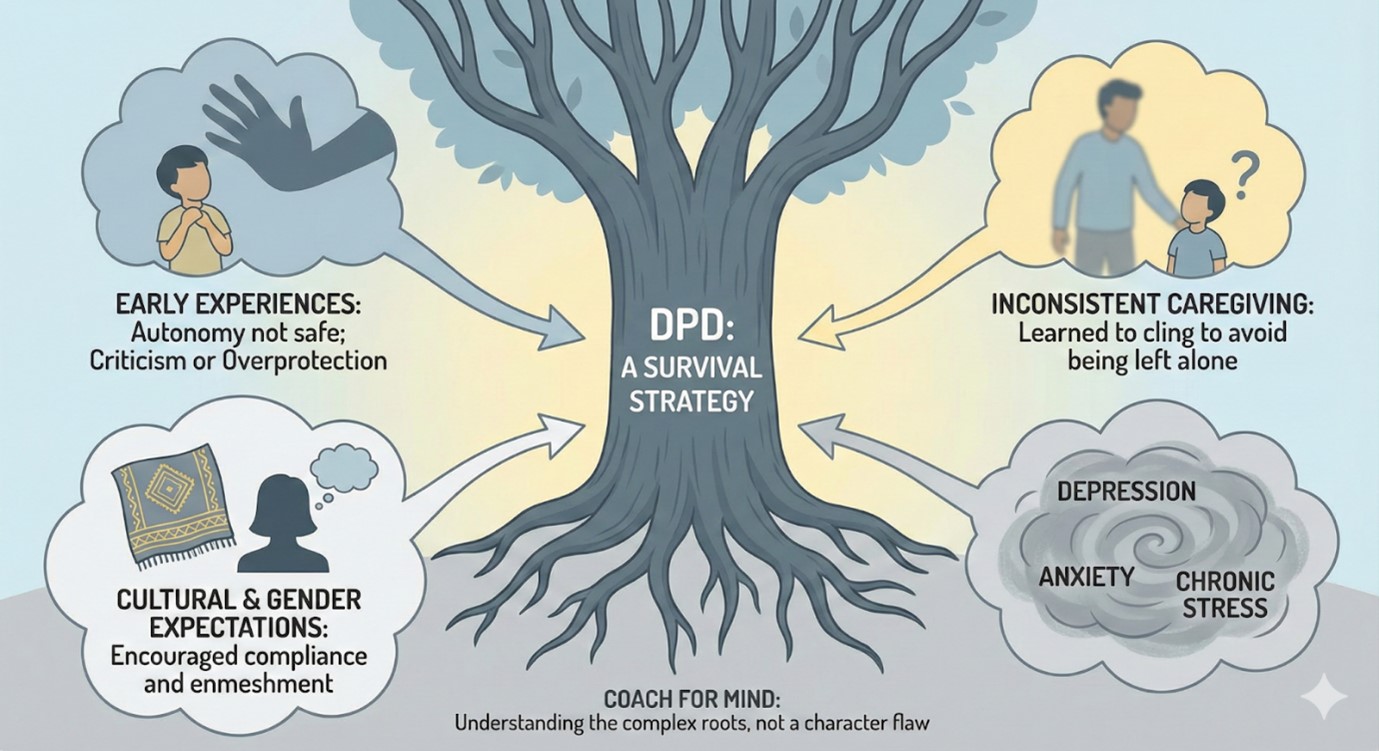
- Early experiences where autonomy wasn’t safe or allowed: Maybe you were criticised harshly for small mistakes, overprotected (“You can’t do that, let me”), or constantly told the world is dangerous and you aren’t capable.
- Inconsistent or neglectful caregiving: If care was unpredictable, you may have learned, “I must cling tightly when I have someone, or I’ll be left alone and helpless again.”
- Overprotective Parenting: Conversely, parents who consistently discourage autonomy, take over all decision-making. The message received is: “The world is dangerous, and you are not equipped to handle it.”
- Cultural and gender expectations: In many cultures (including Indian context), being soft-spoken, compliant, or dependent is more accepted or even encouraged, especially for women. This can blur the line between “normal” social roles and harmful dependency. In many Indian families, emotional closeness is often intertwined with enmeshment, everyone knows everything, decisions are made collectively, and saying “no” can be seen as selfish or disrespectful. Gender roles can deepen this further: girls are often praised for being “adjusting,” “mature,” and “not creating drama,” while boys may be discouraged from showing vulnerability. Many clients tell us they grew up hearing some version of, “Good girls don’t argue,” or “Don’t talk back, just listen.” Over time, this can create a painful conflict between cultural expectations and psychological needs: asserting boundaries or choosing independence may evoke not just anxiety, but also guilt, shame, and fear of being labelled ungrateful or difficult.
- Co-occurring mental health conditions: Depression, anxiety, other personality patterns, and chronic stress can all intensify dependency. If you’re already feeling low or anxious, it’s even harder to trust that you can manage alone.
At Coach for Mind, we don’t see DPD as a character flaw. We see it as a survival strategy your younger self learned to stay safe in an environment that didn’t fully support your autonomy.
The development of DPD is complex, involving a combination of genetic predisposition, early life experiences, and environmental factors. The goal of DPD treatment is not to eliminate relationships entirely, but to transition from pathological dependency to healthy interdependence, the ability to choose who you rely on and for what, rather than needing someone indiscriminately just to survive.
DPD Is Not Just in Your Head, It’s in Your Body Too
Dependent Personality Disorder is not just a pattern of thoughts or fears; it is deeply rooted in the body and nervous system. For many individuals with DPD, the fear of abandonment isn’t a simple cognitive worry like “What if they leave me?” - it is a full-body physiological event that feels overwhelming, involuntary, and impossible to ignore.
Even subtle signs of relational distance like a delayed text, a quiet partner, a shift in routine, can trigger the autonomic nervous system to respond as if separation equals immediate, existential danger. This isn’t “being sensitive” or “overreacting.” It is a biological survival response shaped by early experiences where connection felt uncertain, inconsistent, or unsafe.
The body learns these patterns long before the mind can make sense of them. Over time, it becomes conditioned to interpret distance as threat. As a result, the symptoms of DPD often arise from somatic alarm, not conscious choice.
Common body-based reactions include:
- a sudden drop or sinking feeling in the stomach
- tight or restricted breathing,
- pressure or constriction in the chest,
- trembling, sweating, restlessness, or a racing heart,
- a collapse or freeze response with numbness or weakness,
- and an urgent, almost frantic drive to restore contact or reassurance.
These are autonomic nervous system responses, not signs of weakness, neediness, or poor self-control. They reflect a body that has learned to equate distance with danger, and is trying, in its own way, to keep you safe.
Case Example: Riya, (Name Changed) is a 27-year-old graphic designer who came to therapy almost 6 months ago. On the outside, she appeared soft-spoken, responsible, and easy to get along with. But internally, her entire emotional world feels tethered to one person: her partner.
For Riya, even small separations felt unbearable. If her boyfriend took longer than usual to reply to a message, she immediately feels a drop in her stomach, a heavy, sinking fear that something is wrong. Within minutes, her breathing becomes shallow, her hands tremble, and her mind rushes into catastrophic thoughts: “He’s upset. He might leave. I won’t be able to handle this. I can’t do this alone.”
To make the anxiety stop, she sends multiple messages back-to-back, apologizing for things she hasn’t done, asking if he’s upset, promising to “do better.” The moment he replies, her body relaxes, like a crisis has been averted. But the relief never lasts.
Therapy helped her notice the bodily sensations behind the panic, the tight chest, the trembling, the freeze response and understand that her nervous system was reacting to old danger, not the present moment. Through CBT, she practiced small autonomy-building steps like choosing a meal or handling one bill. Through attachment work, she explored the grief of never feeling securely held. With somatic grounding, her body learned that distance was tolerable, not life-threatening.
DPD Through the Lens of Polyvagal Theory
Dr. Stephen Porges’ Polyvagal Theory provides the authoritative framework for understanding DPD's biological underpinnings. The nervous system is constantly scanning the environment for cues of safety or threat (neuroception). When past trauma taught the body that separation was unsafe, even minor relational distance can trigger a full survival response.

The intensity of DPD symptoms stems from the body’s conditioned response to threat, which can trigger a rapid shift through the Polyvagal states:
| Nervous System State | Somatic Experience & DPD Behavior | Interpretation by the Person |
|---|---|---|
| Alert (Sympathetic) | Fight/Flight Activation: The person feels intensely anxious, restless, or panicked at the first sign of distance. This fuels frantic efforts to control the relationship. | “I feel this anxiety because I truly can't handle things alone.” |
| Collapse (Dorsal Vagal) | Freeze/Shutdown: When reassurance is delayed or absent, the body goes into a defensive collapse. The person feels heavy, numb, helpless, or despairing. | “See? My body is telling me I need someone else to survive this feeling.” |
| Urgent Clinging | Survival Strategy: A desperate, impulsive attempt to move back into Safety (Ventral Vagal). The person reaches out excessively,calling repeatedly, apologizing, overexplaining,to restore connection and stabilize the system. | “This desperation proves I need to hold on tighter.” |
Separating Past Danger from Present Reality
Because these sensations are so intense, individuals with DPD often assign them profound, yet inaccurate, meaning:
The Misinterpretation: "My body is telling me I truly need someone else to survive. This panic means I cannot cope without them."
The Clinical Reality: The body is reacting to old, stored danger, not to the reality of the present situation. The survival response is disproportionate to the current threat (a delayed text is not actual, life-threatening abandonment).
Why This Somatic Understanding Matters for Healing
This neurobiological shift in understanding is foundational to recovery because it directly reduces shame and increases self-compassion.
When individuals learn that:
- Their breathlessness is a nervous system reaction,
- Their stomach-drop is a conditioned fear response,
- Their collapse is a biological freeze,
...they can finally stop interpreting these sensations as "evidence" of incompetence or inadequacy. The body is reacting to old, stored danger, not to the reality of the present situation.
The Journey to Healing DPD
Effective treatment for DPD is rarely one-dimensional. At Coach for Mind, we use an integrated approach that addresses the problem on three levels: the mind (thoughts and behaviors), the roots (attachment history), and the body (nervous system responses).
- Working with Thoughts and Behaviour (CBT and DBT)
This modality directly targets the "Lie of Helplessness”, the core, often catastrophic, belief that one cannot survive or function alone. The goal is to shift the conviction from: "I am completely helpless alone" to "I am capable enough, even if I feel scared or unsure."
- Cognitive Behavioral Therapy (CBT)
CBT focuses on noticing, challenging, and reframing the automatic negative thoughts that fuel dependent behavior.
- Challenging Catastrophic Thinking: CBT helps you identify "worst-case scenario" thoughts (e.g., "If I choose wrong, everything will fall apart" or "If I get criticised, it means I'm unworthy"). The therapist uses a gentle approach to explore the evidence for and against this belief. Instead of just telling you the thought is wrong, therapists at Coach For Mind use language like, "Let’s test this belief together," making the process a collaborative investigation rather than a confrontation.
- Behavioral Experiments: This is the heart of skill-building. You try small, low-stakes actions that run contrary to the core belief in helplessness, generating corrective emotional data.
- Examples: Choosing a meal, making a minor plan, handling one bill, or sitting with a slightly difficult feeling for 15 minutes without seeking reassurance. The world doesn't end, and this experience begins to erode the belief in total incompetence.
- Tracking and Tolerance: We track the frequency of reassurance-seeking (e.g., constantly checking in with a partner or coworker). The goal is to slowly build distress tolerance for ambiguity and decision-making without external approval, allowing you to tolerate the discomfort that comes with autonomy.
It’s also important to say this clearly: not all reassurance is unhealthy. We are relational beings, and it is normal to seek comfort, validation, or clarification from people we trust. In therapy, we don’t pathologise every request for reassurance. Instead, we pay attention to the pattern and the function. When reassurance becomes compulsive, urgent, and driven by panic, when you feel like you cannot calm down without it, that is when it starts to reinforce dependency. A big part of healing DPD is learning to receive reassurance sometimes, while also building the capacity to soothe and ground yourself from within.
- Dialectical Behavior Therapy (DBT) Informed Skills
DPD often involves intense emotional swings, especially fear of abandonment. We use DBT skills to manage these crises.
- Distress Tolerance: Teaching immediate crisis-coping skills, such as the DPD Emotional First Aid Kit (detailed below), to interrupt the physiological panic that drives compulsive clinging.
- Emotion Regulation: Helping you identify, label, and moderate intense emotions instead of letting them dictate your actions.
- Understanding the Roots (Psychodynamic & Attachment Work)
This deep, tender work addresses why the dependency pattern was needed in the first place, focusing on attachment history. The premise is that current patterns often echo older dynamics.
- Exploring Early Relationships: Psychodynamic work looks at how early interactions with caregivers shaped your core sense of self, specifically if you were taught that the world was dangerous and you were fragile, or that your needs were only met when you were compliant. For example, exploring how overprotective parenting taught someone the world was dangerous, leading to consistently seeking an "over-functioner" in adulthood.
- Echoing Older Dynamics: Identifying how your adult patterns of over-relying on a partner or constantly seeking guidance mirror the way you once had to over-rely on a caregiver for safety and guidance.
- Grief and Validation: Allowing space to genuinely grieve what you missed out on, things like safety, guidance, encouragement, and unconditional care. This process moves the need from a current demand on a partner to a past experience that can be processed and mourned. For many people with DPD, this grief is not just about the past; it also touches the present. You may grieve the years spent in relationships where you silenced yourself, tolerated harm, or stayed small just to feel chosen. You may grieve the version of you that never got to feel safe enough to experiment, make mistakes, or be messy. Naming and feeling this grief is not self-pity, it is a powerful part of reclaiming your story. As you honour what you didn’t receive, you begin to loosen the desperate demand for others to “fix” that longing right now, and instead move towards relationships that can meet you in healthier, more mutual ways.
- The Healing Therapeutic Relationship: One of the most powerful healing agents is the therapeutic relationship itself. The therapist provides a consistent, non-judgmental presence who models healthy boundaries, supports your autonomy, and stays even when conflict or boundary-setting occurs, directly contrasting the unstable or conditional love often experienced in the past. This provides a corrective emotional experience. In therapy, ruptures are not proof of abandonment, they become chances to experience repair, which gently rewires the nervous system to learn that conflict, disappointment, or difference does not automatically mean rejection or loss.
Attachment research often talks about the idea of “earned security.” You don’t have to be born into a secure, predictable environment to eventually feel secure in relationships. Through ongoing, reliable, boundaried connections – including the therapeutic relationship, your nervous system can learn a new template: “I can be myself, have needs, make mistakes, and still be held.” This is what earned security looks like in practice: not perfection, but a gradual shift from survival-based relating to calmer, more trusting connection.
- Overcoming Decision Paralysis
A critical step in DPD recovery is building self-trust through small, successful acts of autonomy. Since the fear of making a mistake is often paralyzing, we must start small.
To combat this, we use the Autonomy Ladder, a structured approach to decision-making:
| Level | Task Difficulty | Action Step | Self-Validation Statement |
|---|---|---|---|
| Level 1 (Low Stakes) | Choosing a meal, choosing clothes for the day, choosing a new coffee brand. | Make the choice without consulting anyone. Sit with discomfort for 5 minutes. | "I made a choice, and the world did not end. I am capable of deciding." |
| Level 2 (Medium Stakes) | Planning a 1-hour solo activity (e.g., visiting a museum, going to a movie), initiating a small work task. | Plan the logistics entirely alone. If anxiety hits, use distress tolerance skills. | "I am capable of initiating and executing a plan, even when it feels scary." |
| Level 3 (High Stakes) | Making a minor financial decision,choosing a new therapist, addressing a small conflict with a peer. | Write down pros and cons, make a choice, and commit to accepting the outcome (good or bad). | "I trust my judgment. Mistakes are data, not proof of incompetence." |
At Coach for Mind, we are very intentional about not throwing you into the deep end of independence. We never push you into independence; we build it with you, step by step. Autonomy is increased in small, carefully titrated doses so your nervous system can adjust without feeling overwhelmed. You are never shamed for needing support – instead, we work together to slowly expand your sense of “what I can handle on my own,” while honouring the very real fear that comes with doing things differently.
- Working with the Body (Somatic and Mindfulness-Based Work)
Because dependency, fear, and panic are fundamentally bodily experiences, we integrate somatic tools alongside cognitive work. This is crucial for nervous system regulation.
- Body Awareness and Mindfulness: Learning to notice the first, subtle signs of panic or abandonment fear in your body (e.g., chest tightness, stomach drop, shallow breath). Simply noticing the sensation before acting on the urge to cling creates a pause.
- Grounding and Resourcing: Practising simple, titrated (small, controlled) grounding exercises in session:
- Paced Breathing: Regulating the nervous system.
- Sensory Focus: Feeling your feet on the ground or looking around the room for safe cues (5-4-3-2-1).
- Somatic Experiencing (SE) Informed Work: Gently helping the body release stored defensive energy (fight/flight/freeze) that can trigger the intense, overwhelming panic of abandonment.
- Building the Window of Tolerance: The therapist ensures the work stays within your window of tolerance, the optimal zone where you have enough activation to grow and learn, but not so much that you feel flooded, shut down, or re-traumatized. At Coach For Mind, we prioritize titration (small steps) to teach your nervous system that increasing autonomy is tolerable and manageable, even when the old alarms ring.
Emotional First Aid for Fear of Abandonment
The most debilitating symptom of DPD is the panic and devastation immediately following a perceived abandonment or rejection. This triggers the Cycle of Dependency, where the intolerable feeling of helplessness forces an urgent search for a replacement relationship. Recognizing this mechanism, that the urgency is a trauma response designed to avoid the feeling of helplessness, is the first step to pausing the cycle.
The Cycle of Dependency
DPD often operates through a predictable emotional loop that feels impossible to interrupt:
- Trigger (Real or Perceived Distance): A delayed message, a partner sounding tired, a change in routine. Your nervous system interprets this as danger.
- Panic Response
Your body reacts instantly:
- tight chest
- sinking stomach
- catastrophic thoughts
- fear of abandonment
This is not “being dramatic” - it’s a conditioned survival response.
- Clinging or Reassurance-Seeking

To stop the internal alarm, you reach out urgently:
- multiple messages
- apologizing
- People-pleasing
- trying to fix the “threat”
This is the body trying to restore safety through proximity.
- Temporary Relief
When the person replies or reassures you, the panic drops. You feel calmer, but only for a short time.
The dependency cycle reinforces itself because the relief works temporarily, the brain learns:
“Clinging = safety.” This strengthens the dependency pattern over time. Therapy interrupts this loop by building body regulation, emotional tolerance, autonomy, and internal safety, so the alarm doesn’t control your behaviour
The DPD Emotional First Aid Kit
When the fear of abandonment is acute, use these immediate distress tolerance techniques to interrupt the panic cycle:
- Temperature Shift: Use extreme temperatures to interrupt the intensity in your body (e.g., splashing ice-cold water on your face, holding an ice cube for 60 seconds). This creates a biological system reset.
- Movement: Use short bursts of intense movement (e.g., marching in place, wall sits, 10 minutes of running) to discharge the adrenaline fueling the panic response.
- Sensory Grounding (5-4-3-2-1): Name 5 things you can see, 4 things you can feel, 3 things you can hear, 2 things you can smell, and 1 thing you can taste. This pulls your mind out of catastrophic thoughts and into the present moment.
- Validate the Pain, Delay the Action: This is the most critical step. Acknowledge the feeling without acting on the dependent urge.
- Say to yourself: “I feel terrified right now. I won’t pretend I don’t. But I will wait 20–30 minutes before I text/call again.”
- This combination of naming the pain and delaying the action creates a crucial wedge of space in which you can choose a different, more autonomous response.
Assertiveness and Healthy Boundaries
A critical, often tragic, consequence of DPD is the extreme vulnerability to exploitation and abuse. Because the fear of abandonment outweighs the fear of harm, individuals with DPD are prone to tolerating emotional or physical abuse to maintain the relationship.
- The Predator Trap: Individuals with DPD often attract partners who are "over-functioners" or those with narcissistic or controlling tendencies. These partners enable dependency because it feeds their own need for control or validation.
- Critical Red Flags in Potential Partners:
- Excessive Control: They insist on managing all finances, decisions, or social interactions "for your own good."
- Belittling Your Competence: They frequently remind you of your flaws or mistakes,reinforcing your core belief in inadequacy.
- Isolation: They subtly or overtly discourage relationships with friends or family who might challenge the dependent dynamic.
Building Assertiveness
Assertiveness is not a personality change; it’s a measurable skill taught through practice and role-playing. Assertiveness is about stating your needs and boundaries respectfully, moving away from passive compliance.
- The Core Shift: Moving from the belief "I must disappear to be loved" to "My needs matter too, and I can say no without being a bad person."
| Scenario | Passive Response (DPD Tendency) | Assertive Response (Skill-Building) |
|---|---|---|
| The partner demands you cancel plans. | "Okay, I guess I can cancel. I don't want you to be mad." | "I understand you need me, but I am committed to this plan. I can check in later, but I am going now." |
| Receiving mild criticism at work. | "I'm so sorry, I'm just terrible at this. I'll try harder." | "Thank you for the feedback. I will focus on improving X specific area next time." |
| Feeling drained by a friend. | (Tolerate the draining interaction and resent it.) | "I only have 30 minutes to talk today, but I want to hear about your situation." (Setting a time boundary.) |
Therapy helps you role-play difficult conversations in session, practicing language with assertiveness and boundaries. Very often I tell my clients, boundaries are not about saying no to others, instead about saying yes to yourself. Yes to what feels safe and comfortable to you. This prepares you to navigate the inevitable discomfort that arises when setting boundaries.
The Journey to Healthy Interdependence
As you reach the end of this guide, it’s important to remember that recovery from Dependent Personality Disorder is not about becoming invulnerable or emotionally self-sufficient. No human being is. The true goal is something far more realistic, compassionate, and sustainable: healthy interdependence, the ability to stand on your own while still allowing yourself to be supported, valued, and connected by trusted others.
People struggling with DPD often feel trapped, imagining they must choose between two painful extremes
- Clinging to Others (Pathological Dependency): A life shaped by the fundamental belief, “I can’t manage without someone else.” Every decision feels terrifying, boundaries feel dangerous, and separation feels unbearable. This is the comfort of known pain.
- Pushing Everyone Away (Isolation): A protective retreat that states, “If I depend on no one, no one can hurt me.” This strategy, however, replaces the fear of abandonment with the deep, chronic ache of loneliness.
Most recovery gets stalled here because these two strategies seem like the only options available. But they are not.
Healthy Interdependence
Healthy interdependence strikes a balance between the two extremes. Rooted in the belief “I am capable, and connection adds value,” it reflects both autonomy and openness to relationships. Boundaries are flexible, clearly communicated, and grounded in self-respect. Self-worth remains stable and internal, not dictated by external approval or achievement. The defining skill in this state is self-efficacy combined with the ability to offer and receive mutual support, allowing genuine intimacy without losing individuality. Healthy independence looks like:
- You can make choices without collapsing into panic.
- You can be alone without feeling abandoned.
- You can stay connected to others without losing yourself.
- You can ask for help without believing you are helpless.
- You can tolerate discomfort without rushing to repair, cling, or appease.
It is not perfection; it is balance. It is not fearlessness; it is capacity. And importantly, it is a learned state, not an inherent trait. We learn it through relationships that support autonomy rather than replace it, and through experiences that teach the nervous system that independence is tolerable, not dangerous.
Therapy does not aim to “delete” your need for others. Healthy humans are meant to be interdependent. What changes in healing from DPD is your relationship with dependence itself. Instead of feeling like you must latch on to someone to survive, you develop choice and flexibility. You can relate from an adult-to-adult place rather than from a frightened, child-like part that feels helpless. You cultivate internal self-support, an inner sense of, “I may not like this, but I can get through it.” Dependency doesn’t disappear; it becomes healthier, more conscious, and less controlling of your life.
This stage of healing in therapy is profound. The small, consistent steps of the Autonomy Ladder start translating into undeniable evidence of internal change. Clinically, these shifts represent a profound reorganization of the mind and nervous system:
- Internal Shifts
- Decisions start feeling possible—not easy, but possible.
- Moments of silence no longer feel like a prelude to abandonment, but rather peace.
- Self-doubt softens enough for action; you begin trusting your judgment.
- Relational Shifts
- You speak up without fearing that a single disagreement will ruin everything.
- You feel drawn to partners and friends who respect your boundaries and encourage your growth.
- You no longer settle for relationships that harm you just to avoid being alone.
- Somatic Shifts
- The body doesn’t go into collapse or freeze as quickly when distance occurs.
- Breathing stays steadier during conflict or uncertainty.
- The physical “urgency to cling” becomes less overwhelming and loses its power to control your actions.
These changes are not just mental; they are physical, proving that you are actively rewriting the trauma and attachment narratives held in your body. Every time you choose autonomy over panic, you are teaching your nervous system that you are safe, even when alone.
Why Choose CoachForMind for Your Healing Journey?
At CoachForMind, we understand the unique experiences of those going through DPD and how easily deep wounds can be misunderstood.
Experienced and Licensed Psychologists: We are a team of licensed RCI-registered (Rehabilitation Council of India) mental health counselors. Our team is well-experienced in various forms of therapies such as CBT, IFS, DBT, EMDR, Somatic and Narrative Therapy. Our expertise is verifiable, and our commitment to ongoing training ensures we deliver the most current and effective treatments.
Personalized, Client-Centered Approach
We are dedicated to treating our clients in the best-suited way, carefully curated as per the client's needs, and adhering to one-on-one, client-centered therapy. Every individual is different and every story is unique. We move beyond a one-size-fits-all model to create a safe, non-judgmental space where genuine healing can occur.
Scientific, Evidence-Based Techniques
Our treatment plans and therapeutic methods are based on highly researched scientific findings such as Cognitive Behaviour Therapy, Narrative Therapy, and Dialectical Behaviour Therapy. We believe in transparency and utilizing methods that have been proven effective in treating trauma. Our goal is to empower our clients, making them the authors of their own stories rather than passive recipients of a diagnosis.
Quality Service Grounded in Empathy
We at CoachForMind ensure quality services in our treatment regime and therapeutic approaches. Our clients hold most value to us, so we ground our techniques in empathy while maintaining the highest level of professionalism and confidentiality. We help you slow down the inner chaos so you can finally listen to what the masked trauma has been trying to tell you.
Begin with a free 15-minute discovery call For more information, please visit our website or contact us directly at coachformind@gmail.com
Written by Ms Akshita: Psychotherapist at Coach For Mind
FAQs
DPD often doesn’t show up as dramatic symptoms, it shows up as patterns that feel normal to you because you’ve lived in them for so long. Many people with DPD say things like:
“I just feel safer when someone else decides.”
“I panic if I sense someone pulling away.”
“Being on my own feels unbearable, even if I know I’m capable.”
DPD isn’t about being “clingy”, it’s about your nervous system having learned that closeness equals safety and autonomy equals danger. Your coping style likely developed in childhood, especially if you grew up in environments where approval was tied to obedience, conflict was punished, or independence wasn’t encouraged.
For some, dependency is loud and obvious: constant reassurance, difficulty being alone, fear of abandonment. For others, it’s internalized: chronic self-doubt, avoiding disagreements, feeling “small,” or becoming the easygoing one who never has needs.
In women, DPD is often misread as “good girl syndrome,” over-compliance, or being “too nice.”
In men, it may hide beneath over-reliance on a partner, workaholism, or letting others “run the show” to avoid responsibility. If these patterns are long-standing and shape most of your relationships, it’s worth exploring DPD.
At Coach for Mind, we don’t label you, we understand your story. We explore where these patterns came from and how they protected you. We combine:
- IFS (Parts Work) to meet the child-part that fears abandonment.
- Attachment-focused psychodynamic therapy to trace relational patterns.
- Somatic and polyvagal work to calm the physical panic that arises when you face independence.
- CBT/DBT to challenge catastrophic thoughts and build communication skills.
Dependency isn’t a flaw - it’s a survival map. Therapy helps you draw a new one.
Yes, recovery doesn’t require cutting people out of your life. It requires learning how to stay connected without losing yourself. People with DPD often fear that healing means becoming “cold,” “selfish,” or abandoning loved ones. In reality, healing looks like:
- making decisions without spiraling
- saying “no” without guilt
- allowing others to support you without collapsing into them
- being able to be alone without panic or emptiness
You don’t have to choose between closeness and autonomy, you learn how to balance both.
Many people with DPD also discover that relationships improve when dependency decreases. Emotional pressure eases, resentment reduces, and communication becomes clearer.
How therapy at Coach for Mind can help
Our work focuses on interdependence, not detachment. We use:
- Relational therapy to practice healthy closeness and separation in-session.
- IFS to support protectors that fear abandonment.
- Somatic grounding to help your body feel safe when you take small independent steps.
- Communication training/DBT for boundary-setting and assertiveness.
- Real-life behavioral experiments to experience healthy autonomy without losing connection.
You don’t have to let go of people. You just stop letting go of yourself.
Healing DPD is not a quick or linear process, because dependency isn’t just a set of thoughts you can “correct”, it’s a survival pattern woven into your nervous system, your attachment history, and your deepest emotional memories. Most people with DPD didn’t choose dependency; it was the safest strategy available in childhood. So therapy focuses on slowly teaching the mind and body that autonomy, boundaries, and being alone are not dangerous.
For many clients, the first 3–6 months are about increasing awareness: noticing the patterns that drive reassurance-seeking, understanding why separations feel so threatening, and learning how to regulate the waves of panic or self-doubt that rush in when you try to act independently.
Between 6–12 months, clients typically begin building healthier relational habits — setting small boundaries, practicing saying “no,” taking responsibility for decisions, and reducing the urge to cling or collapse in relationships. This is also when confidence begins to grow: you learn you can survive discomfort without losing people.
Longer-term work, often 12–24 months or more, goes deeper. This phase focuses on identity formation: discovering who you are outside of caretaking, compliance, or others’ approval. Many people explore their inner child wounds here, reprocess abandonment fears, challenge internalized family dynamics, and slowly rewire attachment patterns that may have shaped them for decades. If you carry childhood trauma, C-PTSD, chronic anxiety, or deep attachment wounds, the process may take longer — not because you’re “difficult” or “not progressing,” but because your system learned to equate independence with danger, and safety with closeness.
Relearning this takes time, compassion, and consistency.
How therapy at Coach for Mind supports this process
At Coach for Mind, therapy is paced intentionally, slow enough that your nervous system feels safe, but steady enough that you can see real change. Our therapists work collaboratively with you, helping you build internal safety before challenging old patterns. We use long-term psychodynamic and attachment-based therapy to help you understand how your dependency formed and how it shows up today. We incorporate IFS (Parts Work) to gently work with the younger, frightened parts of you that still believe they cannot survive without someone else. When abandonment trauma or painful relational memories block progress, we may integrate EMDR to reprocess those emotional imprints.
Because DPD affects the body as much as the mind, we also use somatic and polyvagal-informed work to help your nervous system expand its capacity to tolerate separation, uncertainty, and independence. And throughout therapy, you’ll build concrete skills — through DBT and CBT, to manage anxiety, reduce reassurance-seeking, and make decisions with more confidence. Our goal is not to rush you or push you into independence; it’s to help you grow into yourself at a pace that feels safe, supported, and sustainable.
Absolutely, and it often does. Many people with DPD also struggle with:
- Anxiety: constant worry about losing relationships, being rejected, or making “wrong” decisions.
- Depression: feeling helpless, overly dependent, or ashamed of needing others.
- BPD traits: intense fear of abandonment, emotional sensitivity, or difficulty regulating emotions.
The overlap can create confusion, for example, is a fear of abandonment due to BPD traits, attachment trauma, or DPD? A skilled therapist helps you untangle these layers without judgment.
How therapy at Coach for Mind can help
Our therapists are trained to work with complex and overlapping diagnoses. We use:
- Psychodynamic assessment to clarify patterns
- DBT if emotional intensity resembles BPD.
- IFS + somatic therapy to soothe fear-based parts.
- CBT for cognitive distortions around rejection or helplessness.
- EMDR for traumatic abandonment experiences.
Your symptoms make sense in context, therapy helps you understand that context.
While Dependent Personality Disorder (DPD) is more often diagnosed in women, this doesn't definitively mean the condition is biologically more prevalent among women. The difference in diagnosis rates is largely understood through the lens of gender socialization and cultural norms, which significantly influence how symptoms are expressed, perceived, and ultimately pathologized by clinicians.
Women are frequently socialized to embody traits that overlap with DPD symptoms, leading to higher rates of diagnosis. These societal expectations include learning to be accommodating, prioritize others' needs, avoid conflict, seek reassurance, and attach one's identity to relationships. Because these roles are considered "normal" or "feminine," DPD symptoms in women may be pathologized (labeled as a disorder) when they are slightly excessive, or conversely, they may be missed entirely because the person is simply seen as fulfilling their traditional role. For instance, a woman who fears being "too difficult" or "too independent" aligns perfectly with the DPD symptom of excessive reliance on others for decision-making.
Conversely, DPD in men is often expressed through behaviors that are less immediately recognizable as classic dependency, making the condition potentially underdiagnosed in men. Men with DPD may express dependency by:
- Relying heavily on partners to manage all domestic, emotional, and social labor, effectively rendering the man dependent on the partner's management skills.
- Avoiding adult responsibilities or major life decisions.
- Staying in dependent financial or relational roles where others take the lead.
These patterns may be dismissed as merely "traditional male roles" or "laziness" rather than a true personality disorder, contributing to the lower diagnostic rates among men. The disorder is present, but the expression of the dependency is masked by a different set of gendered expectations.
At Coach For Mind, we believe it's vital to consider gender conditioning, cultural expectations, and family systems before drawing conclusions about a diagnosis. We don't rush to label your personality; we prioritize exploring your lived experience to understand the root of these patterns.
- Gender-Informed Psychodynamic Therapy: We explore how societal roles and expectations have shaped and reinforced dependent patterns.
- Internal Family Systems (IFS): We work with the "parts" of you that feel obligated to conform, please others, or sacrifice your own needs to maintain safety or attachment.
- Boundary Work and Assertion Training: This is crucial for clients socialized to be passive or compliant, helping them build the confidence and skills to establish healthy boundaries and assert their needs.
By using these integrative approaches, we aim to understand the function of dependency patterns in your life, providing a pathway to genuine self-reliance and autonomous living.
Yes, absolutely, you can form incredibly healthy and reciprocal relationships. People who struggle with Dependent Personality Disorder (DPD) often possess an enormous capacity for loyalty, empathy, and emotional depth. The fundamental challenge isn't a lack of ability to love; it's the tendency to lose yourself within the framework of that love. Because the core fear is abandonment, the relationship becomes a vessel for survival rather than a source of mutual growth.
Healthy relationships become genuinely possible when the pattern shifts from seeking stability from the partner to cultivating stability within yourself. This involves learning to express your needs clearly without fear of rejection, to tolerate small conflicts and disagreements as normal parts of intimacy, and to trust your own internal decisions. Healing DPD doesn't diminish your tenderness or your desire for connection; instead, it strengthens these qualities by reinforcing them with robust boundaries and self-worth. You move from clinging out of fear to choosing closeness from a place of genuine security.
How Therapy at Coach For Mind Can Help
We specialize in helping clients with DPD build secure patterns of connection using targeted, integrative modalities:
- Attachment-Based Work and Relational Psychodynamic Therapy: We model healthy closeness within the therapeutic relationship. This secure, non-judgmental space allows you to experience a stable connection with boundaries—warmth that doesn't demand compliance, and separation that doesn't equal abandonment. This "earned security" becomes the foundation for forming healthier attachments outside of therapy.
- Somatic Regulation: We use body-focused techniques to help your nervous system become less reactive, allowing you to reduce panic and physical distress during conflict or separation triggers.
- Internal Family Systems (IFS): We compassionately identify and support the "parts" of you that feel they must cling, appease, or collapse to ensure survival.
- Communication and Boundary Coaching: We provide concrete, practical guidance and rehearsal for practicing healthy dialogue and enforcing boundaries, preparing you to show up differently inside your relationships.
Reassurance-seeking is a core manifestation of DPD and is driven by an intense, overwhelming fear. This behavior comes from an internal "part" of you that genuinely believes: “If they leave, I won’t survive.” That part isn't being dramatic; it is profoundly terrified that uncertainty equals abandonment and that abandonment means catastrophe.
The reassurance-seeking loop is a cycle of temporary relief followed by quick rebound anxiety. Signs you are stuck in this loop include: repeatedly texting or asking for confirmation that your partner isn't upset, panicking when messages go unread, or constantly needing external guidance for minor decisions. The intense need for external validation depletes both you and the relationship. The goal isn't to stop needing connection; it's to build enough internal safety that connection feels supportive, comforting, and chosen, rather than urgent and compulsory.
Therapy at Coach For Mind can help break the reassurance cycle gently, focusing on self-regulation rather than pure willpower.
- Internal Family Systems (IFS): We first acknowledge and comfort the anxious child-part that panics during uncertainty. By witnessing and validating its terror, we reduce its need to drive the compulsive reassurance-seeking behavior.
- Somatic Tools: We use somatic grounding and self-soothing techniques to regulate the body when separation or uncertainty triggers the nervous system. This teaches your body that you can tolerate the discomfort without immediately reaching for an external source of calm.
- DBT Distress Tolerance: We equip you with practical skills to survive emotional distress and uncomfortable uncertainty without immediately reaching for the reassurance hook.
- Cognitive Restructuring: We work to challenge the underlying "catastrophe scripts" (e.g., "If they don't reply in five minutes, it means they hate me") that fuel the panic.
- Partner-Based Agreements (When Appropriate): We can help you create intentional communication agreements with your partner so that reassurance, when given, doesn't inadvertently reinforce the panic pattern.
You learn not to eliminate the need for closeness, but to build closeness from a place of security, not crippling fear.
Good, ethical therapy should never increase dependency, instead it should strategically reshape it into autonomy. The therapeutic relationship is intentionally structured to be the first safe space where you can fully experience:
- Stable connection with healthy boundaries.
- Warmth and support that doesn't demand compliance or over-accommodation.
- Conflict or miscommunication that doesn't equal relational threat.
- Separation (like the end of a session or a scheduled break) that doesn't equal abandonment.
If dependency temporarily intensifies in early therapy, it's typically because you are finally safe enough to feel what you have been suppressing, the deeply held fears of abandonment and helplessness. With skilled and boundary-aware guidance, this vulnerable phase quickly transitions into autonomy and self-mastery, not enmeshment.
How Therapy at Coach For Mind Can Help
We are extremely mindful of the unique boundary and dependency dynamics inherent in DPD treatment.
- Relational Psychodynamic Therapy: We explore the phenomenon of transference (unconscious shifting of feelings from past relationships onto the therapist) safely and use it as valuable material to understand your relational patterns, rather than letting it become enmeshing.
- Internal Family Systems (IFS): By strengthening your "Self" (the core of wisdom and resourcefulness), we gradually shift the reliance from the therapist to your own inner resources.
- Structured Therapy Frame: We utilize a structured framework with clear start/end times and expectations that models healthy, predictable separations, teaching your nervous system that leaving and returning is safe.
- Somatic Grounding: We teach you techniques for self-regulation to soothe your nervous system between sessions, strengthening your capacity to hold uncertainty independently.
- Gradual Autonomy-Building Exercises: We gently incorporate practices like independent decision-making and independent tasks to build your confidence outside the protective container of the session.
Ultimately, you don't become dependent on the therapist; you learn to become securely attached to and reliant upon yourself.