Can IFS (Internal Family Systems) Truly Heal Trauma? A Therapist’s Honest Perspective
Riya had a long week where she barely slept and her body ached for rest. She had been looking forward to a quiet cozy Sunday to rest and recharge.
When she received a text from her boyfriend asking her to meet him, she replied honestly, "Hey, can we meet another day? I could really use some rest today."
He replied swiftly, his tone sharper than she expected, "Wow, I suppose I'm not your priority anymore."
Riya's chest tightened and she felt her stomach drop.
A calm steady voice spoke, “You are not doing anything wrong, you are not doing anything wrong.” This was her assertive and compassionate Authentic part.
Another voice, panicked, chimed in, "Don't upset him, he'll think you don't care and leave. Just tell him yes." This was her Pleaser part that was terrified of abandonment and equated love with sacrifice.
A third voice, heavier and guilt soaked, said, "Don't be selfish. He loves you. You should be grateful. Don't make this about yourself." This was the internalised Guilt part shaped by years of being told that "good girls" put others' needs before their own.
Conflicted by the onslaught of her inner chatter, Riya gave into the loudest voices of fear, shame and guilt and typed, “Okay, I’ll come”.
How many times have you experienced something similar where you’ve been internally conflicted about a decision or an experience you had? One part of you might be calling you lazy, while the other part just wants to rest? One part of you wants to desperately leave a relationship but another part of you wants to stay?
How many times have you chosen someone else over yourself, not out of love but out of fear or shame?
There is nothing shameful about this. It’s your mind and body doing their best to keep you safe. You might be wondering how fear, shame or guilt keep you safe? That sounds like utter nonsense? Let’s take a closer look at the inner workings of your internal system.
WHAT IS INTERNAL FAMILY SYSTEM?
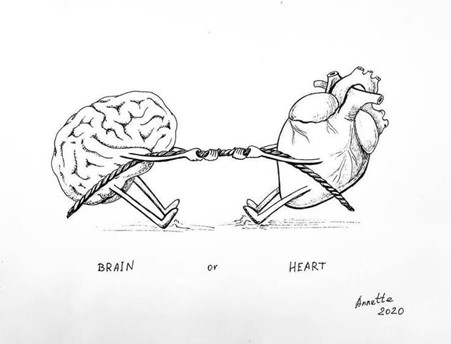
Developed by Richard Schwartz, Internal Family System (IFS) is a non pathologising psychotherapy model rooted in the understanding that the mind is made up of multiple subpersonalities or "parts", each with its own feelings, beliefs and roles.
This “splitting” of the mind into multiple parts is caused by the experience of trauma.When a person goes through something overwhelming or traumatic without having someone who can comfort, witness or help them make sense of their experience, their mind splits internally to protect them. This internal splitting is a survival strategy designed to adapt and cope from the pain. However, what once kept you safe, now becomes stuck in these extreme roles still trying to protect you.
This is not the same as being diagnosed with a multiple personality disorder. Rather, it is about acknowledging having inner voices and opinions that might not always agree with each other.
For example, in Riya’s case above,
- One part of her just wanted to rest and relax without the fear of losing the relationship.
- Other part of her learned that if she put her needs forward, it’d lead to rejection and abandonment
Often, these parts show up more intensely with people who have experienced trauma and learned that safety means suppression, silence or overperformance.

THE MAP OF YOUR MIND
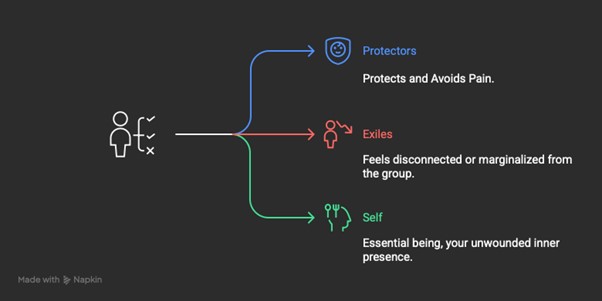
IFS categorises your parts into 3 categories:
- Protectors
- Exiles
- Self
- PROTECTORS
Protectors developed in your childhood with the primary goal of keeping you safe from emotionally overwhelming or unsafe situations. Their main job is to minimise suffering, avoid vulnerability and keep the system functional. They show up in 2 different ways:
- Managers -
They are the proactive parts of your mind that prevent emotional pain from being triggered. Their primary task is to keep life running smoothly, avoid risk, maintain control, and make sure exiles stay hidden and suppressed. They are like the shield that protects Exiles from getting hurt.
Managers are developed as coping strategies whose aim is to make you enough, lovable, worthy, acceptable, or invisible so that you never get hurt again. Managers often make you look functional on the outside but they're working overtime on the inside.
Managers carry the fear that if they don't stay in charge or in control, the Exile's pain would flood the system and overwhelm you.
Managers are often:
- Hypervigilant
- Highly Organized
- Often live in the future, anticipating and preparing for what could go wrong
- Rigid
- Anxious
- Highly Self-Critical
- Focused on Prevention and managing image
- Sabotage intimacy to avoid feeling vulnerable
Common Manager Parts:
- The Perfectionist: "If I can fix everything about myself, I would never get rejected."
- The Pleaser: "If I suppress myself and do and be everything for everyone, I will finally be loved and accepted."
- The Inner Critic: "If I point out all my mistakes before anyone else can point them, no-one can hurt me."
A CLOSER LOOK AT RIYA’S MANAGER:
"Don't upset him, he'll think you don't care and leave. Just tell him yes."
When this fearful part spoke up, it was trying to protect Riya from abandonment. That part learned in her childhood that love means self-sacrifice, stemming from emotionally immature parents.
"Don't be selfish. He loves you. You should be grateful. Don't make this about yourself."
This shame laden voice is an echo of her early conditioning where being a "good girl" meant betraying her own needs to meet other's needs. This part holds the pain of not being allowed to exist in her own right.
- Firefighters -
They are the reactive parts of the mind that jump into action when the exile is triggered. Firefighters come online when managers fail to prevent pain. Firefighters are impulsive and focused on immediate relief or distraction from pain, unlike Managers who strategise and plan.
Firefighters often:
- Impulsive
- Compulsive
- Out of control
- Seek immediate relief or numbing of emotions
- Short sighted and Disregard long-term consequences
Common Firefighter Behaviors:
- Doom-Scrolling
- Alcohol or Drugs Misuse
- Binge-eating
- Overshopping
- Compulsive Sex
- Self Harm or Suicidal ideation
- Explosive Anger or sudden shutdowns
Firefighters are focused on shutting down the pain and they don't care about "how it looks". Hence often leading to behaviours we later regret. IFS focuses on understanding their role, acknowledging and thanking them, instead of shaming them.
- EXILES
These are the most vulnerable parts of you that carry your deepest emotional wounds of hurt, shame, rejection, abandonment, loneliness and maladaptive beliefs. They are frozen in the time where you felt overwhelming emotions, neglect, rejection or hurt.
They carry your unmet needs and raw emotions that couldn't be expressed or soothed in your childhood. Hence, your mind split them off and buried them under the layers of protection of managers and firefighters.
Exiles often:
- Got shamed for being "too much"
- Felt alone, unlovable and unsafe
- Never felt truly seen
Exiles want to:
- Be heard without being dismissed
- Cry without overwhelming the other person
- Exist without feeling the pressure to perform or be a certain way
- Be loved
IFS teaches how to meet exiles with love, listen to them and fulfil their unmet needs.
A CLOSER LOOK AT RIYA’S EXILE:
“People will leave me if I express my needs. I’m too much”
It carries deep sadness, fear of being unloved, and shame for having needs. It developed when she wasn’t allowed to say “no” or establish boundaries. Her emotions were neglected and suppressed. These feelings were too overwhelming or unsafe to feel back then so her system pushed this part down to protect her from re-experiencing that pain.
- SELF
This is your essential being, your unwounded inner presence. It is who you are without any effort or performance. Self is the natural leader of your inner system when it is not hijacked by pain, fear or old roles.
Send may be obscured by the protectors, but it cannot be damaged.
Self is not a trauma adaptation, or reactive. It's you in your clearest, kind, connected and grounded form.
IFS explains Self as possessing these 8 core qualities:
- Calm: centered, steady, emotionally balanced
- Clarity: able to see with truth and perspective
- Compassion: deep empathy for your own parts and others
- Curiosity: a gentle, open “I want to understand you” energy
- Confidence: quiet trust in yourself and life
- Courage: a willingness to face pain without resistance
- Creativity: spontaneous, playful, expressive
- Connectedness: a feeling of being linked to others, life, and source
Your Self leads from love, not fear.
|
Self |
Parts |
|
Calm, clear, connected |
Reactive, protective, wounded |
|
Leads with love |
Try to control or survive |
|
Feels whole |
Feels fragmented or stuck |
|
Holds space |
Tries to fix, fight, or flee |
|
Timeless |
Often locked in past trauma |
HOW BEING IN YOUR SELF CAN FEEL LIKE:
- Even when sadness or fear is present, you feel centred.
- You respond, instead of reacting.
- You show up with kindness, not judgment.
- You can hold polarity without shutting down.
- You feel more in touch and like yourself, without feeling the urge to perform.
As this reddit user shares their experience with IFS:
GOAL OF IFS THERAPY
The goal of IFS is to strengthen your inner leadership and integrate the fragmented parts. IFF helps you:
- Understand and honour the roles of each part
- Show up from your Self
- Help your Protector parts develop trust
- Help release the burdens of Exiles safely
HEALING THROUGH IFS
IFS invites curious and compassionate inquiry involving:
- Become aware of and name your parts
- Unblend or separate from them
- Start a dialogue with them and Understand their roles
- Make your parts feel heard
- Reclaim your Self, your inner leadership
HOW IFS HELPED RIYA
- IFS helped Riya identify her:
- Pleaser Manager - “If you don’t say yes, they’ll leave. You’ll be alone.”
- Guilt Soaked Critic Manager - “You’re selfish. You’re lucky to have love at all.”
- Exile - Wanting to be loved while being herself and voicing her needs.
- Self - “You are not doing anything wrong, you are not doing anything wrong.”
- Befriend her protectors:
With the therapist's guidance Riya began inquiring with curiosity and compassion about the roles, and fears of her protectors.
- Unburdened the Exile: Allowed her Exile to feel seen, validated and safe.
She said,
“You don’t have to earn love anymore. I see you. I’m here now. You matter too.”
- Show up as her Self.
IFS helped Riya stop abandoning herself in the name of connection.
It didn’t teach her to fight her parts, it taught her to love them back into wholeness.
She realized:
“I don’t have to choose between love and myself.
When I lead from my Self, I create a space where both can exist.”
And that changed everything.
This also prevented her from being in a fulfilling loving and healthy relationship where she can voice her needs and still be loved. Through IFS, Riya stopped abandoning herself in the name of connection. It taught her to love them back into wholeness and she realized that she doesn’t have to choose between love and herself. When she leads from my Self, she can create a space where both can exist.
Ultimately, healing is not about diminishing who you are, rather deepening your connection to yourself. You gain more clarity, resilience, and get a more grounded sense of self rooted in authenticity and compassion, rather than survival.
To summarize, healing doesn't mean erasing the adaptive personality you created to survive. It means letting go of burdens holding you back and showing up as an integrated, authentic and resilient version of your "Self".
If this resonates and you're looking for a qualified IFS practitioner, see our guide on finding a qualified IFS therapist in India — including the credentials and training to look for.
FAQs
Developed by Richard Schwartz, Internal Family Systems (IFS) is a non‑pathologising psychotherapy model rooted in the understanding that the mind is made up of multiple sub‑personalities or “parts”, each with its own feelings, beliefs and roles.
This “splitting” of the mind into multiple parts is caused by the experience of trauma. When a person goes through something overwhelming or traumatic without having someone who can comfort, witness or help them make sense of the experience, their mind splits internally to protect them. This internal splitting is a survival strategy designed to adapt and cope with the pain. However, what once kept you safe can become stuck in extreme roles still trying to protect you.
It is not the same as being diagnosed with multiple personality disorder. Rather, it is about acknowledging inner voices and opinions that might not always agree with each other.
Often, these parts show up more intensely with people who have experienced trauma and learned that safety means suppression, silence or over‑performance.
No. IFS is a non‑pathologising psychotherapy model that sees the mind as made up of multiple sub‑personalities or “parts”, each with its own feelings, beliefs and roles. Having inner voices that want different things is normal.
DID is a clinical condition that involves multiple identity states and significant memory gaps. IFS can be used in treating DID, but having “parts” does not mean you are disordered.
IFS is especially effective for:
- Trauma (complex, developmental, attachment)
- Anxiety & depression
- Inner critic and self‑esteem issues
- People‑pleasing, codependency, and boundary struggles
- PTSD and C‑PTSD
- Burnout and chronic stress
- Relationship issues and emotional reactivity
- Addiction, bingeing, and impulsive behavior
CBT focuses on thoughts and behavior. Talk therapy often explores past experiences.
IFS, on the other:
- Works inside‑out: it engages with internal parts and their emotional burdens.
- Doesn’t try to change thoughts or behavior directly, but helps parts feel seen and unburdened, which naturally shifts external patterns.
- Centers on curiosity, compassion, and deep inner work—not logic or analysis alone.
IFS has been shown in numerous studies to be useful in treating a range of mental‑health issues, such as substance‑use disorders, anxiety, depression, and trauma.
Research suggests IFS may be especially beneficial for people who have suffered childhood trauma.
According to IFS, trauma causes fragmentation of the mind. This “splitting” into multiple parts is a survival strategy that protects the person from overwhelming pain. The protective parts can become stuck in extreme roles, continuing to act out of fear long after the original danger has passed.
The “Self” is your essential, unwounded inner presence – who you are without effort or performance. Self is the natural leader of your internal system when it is not hijacked by pain, fear, or old roles.
Self cannot be damaged, though it may be obscured by protectors.
IFS describes Self as possessing eight core qualities:
- Calm – centered, steady, emotionally balanced
- Clarity – able to see with truth and perspective
- Compassion – deep empathy for your own parts and others
- Curiosity – a gentle “I want to understand you” energy
- Confidence – quiet trust in yourself and life
- Courage – willingness to face pain without resistance
- Creativity – spontaneous, playful, expressive
- Connectedness – feeling linked to others, life, and source
Your Self leads from love, not fear.
Not at all. IFS does not force you to re‑experience trauma. It first establishes a steady, safe relationship with your parts. Until they feel safe and acknowledged, many parts will not want to revisit the traumatic memory.
In IFS, unburdening trauma is gentle and often occurs when parts themselves decide to let go, not because the therapist coerces them.
It varies. Some people build safety with their parts quickly and notice early shifts; others, especially those with complex trauma, may need more time. IFS is a respectful, profound process—not a quick fix—but many find the changes sustainable, kind, and honest.
Yes. IFS integrates well with a variety of modalities. Many trauma‑informed therapists combine IFS with mindfulness, EMDR, somatic work, narrative therapy, or CBT. By helping you develop a compassionate inner map, IFS can deepen the effectiveness of other approaches and fit within cultural or spiritual frameworks.
“IFS completely changed the way I relate to myself and my emotions. One of the most significant impacts it’s had is being able to recognize and communicate with parts in combination with other modalities like EMDR. I’ve come a long way on my healing journey and I don’t think I would have made the same progress without IFS. I’ll be using these skills for the rest of my life.”
You can explore IFS on your own, but working with a qualified IFS therapist—especially if you have trauma—is strongly recommended. Books such as “Introduction to the Internal Family Systems Model” and “No Bad Parts” are helpful, as are journaling exercises and guided meditations. A therapist provides a safe container for deeper work, particularly when dealing with exiles.
Yes. The IFS concept of “parts” resonates with many Indian clients who grew up in emotionally complex, high‑pressure households. IFS helps address:
- Internal conflict between honoring oneself and pleasing family
- Shame from early life
- Generational trauma
Because IFS emphasizes compassion rather than pathologising, it feels emotionally secure and culturally flexible.
That’s okay. Not everyone hears literal voices. Many experience parts as emotions, images, bodily sensations, or subtle urges. It often takes time to establish a connection. You don’t have to force anything—your parts will speak in their own language when they’re ready. An experienced trauma‑informed IFS therapist can safely guide you through this process.
Absolutely. Parts such as the fearful child, the avoidant protector, or the inner critic often drive relational conflict. By understanding your own internal system, you can identify and work with these parts, responding from Self rather than from reactive patterns. In couples work, IFS shifts the dynamic from blame to curiosity about each other’s inner lives.
No. Healing in IFS is about reconnecting to the Self, allowing it to lead you from a place of greater composure, clarity, and compassion. You retain your personality; you simply become less driven by wounded, reactive parts. For example, Riya always saw herself as “really caring” and “never says no.” IFS helped her realize that this was a protective aspect, not her true identity, and she learned to honor her authentic needs.